
Did Donald Trump rule FIFA? Find out more about Balogun’s reversed red card


An unprecedented movement behind the scenes of world football exposed the direct influence of the North American executive branch on international sporting decisions. An investigative report conducted by The New York Times revealed that Donald Trump, former president of the United States, made a personal telephone call to Gianni Infantino, the supreme president of FIFA. The objective of the communication was clear and direct: to demand the reversal of a red card given to Folarin Balogun, a fundamental part of the American team’s offensive sector, guaranteeing his presence on the pitch.
The diplomatic and political onslaught occurred moments before the Disciplinary Committee of football’s highest governing body announced a surprising decision on the case. The body opted to suspend the punishment that would remove the top scorer from the decisive clash against Belgium, valid for the knockout phase of the tournament. This direct interference by a head of state in disciplinary issues at a global tournament raises profound debates about the autonomy of sports federations and FIFA’s permeability in the face of economic and political powers.
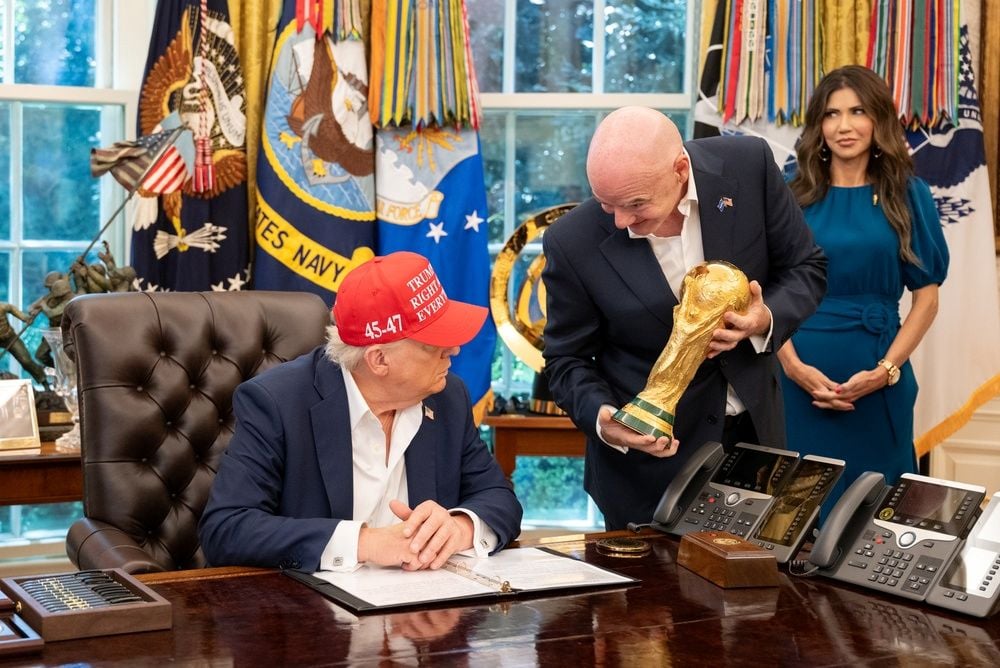
The scenario described by the American publication demonstrates that the call to Infantino was just the tip of the iceberg of a much broader and coordinated operation. The mobilization to release the athlete involved a network of contacts that mixed high-ranking government officials with prominent figures from the financial market, creating a powerful lobby that acted incisively on the sports courts based in Switzerland.
Behind-the-scenes coordination involved high-ranking government officials and Wall Street investors
The information gathered indicates that the pressure on FIFA was not limited to the presidential phone call, extending to a legal and governmental task force. Professionals specializing in sports litigation were hurriedly called in, working together with Howard Lutnick, who holds the position of United States Secretary of Commerce. The presence of a member of the government cabinet in an on-field imbroglio highlights the weight that the national team’s campaign has gained on the country’s political agenda.
Along with the lawyers and the secretary, the operation had the active participation of Scott Goodwin, an extremely important name behind the scenes in American sport. Manager of billion-dollar investment funds and one of the most influential donors to the United States soccer federation, Goodwin used his network of influence to amplify discontent with arbitration. The convergence of interests between billionaires, politicians and sports directors has created an environment of unsustainable pressure for FIFA’s independent auditors.
Experts in sports governance point out that the entry of figures with such financial and political power into a red card judging process breaks the usual football protocol. Generally, appeals are conducted strictly by confederations’ legal departments, based on video evidence and arbitration reports, without interference from state authorities or private investors.
Influential donor downplays lobbying accusations, cites outrage as common fan
Faced with the negative repercussions regarding FIFA’s alleged breach of independence, those involved in the articulation began to speak out publicly to justify their actions. Scott Goodwin, who in addition to being a donor is the founder of the company Diameter Capital and played a crucial role in financing the hiring of coach Mauricio Pochettino, rejected the narrative that there was a political plot. The executive argued that the media is creating a storm in a teacup by reporting the involvement of the federation’s benefactors in the case.
To defend his position, the fund manager adopted a speech focused on nationalist sentiment and passion for sport. He declared that his reaction was identical to that of millions of American citizens who watched the match, feeling a deep anger at what he considered an unfair expulsion. According to his version, the contact with the US Football Federation was a spontaneous act by a concerned fan, something that many other compatriots would also have done at that moment of tension.
Goodwin made a point of clarifying that, when he contacted the leaders of the national entity, he received the guarantee that the legal procedures were already underway. The top hats informed the investor that the official defense had been filed with FIFA’s Independent Disciplinary Committee and that it was necessary to wait for the normal procedural procedure. This statement attempts to dispel the idea that his financial power accelerated or altered the verdicts of sports judges.
The origin of the controversy on the pitch and the weight of the absence for the tactical scheme
The incident that triggered the entire diplomatic crisis occurred during the tense clash against the Bosnian team, valid for the round of 16 of the World Cup. In the 18th minute of the second half, Folarin Balogun was involved in a harsh dispute with defender Tarik Muharemović, resulting in a tackle considered disproportionate. The move paralyzed the confrontation and generated intense complaints from European athletes, demanding a firm stance from the refereeing team.
The command of the whistle was in the hands of Brazilian referee Raphael Claus, who initially evaluated the play on the field, but was promptly called by the Video Assistant Referee (VAR) booth. After reviewing the images on the monitor at the edge of the pitch, Claus did not hesitate to issue a direct red card, interpreting the move as a serious brusque play. The technical decision based on video protocol seemed definitive, following the rigorous standards established by the tournament’s arbitration committee.
The expulsion represented a devastating blow to American aspirations in the competition, justifying the despair behind the scenes. Balogun is not just an ordinary player in the squad, but the team’s isolated top scorer at the World Cup, accumulating three key goals for the campaign. His absence in the subsequent duel against the strong Belgium team would force coach Mauricio Pochettino to restructure the entire offensive system, losing his main reference of finishing and speed.
Unprecedented legal maneuver in disciplinary regulations and public celebration on networks
To get around the punishment imposed by Raphael Claus, the FIFA court resorted to an unusual loophole in short-throw competitions like the World Cup. The legal basis for releasing the attacker was article 27 of the entity’s Disciplinary Code, a device that allows considerable interpretative flexibility. The normative text grants judicial bodies the discretionary power to suspend the execution of a sanction, whether in full or in part, depending on the extenuating circumstances presented by the defense.
The practical application of this rule resulted in a conditional format for the American athlete, guaranteeing his immediate selection. The official statement issued by the organization detailed the exact terms of the temporary pardon:
- The automatic suspension of a match, which is customary in cases of a direct red card, was frozen.
- Player Folarin Balogun was placed on a probationary period with a fixed duration of one year.
- Any new serious disciplinary infraction during this period will result in the immediate application of the suspended sentence, in addition to new sanctions.
- The decision is immediate, freeing the athlete to participate in any official competition organized by the entity.
The confirmation of the annulment of the hook generated an immediate and effusive reaction in the American political sphere. As soon as the verdict was published on the international federation’s official channels, Donald Trump took to his social media profiles to capitalize politically on the episode. Without hiding his influence in the process, the former president celebrated the result as a personal and national victory.
In a direct message that quickly went viral, Trump publicly thanked world football leaders. He wrote that FIFA acted correctly in reversing what he called a “great injustice”, validating the narrative that the refereeing had deliberately harmed the United States team. The outcome of the case consolidates a historical precedent where government pressure managed to bend the strict disciplinary rules of the most popular sport on the planet.





