
Tianwen-2, the Chinese probe, reveals the first photograph of asteroid Kamo’oalewa, Earth’s mini moon

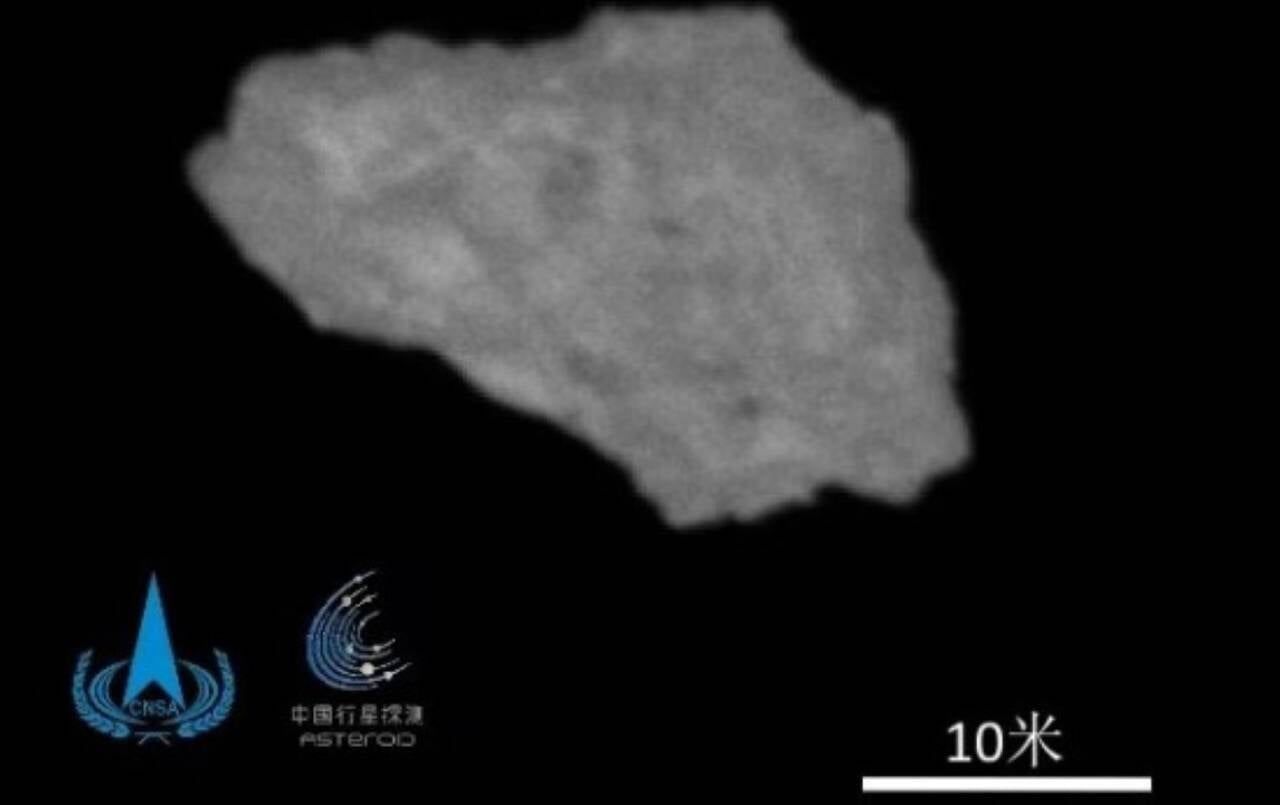
A Chinese spacecraft, involved in an ambitious project to collect and return samples from an asteroid close to our planet, has released its first image of the target celestial body. This mission demonstrates Chinese technological advancement in the exploration of celestial objects.
Named Kamo’oalewa, the space rock follows an orbital path around the Sun but maintains a remarkable proximity to Earth, ranging between 9 million and 25 million miles away. This type of object is known as a quasi-satellite, and astronomers have already identified at least eight rock formations that follow trajectories similar to those of our planet.
Space science experts affectionately dub these bodies Earth’s “mini moons” or “near-moons,” although there is significant debate over their origin. Some studies suggest that Kamo’oalewa could be a fragment of Earth’s Moon, ejected into space after an ancient impact, while observations from the James Webb Space Telescope present evidence that challenges this hypothesis, indicating the complexity of determining the formation of these celestial bodies. Understanding Kamo’oalewa’s true origin could provide crucial insights into the history of impacts on the solar system and the formation of other near-Earth objects.
China's Tianwen-2 probe beamed home a photo of its target, asteroid 2016HO3, also known as quasi-moon Kamo'oalewa. https://t.co/IK3VELdD2G
— SPACE.com (@SPACEdotcom) July 7, 2026
The Chinese probe Tianwen-2 spent 400 days traveling to reach Kamo’oalewa, covering approximately 1 billion kilometers. The asteroid, which is about 20 meters in diameter, is slightly larger than a school bus and completes a rotation on its own axis every 28 minutes. Discovered in 2016, the asteroid will be the target for sample collection by Tianwen-2 from May 28, 2025, with a return to Earth scheduled for 2027, when the samples will be released into the atmosphere during a flyby.
The technology on board Tianwen-2 makes it possible to collect samples using three different methods, adaptable according to the conditions found on the asteroid. One of the techniques involves a touch-and-collect process, similar to that employed by NASA’s OSIRIS-REx and Japan’s Hayabusa2 missions. Additionally, the probe may attempt a docking method, physically attaching itself to the rock to extract material from the surface and underground, or a hover mode, where a robotic arm will be extended to collect samples while the spacecraft remains suspended over the asteroid. This flexibility increases the chances of mission success and the diversity of scientific samples.
The China National Space Administration (CNSA) reported that the Tianwen-2 probe reached a distance of 12 miles from the asteroid in late June.
According to CNSA, the probe will continue its more detailed scientific exploration to compile information on the shape, composition and internal structure of the asteroid, paving the way for future sample collection stages.
After delivering the samples to the Earth’s atmosphere, Tianwen-2 will proceed to a new stage of its journey, heading to comet 311P/PanSTARRS, where it will carry out additional observations and studies.





