
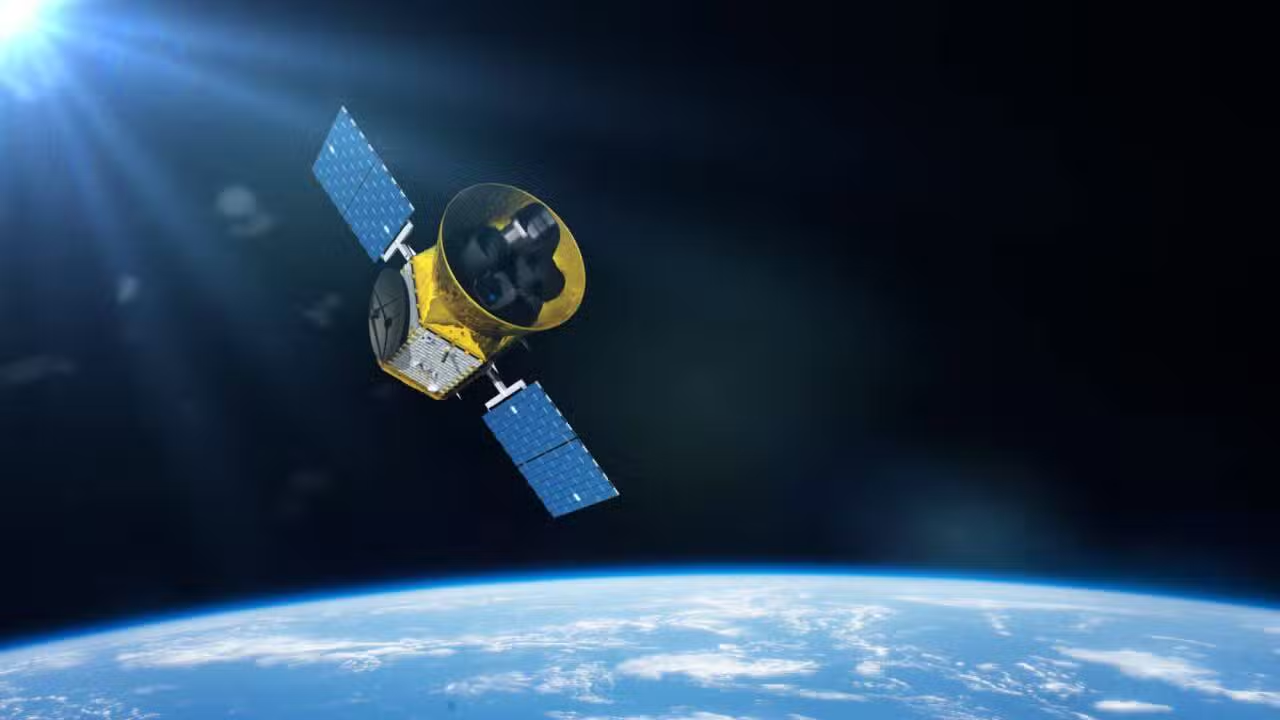
Launched in 2018 with the specific purpose of monitoring nearby stars, NASA’s Transiting Exoplanet Survey Satellite (TESS) has exceeded expectations. Its main mission was to identify distant worlds by detecting minute variations in stellar brightness, signaling the passage of planets. After successfully making hundreds of discoveries, researchers have now identified that TESS recorded data from something completely unforeseen.
New research, released July 1 in the Astrophysical Journal Letters, revealed that the space telescope captured the signal from an exoplanet named Gaia23bra b. This celestial body orbits a star approximately 40,000 light-years away, a distance that exceeds by more than 250 times the range for which TESS was originally configured to investigate.
The situation is comparable to pointing a household camera at the backyard bird feeder and, upon reviewing the recordings, realizing that it accidentally recorded wildlife from a distant continent.
The fact becomes even more remarkable when considering that TESS identified the exoplanet using an observational method for which it was not designed.
The series of events that led to the discovery began in April 2023. At that time, the European Space Agency’s (ESA) Gaia probe noticed a passing glow from a distant star. This phenomenon was the result of gravitational microlensing, a cosmic effect already anticipated by Albert Einstein in his theories.
This mechanism occurs when two stars are positioned almost perfectly aligned in relation to the Earth’s point of view. The gravitational force of the closest star distorts and amplifies the luminosity of the most distant star, functioning as a kind of celestial magnifying glass. If the star in the foreground has a planet, the presence of this body generates specific distortions in the amplified light.
Although the Gaia probe documented the increase in stellar brightness, its data was not enough to confirm the existence of the planet itself. By a happy coincidence, less than a month later, TESS was aiming its sensors at the same area of the sky.
Mallory Harris, a doctoral student at the University of New Mexico and lead author of the research, explained in a note that “Gaia’s observations were insufficient to identify the planet.” She added that, “by chance, TESS was monitoring the same portion of the sky during the gravitational microlensing event, and its more detailed coverage in time revealed additional features in the light curve indicative of the presence of a planet.”
However, the discovery initially went unnoticed.
The reason for this lack of initial detection is clear: “At the launch of TESS, no one predicted that it would have the ability to find this specific type of planet,” said Diana Dragomir, assistant professor at the University of New Mexico and co-author of the study, in her statement.
The phenomenon of microlensing alignment between the two stars occurred and ended in 2023. The signal that indicated the presence of the planet, however, remained archived in the TESS data, unnoticed, for almost three years until the team of researchers managed to make the necessary connections.
For Dragomir, this discovery is an indication that “there are probably other planets detected by gravitational microlensing hidden in the TESS data, planets that we previously did not consider looking for.” This revelation opens a new perspective for mining existing data, suggesting the possibility of countless new identifications without the need for new space launches.
Thus, the recent identification indicates that one of NASA’s most fruitful planetary exploration programs still reserves great potential for new and unexpected revelations in its extensive archives.