JAXA’s Hayabusa2 mission obtains unprecedented image of asteroid Trifune at 5.3 km/s By Jeronimo Santos
6 min read
 |
The Hayabusa2 probe, on its extended mission, successfully performed a flyby of the asteroid Torifune (98943 Torifune) on Friday, July 5, 2026. All four scientific instruments on board the spacecraft collected crucial observational information during the flyby. The team from the Japanese Aerospace Exploration Agency (JAXA) analyzed the results, according to the report presented on July 6 by the Team Leader, Yuya Mimasa, Associate Professor Makoto Yoshikawa, responsible for the scientific part, and the Director of the JAXA Institute of Space and Astronautical Sciences, Masaki Fujimoto.
Yuya Mimasa, team leader, detailed the results of the operation, indicating that Hayabusa2’s closest approach to the asteroid Trifune occurred at 6:30 pm (Japan time) on July 5, 2026. The margin of error was just ±1 second, confirming the passage within the predicted time. The relative speed reached around 5.3 km/s, a value that was in line with expectations. JAXA reported that the exact distance of the closest approach has not yet been fully defined, as the spacecraft’s attitude was not completely stable during orbital control moments before the encounter, and additional analyzes are necessary to determine this data accurately.
🚨 BREAKING: Scientists have discovered that asteroid Ryugu contains all five of the essential nucleobases needed for DNA and RNA—the molecules that store and transmit genetic information.
— Physics-astronomy (@Physicsastronmy) July 9, 2026
Using just 5.4 grams of material collected by Japan's Hayabusa2 mission, researchers… pic.twitter.com/rChQlIDL4t
To date, only a fraction of the captured data has reached Earth, with the remainder expected to be gradually transmitted by the end of this year. Despite this, the first images of scientific results already demonstrate that the objective of passing within 800 meters of the center of the asteroid was fully achieved by the mission.
New scientific observations of the asteroid Trifune
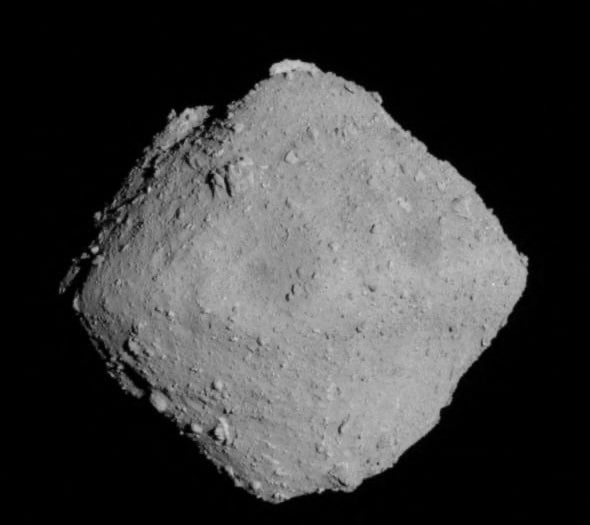
Hayabusa2’s Optical to Telephoto Navigation (ONC-T) camera monitored Trifune from June 20, 2026, continuing until one second before closest approach. The highest-resolution photograph, taken at 18:29:59 on July 5, revealed a striking resemblance to Itokawa, the asteroid investigated by the original Hayabusa probe. Both celestial bodies share similar characteristics, but Trifune is distinguished by a more evident constriction in its structure.
Based on the observed morphology, scientists determined that Trifune is a “contact binary”, a formation that results from the merger of two celestial bodies. The presence of a more pronounced “neck” area suggests that the asteroid may represent a relatively early stage in this merger process. Previous predictions classified Trifune as an S-type asteroid, that is, rocky and with a low carbon content, corroborating its similar appearance to Itokawa, which greatly differentiates it from the dark color of Ryugu, the carbonaceous asteroid previously explored by Hayabusa2.
The asteroid’s surface reveals numerous “blocks”, indicating a debris cluster structure. In contrast to other celestial bodies, craters are not very evident in the visible portion. Previous ground-based observations only indicated an elongated shape, and although this feature was expected, the clear division into two sections was a surprising revelation to researchers.
Associate Professor Makoto Yoshikawa expressed his surprise at the constricted shape of the contact binary system, since projections based on ground-based observations only suggested a “long and slender” body.
The mid-infrared (TIR) thermal camera captured a thermal image at 18:29:58 on July 5, providing preliminary data. Color variations in the image indicate different temperatures, with lighter regions representing warmer areas and darker regions, colder. Absolute temperature values will be detailed in future analyses. The image was obtained at an approximate distance of 10 km from Trifune.
After the successful observation of Ryugu, the TIR (Third Infrared Camera) successfully recorded the asteroid Trifune, consolidating Japan’s important achievements in the infrared observation of asteroids. This TIR camera has been improved for the European asteroid explorer HERA, and a similar version will be installed on the joint Japan-Europe RAMSES mission, which will study the asteroid Apophis in April 2029. This standardization is crucial for comparing data from observations of multiple asteroids (Ryugu, Trifune, HERA’s Didymos-Dimorphos system, and RAMSES’ Apophis) with the same instrument, facilitating a deeper understanding of these celestial bodies.
The NIRS3 near-infrared spectrometer was able to collect crucial information between 20 and 5 minutes, and again between 4 and 2 seconds before the probe passed. Near-infrared spectra are essential for identifying materials and minerals, making it possible to reveal the true composition of Trifune.
LiDAR, a laser altimeter, was essential to accurately measure the distance between the asteroid Trifune and the spacecraft. Four minutes before the closest approach, the equipment continuously emitted lasers, recording distance values of approximately 20 km and 15 km, respectively, four and three seconds before the closest point. This successful LiDAR distance measurement during a high-speed flyby represents a first in global space exploration.
Challenges in capturing images of the asteroid Trifune
Team leader Mimasa detailed the challenges of capturing images with the ONC-T, explaining that the exposure time per image is approximately 5 milliseconds. When combining this factor with the relative speed of 5.3 km/s and the condition that the camera cannot be moved, the complexity of obtaining clear visual records of Trifune becomes evident.
The ONC-T has a narrow 6.32-degree field of view and a 1024 x 1024 pixel CCD sensor. As the camera orientation is fixed, it is not possible to pan to follow the object. Although Trifune is a brighter object than Ryugu and is classified as an S-type asteroid, it passes through the camera’s limited field of view in an instant, at a speed of about 19,000 km/h.
Furthermore, to optimize scientific results, it was crucial that the probe approached the asteroid at the exact moment when its most elongated face was in evidence. Predicting the precise moment in which “Trifune was firmly within the ONC-T’s field of vision at the best angle, and had not yet moved away”, and then crossing it in a mere 5 milliseconds, constituted the mission’s main point of difficulty, demanding extraordinary precision.
Technological advances for planetary defense
One of the purposes of the Trifune mission is the development of technologies to modify the orbit of asteroids. The ability to perform an extremely close pass with high precision demonstrated the feasibility of colliding a probe with a small celestial body. This technology will be fundamental in altering the trajectory of asteroids that could pose a threat of collision with Earth, if they are detected in the future.
However, Trifune is a relatively large asteroid for an impact-based approach, while Hayabusa2 is small. Therefore, even a collision of the probe with Trifune would not significantly alter its orbit. The demonstration focused on guided navigation control, laying the foundation for selecting an appropriate methodology should the need arise in the future.
The Hayabusa2 team recognized the contributions of key navigation and guidance collaborators, including NASA’s Jet Propulsion Laboratory (JPL), NEC, Fujitsu, the Japanese Space Guard Association, and the Matsue National Institute of Technology. They also expressed their gratitude to various manufacturers, such as NEC Networks & System Integration Corporation, SEC, and SED, for operational support. JPL’s Deep Space Network continues to download scientific data in addition to its operational functions.
The Hayabusa2 probe will resume orbital control using its ion engines and begin its next stage, which includes a near-Earth pass in December 2027. Despite concerns about the condition of the ion engines, which have already exceeded their designed lifetime, the mission is scheduled to continue toward its final destination, asteroid 1998 KY26.