3I/ATLAS interstellar comet: 57 km/s hyperbolic orbit confirms it came from another star By Luís Henrique Costa
3 min read
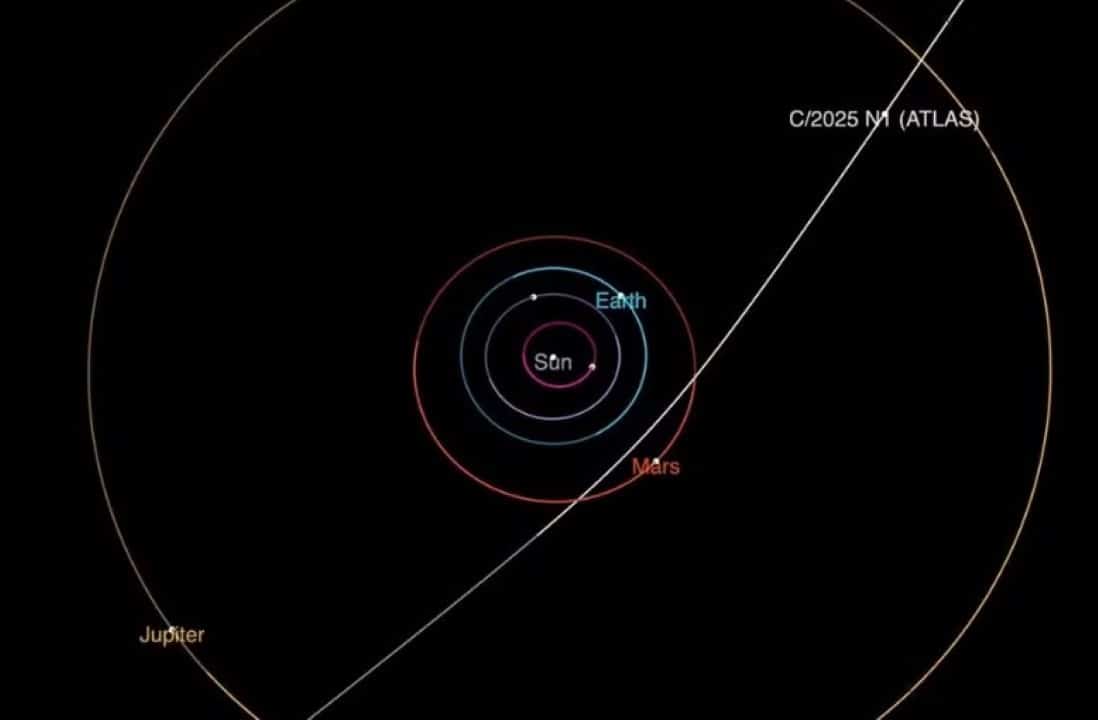 |
Astronomers now say the interstellar comet 3I/ATLAS is already heading back into interstellar space. It was first measured at about 57 km/s, and its path is hyperbolic, so the pull of the Sun cannot hold it in orbit. Telescope observations confirmed that the object came from another star system.
The comet was reported on July 1, 2025, by the ATLAS survey telescope in Chile. It became the third confirmed interstellar object, after 1I/’Oumuamua in 2017 and 2I/Borisov in 2019. Its speed exceeds what is needed to escape the Sun, so the Sun’s gravity only bends its route like a slingshot.
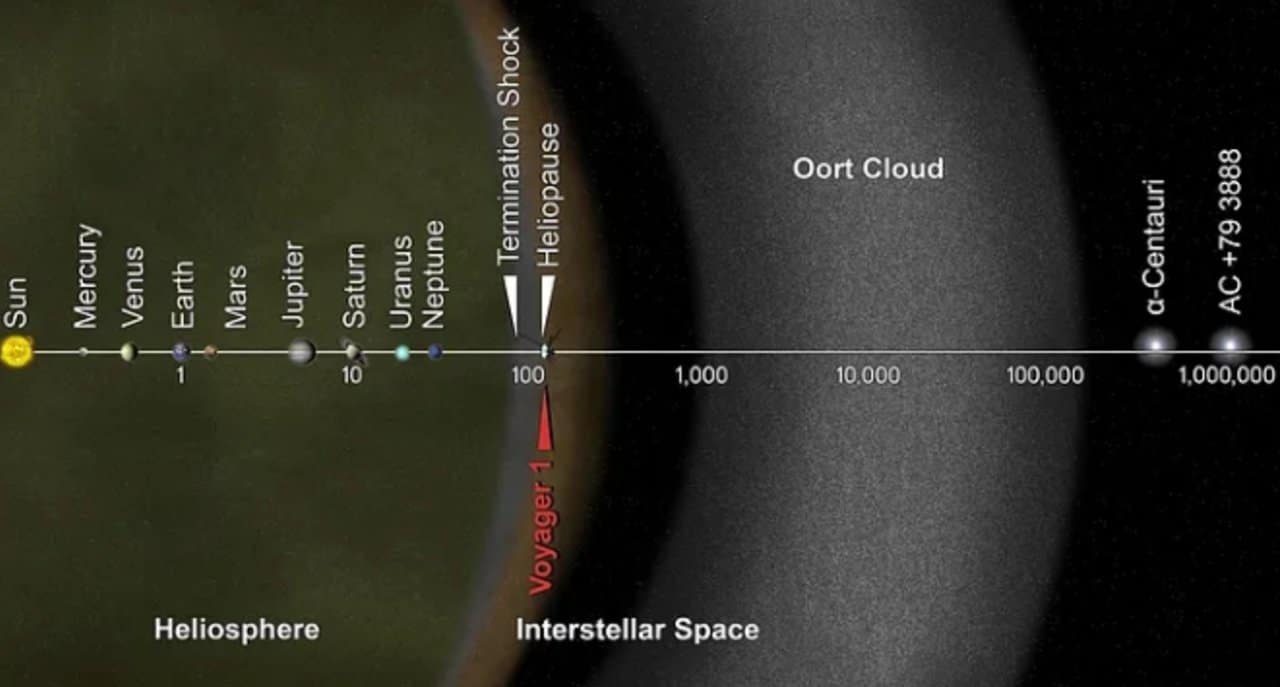
- 3I/ATLAS: about 57 km/s
- 1I/’Oumuamua: 26.33 km/s
- 2I/Borisov: 32.3 km/s
Where the object was born and how it was ejected
Objects like 3I/ATLAS once orbited distant stars before being thrown out. Gravitational encounters or stellar explosions can eject them into interstellar space, where they travel for millions of years before crossing a system like ours.
Telescopes track paths that are not tied to the Sun, which is how astronomers confirm the object’s outside origin.
What a hyperbolic path means for the comet’s route
A hyperbolic path means the object moves faster than the local escape speed at every point along its route. 3I/ATLAS entered the solar system, passed the Sun and is leaving without settling into an orbit.
Solar gravity changes the comet’s direction, but it does not slow it enough to capture it. Observers keep following its path as it moves into deep space.
Keep reading: 3I/ATLAS interstellar comet shows carbon dioxide dominance and up to 14-billion-year age in NASA observations
Calculations placed its closest point to the Sun on October 29, 2025, at 1.357 astronomical units, about 203 million kilometers. Computer models reproduce the slingshot effect, and the interaction lasted several weeks.
How its speed differs from comets of the solar system
Comets born in the solar system can reach tens of km/s near perihelion. Interstellar objects keep the speeds they inherited from the galactic environment they left, and 3I/ATLAS is the fastest interstellar object identified so far.
That gap points to the object’s outside origin. Spectroscopy measures its composition and finds element proportions that differ from those of local comets.
The speed-up seen on ‘Oumuamua in 2017
In 2017, ‘Oumuamua showed an unexpected speed-up as it passed the Sun. One explanation is outgassing of trapped hydrogen, which treats the boost as natural motion.
Solar heat releases gas from inside the object. Alternative hypotheses still lack concrete evidence.
Learn more: Webb finds dust-rich water ice in interstellar comet 3I/ATLAS
How the close pass bent the comet’s route
The flyby bent the path of 3I/ATLAS by a calculated angle. Observatories follow its orbital data in real time.
Its kinetic energy outweighs the pull of the Sun. After leaving the solar system, the object keeps moving through space without being captured.
What chemical analysis reveals about the comet’s ice
Studies found common elements in proportions that differ from those of our solar system, and the analysis confirms its classification as interstellar. Telescopes record spectra to compare the comet with materials found locally.
A Nature Astronomy study published on October 23, 2026, measured a deuterium-to-hydrogen ratio of about 3.33% in the comet’s methane, roughly 14 times the value measured in comet 67P/Churyumov-Gerasimenko by the Rosetta spacecraft. On November 3, 2026, new James Webb Space Telescope findings reported that its water-ice grains contain much more dust than typical solar system comets.