
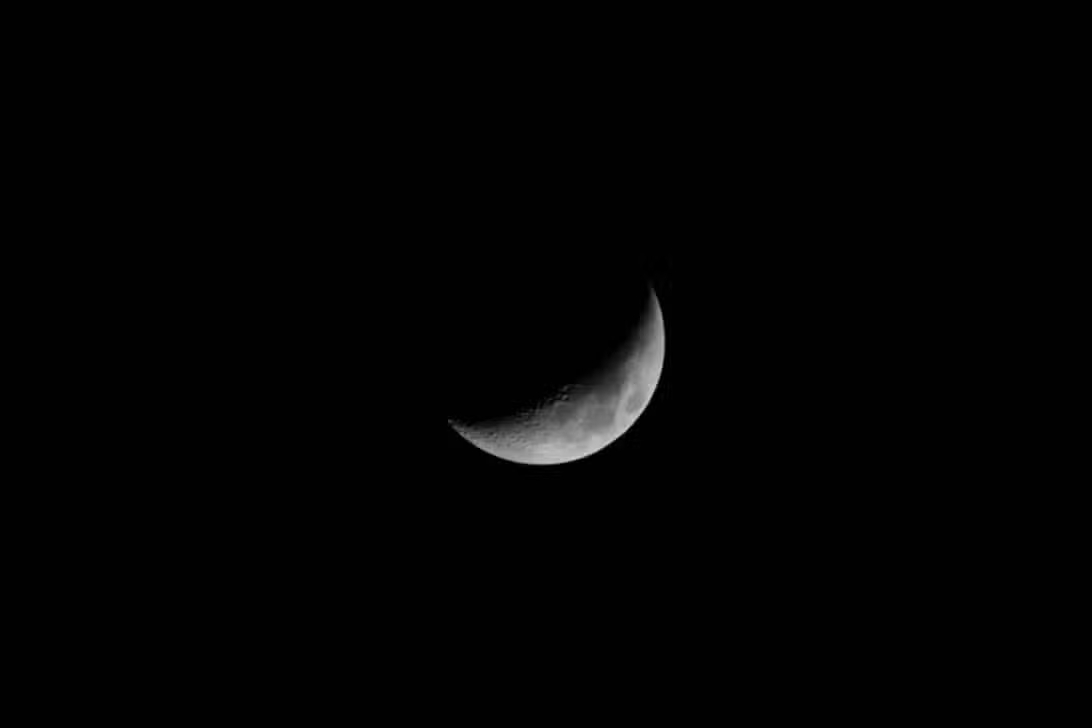
The moon is on the last day of its waning phase this Monday, July 13, 2026, showing just 1% of its visibility in the sky. For those who follow astronomical phenomena, the National Institute of Meteorology (Inmet) has made available the complete calendar of lunar transitions scheduled for this month. Knowledge about the phases of the moon is a relevant factor for various activities, from agricultural practices to simple nighttime enjoyment, connecting us to natural rhythms.
The phases of the moon in July 2026 began on the 7th with the arrival of the Waning Moon, which occurred at 4:30 pm (Brasília time). Then, on the 14th, the New Moon is scheduled for 6:45 am. The Crescent Moon will make its appearance at 8:05 am on the 21st. Finally, the Full Moon will take over the sky on the 29th, at 11:37 am.
A lunar cycle, or lunation, has an average duration of 29.5 days. This period marks the time it takes for the Moon to complete all its phases, starting with the new phase and ending with the waning phase.
Lunar phase calendar for July 2026
Check out the exact dates and times for each phase of the moon during the month of July 2026:
- Waning Moon: 7th, at 4:30 pm
- New Moon: 14th, at 6:45 am
- Crescent Moon: 21st, at 8:05 am
- Full Moon: 29th, at 11:37 am
Understanding the Full Moon Cycle
The lunation, which is the time interval between two consecutive new moons, has a subtly variable duration, with an average of 29.5 days. During this period, our natural satellite goes through its four main phases: new, waxing, full and waning, each lasting approximately seven days.
There are also so-called “interphases”, which are transitions between the main phases. Between the new and full phases, the crescent moon and the gibbous crescent occur. Between full and waning, the gibbous waning and the waning quarter are observed.

What characterizes the New Moon and its symbolism
During the New Moon phase, the celestial body is positioned between the Earth and the Sun. This configuration causes the illuminated side of the Moon to face the star, while its dark side is directed towards us, making it imperceptible in the night sky. This phase is a milestone for the beginning of a new lunar cycle, and is often associated with new beginnings and new possibilities.
The Meaning and Progression of the Waxing Moon
After the New Moon, the Crescent phase begins. Gradually, a narrow illuminated band begins to appear in the sky, expanding night after night. From a thin arc of light, the illuminated part expands until half of the Moon is visible, a point known as the First Quarter. This stage symbolizes development, the construction of new paths and gradual progress.
The intensity and beauty of the Full Moon
When the Moon reaches its full phase, the Earth is interposed between the Sun and the satellite. This position allows the lunar face facing our planet to receive full sunlight, making it fully visible and stunning in the night sky. This is the period of greatest brightness, when the Moon rises on the horizon simultaneously with sunset. The Full Moon is traditionally linked to plenitude, the culmination of processes and energy at its maximum point.
The Waning phase and the reflection process
After the Full Moon, lunar luminosity begins to gradually decline. Each night, a smaller portion of its illuminated surface is observed. When only half of the Moon is visible, the First Quarter occurs, which is the opposite stage to the First Quarter. The decrease in light continues until the Moon returns to the New phase, restarting the cycle. The Waning phase is a symbol of reflection, closing cycles and preparation for new beginnings.