
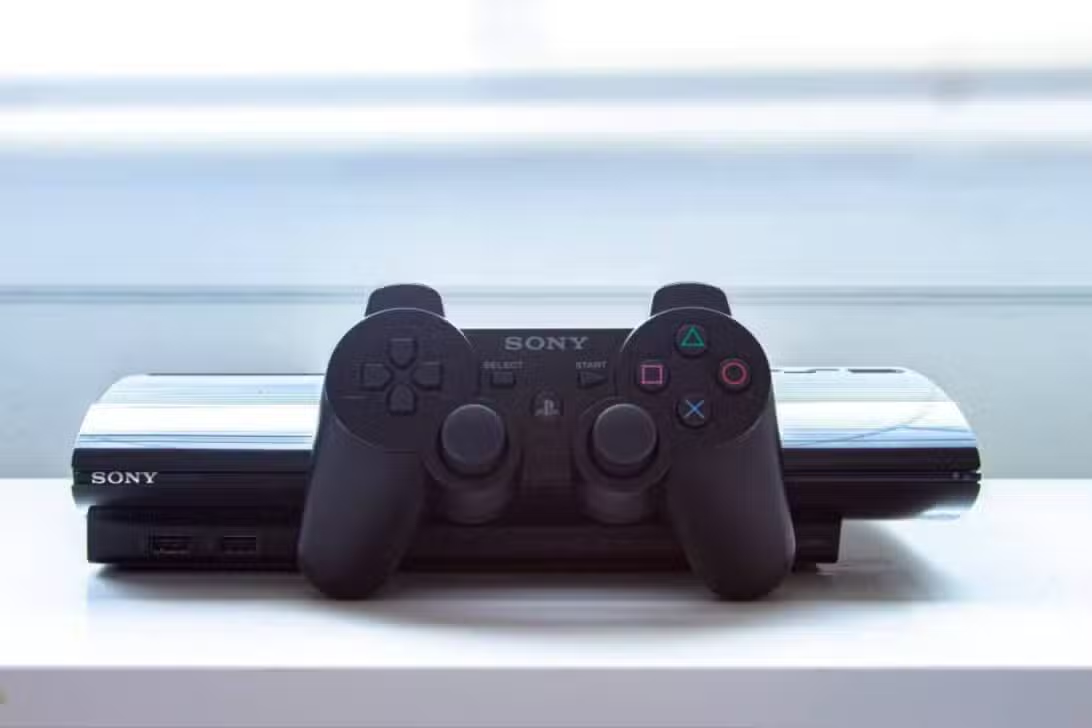
Software experts and major game publishers have taken a revolutionary approach to running older PlayStation 3 titles directly on modern computers. Instead of relying on heavy emulators, the new strategy uses static recompilation so that games communicate without intermediaries with the current components. This code translation transforms the original files into independent programs, taking full advantage of the processing power of cutting-edge graphics cards and processors.
Originally released in 2006, Sony’s video game was marked by its extremely complex hardware architecture, which always represented a nightmare for those trying to port their games to other systems. Now, in the year 2026, significant advances in the area of reverse engineering are breaking down this technological wall, allowing the recovery of a vast entertainment catalog. The initiative is gaining strength driven by companies with an eye on profit and open source enthusiasts, all with the common goal of ensuring that the history of games is not lost over time.
How developers tamed the dreaded Cell processor
The heart of the Japanese console was a chip developed in a historic alliance between Sony, Toshiba and IBM, featuring a central core and eight auxiliary units created for extreme parallel processing. At that time, programmers had to write command lines manually to extract performance from this alien structure, definitively tying the software to the machine’s hardware. While classical emulation struggles to imitate this asymmetry, requiring very expensive computers, static recompilation solves the problem by translating the original instructions into the language of modern multi-core processors. Professionals in the field can read data from disks and rewrite them in universal formats, such as the C++ language. Critical elements such as the physics engine and sound reproduction are recoded to run natively on today’s machines. Automated tools take on most of the heavy lifting, generating a program that accesses your PC’s RAM and graphics card without bottlenecks. To ensure that the result is identical to the creators’ original vision, batteries of tests correct any synchronization errors during the transition.
Graphical improvements and lower hardware requirements
Running games natively reduces the need for a cutting-edge machine to relive the successes of the seventh generation. A current intermediate computer, equipped with 16 gigabytes of RAM, already provides much greater fluidity than the console itself provided in the past. Without having to install unofficial modifications, users can play in 4K resolution at 120 frames per second. All this visual gain is built directly into the file compilation phase. Sharper textures become part of the source code, and the cameras’ viewing angle is expanded to fit modern ultrawide monitors.
When the base game is already running perfectly on the PC, the technical teams apply a second layer of aesthetic improvements. Lighting effects are reworked to support cutting-edge technologies, including the coveted ray tracing on graphics cards that feature this feature. Additionally, sound engineering is given special treatment to deliver accurate spatial audio in contemporary headphones.
Profit and savings opportunity for the games industry
Entertainment giants were quick to see static recompilation as a goldmine for reviving famous brands that had been forgotten. Renowned producers, such as Konami, already use this technology to release collections of classics, ensuring that complex mechanics work without crashes on PCs. This strategy generates significant profits with a development cost up to 50% lower compared to creating a remaster from scratch. Independent studios also take advantage of this facility, managing to bring dozens of old adventures to the present while spending very little. The ultimate target is a gigantic market, made up of more than a billion computer gamers spread across the globe.
From a legal point of view, this new approach creates a protective shield, as it separates the generated code from the video game manufacturer’s hardware patents. This allows companies to re-release their catalogs without the fear of facing lawsuits that often haunt the use of open emulators. Furthermore, the method makes piracy difficult, as conversion requires the person to have an original copy of the game, whether on disc or in digital format, to extract the initial files.
The Independent Developers Task Force
Away from the offices of large corporations, groups of enthusiasts work voluntarily to create open source programs that facilitate this mass migration. Collaborative platforms on the internet bring together experts focused on deciphering the console’s secrets and establishing compatibility standards. The famous RPCS3 emulator, which can already run most titles, serves as an invaluable testing laboratory to validate new recompilation techniques. Thanks to the constant updates of these community tools, lone developers gained the power to rescue obscure games that were in serious danger of disappearing forever.
Barriers in programming and the salvation of the historical collection
Transforming closed source software is still a headache when programmers do not have the original development files. Small errors in memory management or processing glitches require a human to review the code line by line after machine translation. Another major obstacle is old copy protection systems, which act as a concrete wall against reverse engineering attempts.
The solution to these blockages involves grueling hours of memory analysis and repetitive testing to find the root of the problem. Even with these setbacks, current technology is capable of doing the heavy lifting almost alone. This brings real hope for the preservation of more than three thousand games released for the PlayStation 3, ensuring that they remain playable for decades to come. This direct conversion is the only way to avoid the cultural blackout caused by the inevitable rot of the original Blu-ray discs.
- Maintaining access to historic titles without the need to hunt for expensive used consoles.
- Ease of integrating new programs with gaming platforms via cloud streaming.
- Possibility of bringing complex adventures to the screen of cell phones and smart televisions.
- Brutal drop in electrical energy expenditure when compared to the effort required by traditional emulation.
- No more long waiting screens, taking advantage of the extreme speed of solid state storage.
The maturation of this software engineering technique represents a definitive milestone for the digital entertainment industry. The positive results obtained with the Sony device are already motivating research to apply the same magic to other video games that are no longer manufactured. The horizon points to a scenario where humanity’s interactive memory will not be held hostage by plastics and aging circuit boards, remaining alive for the players of tomorrow.