
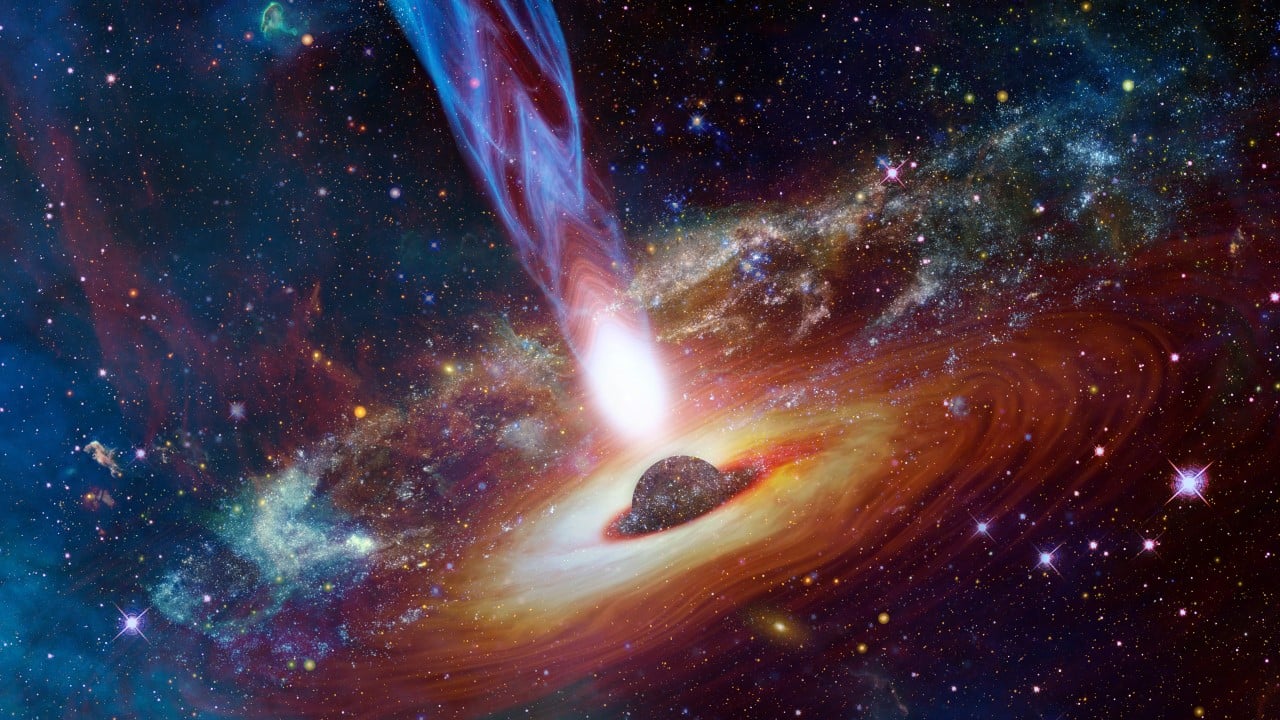
The European Space Agency (ESA) mission found 31 quasars located at the edge of the cosmos. Of these, two are the most distant ever observed, dating back to a period when the universe was just 670 million years old.
The Euclid space observatory, launched by ESA in 2023, has made a discovery that redefines the limits of observational astronomy. He identified 31 quasars from the oldest eras of the cosmos, an unprecedented number that more than doubles the number of these objects known for such remote periods, in addition to including two that break all records for cosmic antiquity.
The two most notable quasars, named EUCL J172902.75+641018.1 and EUCL J125308.55+705432.3, have redshifts of 7.77 and 7.69, respectively. This means that they are more than 13 billion light years away, taking us back to a period when the universe was only 670 million years old, which corresponds to 5% of its current age. This information was released by the research team led by Daming Yang, from Leiden University, in the Netherlands.
Quasars are brief phases in the evolution of a galaxy, marked by the massive infall of matter into its central supermassive black hole. This process releases colossal energy, causing the galactic nucleus to shine hundreds or even thousands of times brighter than the rest of the host galaxy, making them the most luminous objects in the entire known universe.
For decades, the scientific community has searched for these early quasars to decipher the processes of the cosmic aurora, especially the formation and growth of the first supermassive black holes and their host galaxies. However, detection has been difficult due to its extreme rarity, as few galaxies had reached the necessary size, and the low intensity of their primordial light, easily confused with that of nearby stars.
The Euclid telescope, with its unprecedented technical capabilities combining wide field of view, exceptional observing depth, unmatched image clarity and infrared view of space has overcome these barriers. He carried out a true census of the quasar population in the early universe, as highlighted by Antonio La Marca, ESA researcher on the Euclid team. He pointed out that while discovering the first ten quasars with a redshift of 7 or greater took more than a decade, Euclid surpassed that number in just one year of operation.
Among the 31 identified quasars, 12 have a redshift of 7 or more, corresponding to the first 770 million years of universal history. This period is of great relevance to astrophysics, as it coincides with the so-called epoch of reionization, a crucial interval where the cosmos changed from a cold and dark state to a hot and ionized one, laying the foundations for the structures we see today.
The second oldest quasar, discovered by Daming Yang’s team, was the subject of a recent in-depth study led by Silvia Belladitta and her collaborators. The observations showed that this object is located in a galaxy rich in dust and gas, where intense star formation occurs, offering valuable clues about the characteristics of the host galaxies of these first supermassive black holes.
Euclid’s ability to detect such distant objects is not only due to its technical performance, but also to sophisticated data processing. This allows thousands of scientists and engineers from the Euclid Consortium to analyze large volumes of information to identify these rare and remote quasars, which can then be detailed with ground-based telescopes, as explained by Valeria Pettorino, Euclid project scientist at ESA.
The quasars found in this campaign derive from data collected by the Euclid Wide Survey, an observational program that, when completed, will cover more than a third of the entire celestial sphere. Its main objective is to unlock the secrets of the dark universe, exploring its composition, history and evolution, as well as mapping its large-scale structure through the observation of billions of galaxies and, as has now been proven, discovering countless quasars.
This discovery marks a significant advance in understanding these captivating objects. Until now, the oldest known quasars were just the tip of the iceberg, i.e. the easiest-to-spot exceptionally bright specimens. There were not enough quasars from the early universe to adequately study them as a population group, a limitation that Euclid was able to overcome by recording not only the most luminous objects but also the bulk of the ancient quasar population.
The discovery of Euclid doubles the number of known quasars with a redshift greater than 7 and sets a new distance and age record. This turns these two objects into true time machines, allowing astronomers to glimpse an era of the cosmos that remained unexplored and understand how these colossal systems formed and grew so quickly, a mystery that represents one of the greatest challenges in modern astrophysics.
The Euclid mission, which continues its exploration of the universe with the purpose of unraveling the nature of dark matter and dark energy, demonstrated with this discovery its value not only for cosmology. It is also crucial for the study of the most extreme and energetic objects in the primordial cosmos, opening a new window into understanding the processes that shaped the early universe and led to the formation of the structures we observe today.