
Hubble Telescope reveals galaxy LEDA 198197 in rare overlap, allowing unprecedented study of cosmic dust

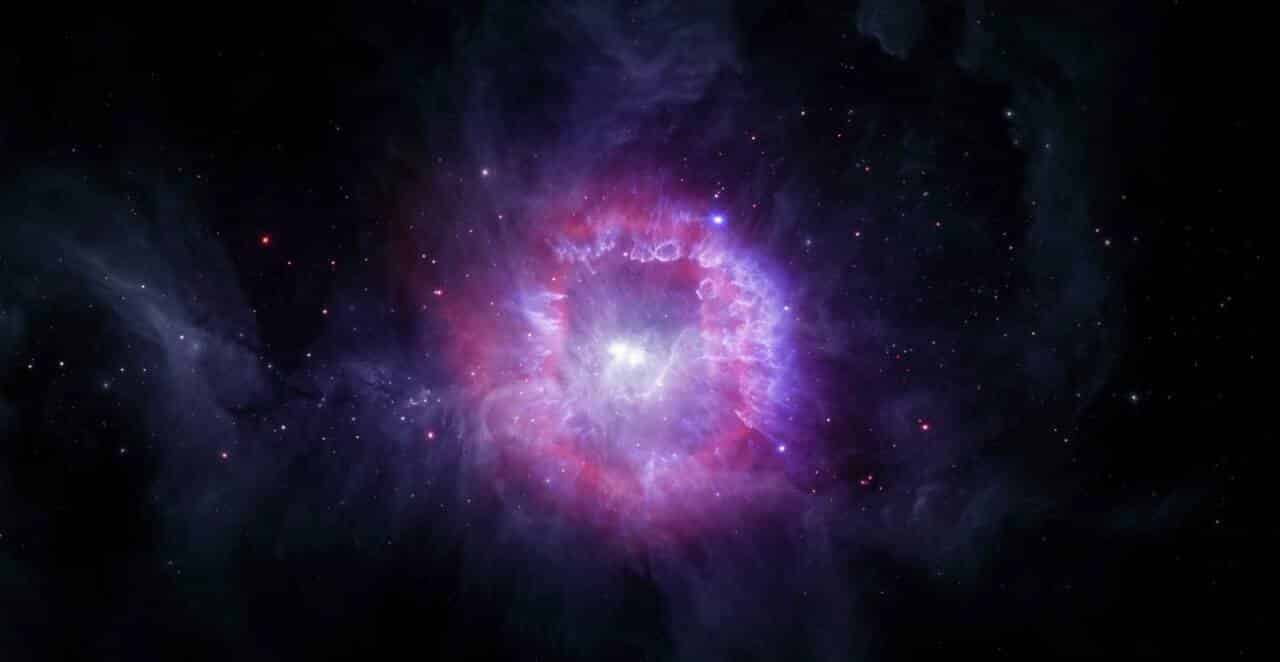
On Tuesday, July 9, 2026, an image captured by the Hubble Space Telescope showed the spiral galaxy LEDA 198197. This celestial body is located in the constellation Sculptor, about 780 million light-years from our planet.
The photograph features the spiral galaxy LEDA 198197, where a smaller galactic formation appears to cross its path in the foreground. Image credits go to NASA, ESA, and the Hubble Heritage Team (STScI/AURA), with thanks to B. Holwerda of the Space Telescope Science Institute and J. Dalcanton of the University of Washington.
Scientists describe this cosmic coincidence as a surprising galactic configuration, the result of a fortuitous alignment.
In this scenario, two spiral galaxies – one large and the other smaller – appear remarkably close, presenting an almost perfect overlap. Such an arrangement is considered unusual, given the vastness of the universe and the number of galaxies that exist.
According to data from NASA, LEDA 198197, located in the background of the image, has dimensions comparable to those of the Milky Way. It appears approximately ten times larger than the smaller galaxy in the foreground.
Observing the structure of dark dust beyond galaxies
A detailed analysis of the image reveals that the luminous core and the area around LEDA 198197 are obscured by the outskirts of the smaller galaxy ahead. This particularity makes it possible to visualize an intricate dust structure, which expands beyond the stellar disk of the main galaxy, appearing as a shadow.
NASA explains that these dust formations are, as a rule, difficult to detect, as they blend in with the blackness of space. However, in this representation, LEDA 198197 functions as an intense light source in the background, making visible the scattering of dust in the smaller galaxy in the foreground.
At the time of its release in 2008, the visualization of cosmic dust exceeding the perceptible limits of a galaxy was classified as an unprecedented discovery. This phenomenon aroused great curiosity among astronomers, who began to investigate whether large-scale dust structures were common in other galactic formations.
Analyzing the structure of the dust, as observed in this case, is fundamental to understanding its influence on the color and luminosity of galaxies, which makes it possible to calculate their intrinsic brightness. By determining the true brightness of a celestial object, it is possible to estimate its exact distance from Earth by comparing the observed brightness and its true brightness. Thus, the study of dust represents a vital line of research to gauge great distances in the cosmos, providing a valuable context for future astronomical investigations.
The impact of accidental revelations on astronomy
Interestingly, the cluster of LEDA 198197 with the smaller galaxy was recorded unintentionally, while the Hubble Space Telescope focused on observing the spiral galaxy NGC 253. NASA clarifies that most of the bright spots scattered around correspond to stars belonging to NGC 253, which also overlap with other structures in the visual field.
A complementary image shows the spiral galaxy NGC 253, captured by the ESO (European Southern Observatory) VST (VLT Survey Telescope). In the illustration, LEDA 198197 is identified by a yellow circle in the upper left corner, a detail included in the version of the image released in December 2011. The credits go to ESO/INAF-VST, with thanks to A. Grado, L. Limatola and the INAF-Observatório de Capodimonte.
The findings obtained by the Hubble Space Telescope were compiled in a scientific article, establishing themselves as a significant case study for understanding galactic architecture. Currently, the technique of observing dust through overlapping galaxies is applied to map the distribution of these elements in other cosmic formations.
The original image was released by NASA and ESA/Hubble on September 16, 2008, and was re-edited and published again by NASA’s official Hubble X account on July 9, 2026.





