

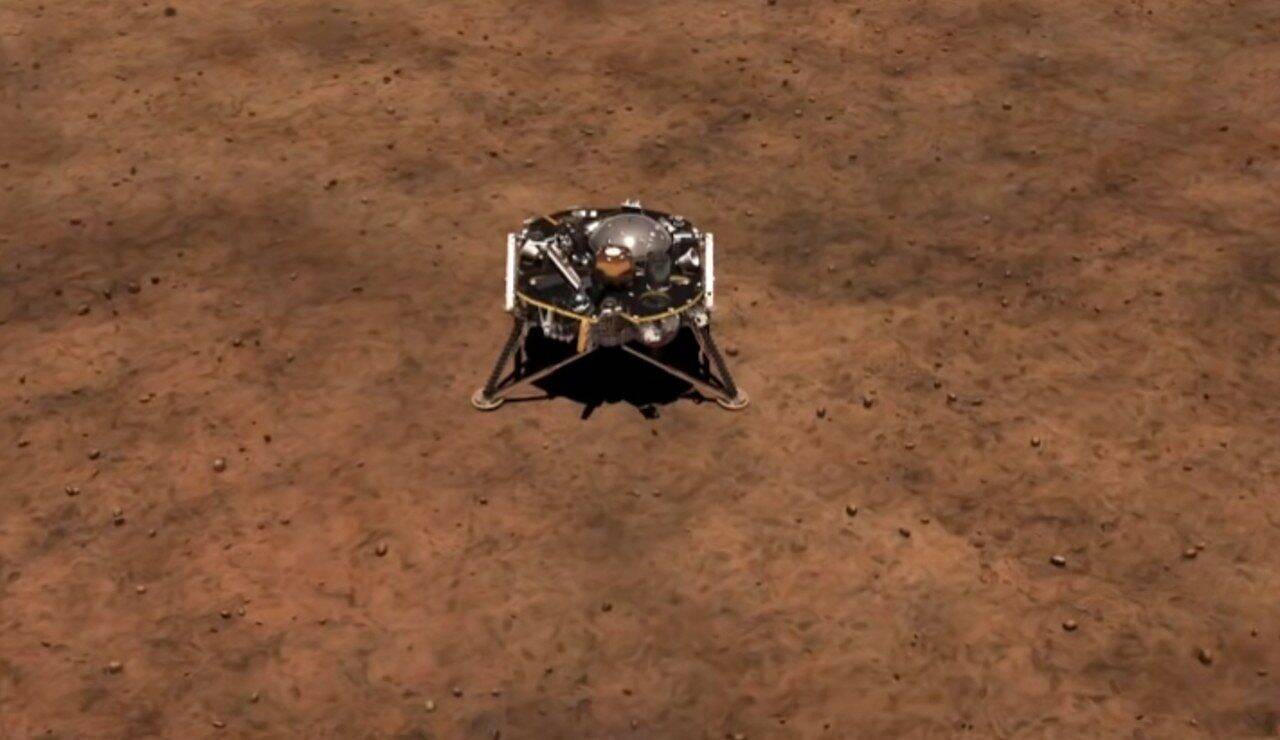
Scientists have identified an immense reservoir of liquid water on the planet Mars, located deep in its crust. The discovery was made through a new analysis of data collected by NASA’s InSight probe, which monitored seismic activity on the red planet between 2018 and 2022. The results indicate that the amount of underground water detected would be enough to cover the entire planet with oceans, changing the understanding of Martian geological evolution.
The study was led by researchers Vashan Wright and Matthias Morzfeld, from the University of California, together with Michael Manga, and published in the scientific journal PNAS. The team used rock physics models and Bayesian inversion, combining the speed of seismic waves with local gravitational data. This innovative methodology made it possible to map the physical properties hidden beneath the planet’s soil.
Where water is hidden in the Martian subsurface
The research demonstrated that liquid water is not pooled in open lakes, but rather percolates within fractured igneous rocks in Mars’ mid-crust. Geophysical data indicate that this reservoir is located at a depth that varies between 11.5 and 20 kilometers below the current surface. The presence of fluid water in this range suggests that the planet’s interior maintains specific thermal conditions.
The calculations reveal that, if the composition of the middle crust recorded by the InSight probe is representative of the rest of the Martian territory, the total volume of liquid stored would be colossal. The estimate points to a quantity capable of forming a global layer with a thickness of between 1 and 2 kilometers. This volume exceeds projections about the amount of water that flowed on the Martian surface in the geological past.

The fate of the ancient water that filled the surface
Experts explained that the identified groundwater remained protected deep underground as Mars’ atmosphere dissipated over billions of years. More than 3 billion years ago, the planet was home to rivers and lakes. The new mapping suggests that the disappearance of this resource on the surface did not occur simply due to the loss of gases into space, but rather due to a process of geological sequestration in the inner crust.
The retention of this liquid in fissures requires the upper crust to have permeability that has allowed infiltration over the ages. Furthermore, temperatures at depth need to be high enough to prevent freezing, keeping the element in the liquid phase even under the cold of the surface.
The practical impact on future space exploration
While the water confirmation is a milestone, the discovery poses a severe technical challenge to colonization plans. The depth of more than 11 kilometers makes the resource inaccessible to current drilling tools. This means that future human missions will not be able to extract this water for consumption or fuel, depending on surface ice.
On the other hand, the announcement reignites the debate about the habitability of the red planet. Deep, water-saturated environments on Earth are home to microorganisms that survive without sunlight. The discovery indicates that the middle crust of Mars may represent an active refuge where microbial life forms would be able to persist.




