

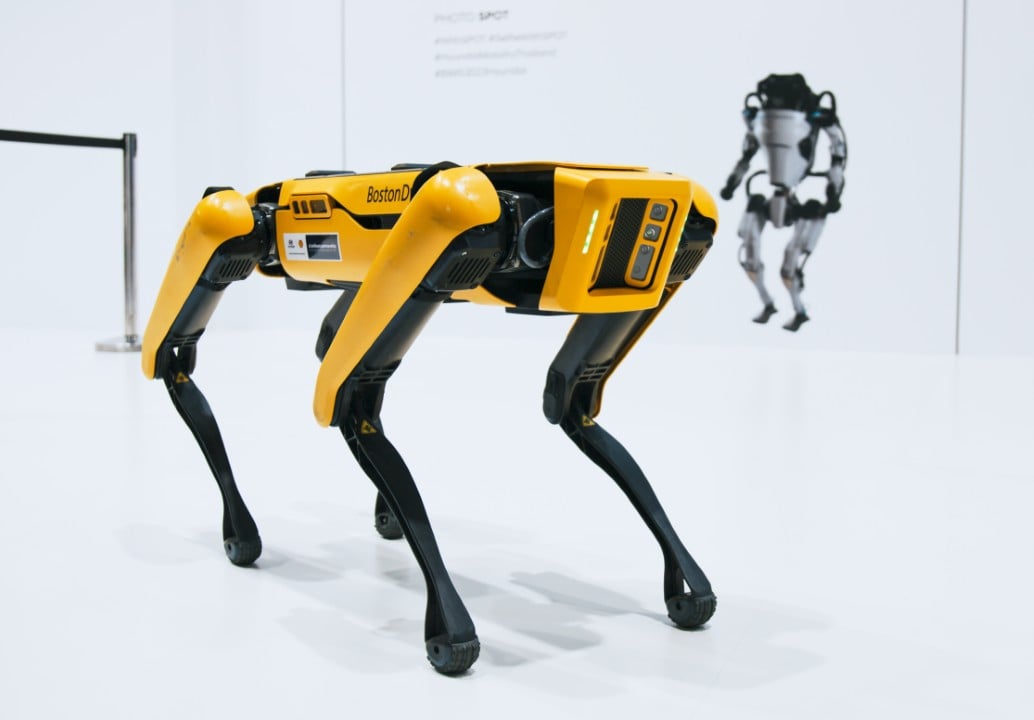
The company Boston Dynamics revealed, on Tuesday, July 14, that it was carrying out new tests to expand the functionalities of its well-known quadruped robot, Spot. The main objective is to explore the equipment’s potential in last-mile deliveries, enabling packages to be taken from transport vehicles directly to recipients’ doors autonomously.
This initiative aims to reduce the physical effort of delivery drivers and optimize the efficiency of logistics chains. According to the company, the first demonstrations of the technology have already attracted the interest of important players in the sector, who are currently discussing the implementation of pilot programs.
To perform this new task, the Spot robot was equipped with a special accessory that resembles a conveyor belt, designed to store and release orders. The procedure is simple: the driver places the package on the robot, which then moves independently to the delivery location, guided by its advanced navigation systems.
The essence of this proposal lies in trying to overcome one of the biggest obstacles in last-mile delivery. While other solutions such as wheeled robots and drones have seen significant advances, elements such as stairs, uneven sidewalks, garden areas and narrow paths continue to be complex barriers for these devices.

In this context, Spot stands out for its ability to cross uneven terrain and avoid obstacles with agility. These qualities have already established it as a valuable resource in several applications, including inspections in industrial environments, search and rescue operations and even surveillance of the ancient ruins of Pompeii.
Boston Dynamics emphasizes that such attributes make the equipment particularly suitable for suburban areas, places where the route between the street and the entrance to the residence often presents uneven levels and natural obstacles. The vision is for the robot to act as a support for the delivery person, and not as a full replacement for human labor.
While Spot takes care of a specific delivery, the driver gains time to organize the next order or plan the route sequence. The company projects that this distribution of activities will increase operational productivity without requiring an increase in physical effort from employees.
According to Paige Miller, senior product manager for Spot at Boston Dynamics, projections indicate a significant increase in operational capacity. The estimate is that, for every three deliveries made by the robot, it is feasible to add one more package to the vehicle’s total distribution load.
Currently, the project is in the demonstration stage. However, the company reveals that it is already in negotiations with large logistics companies to implement pilot programs. If initial tests validate the expected benefits, Spot could emerge as an effective solution to improve delivery service in areas that are challenging for conventional automation.




