

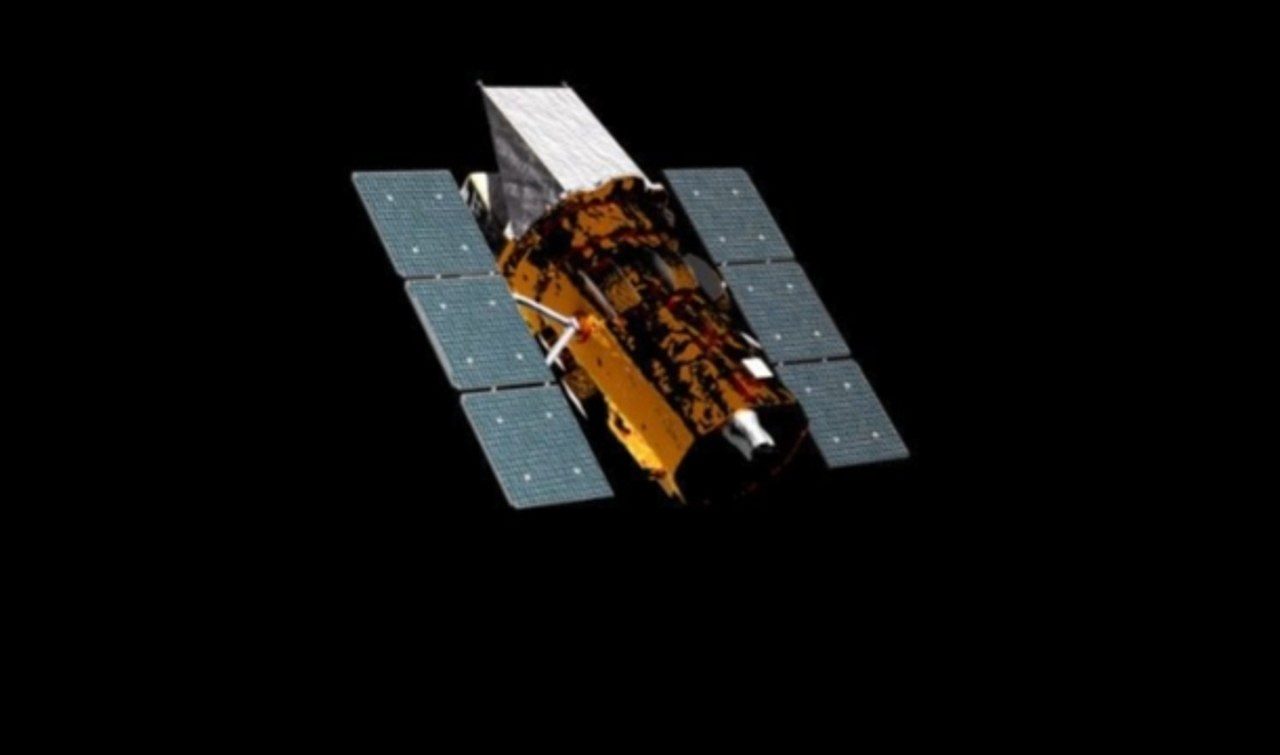
The US space agency NASA is in a race against the clock to rescue a long-lost telescope that is at risk of crashing back into the planet. A rescue mission, valued at US$30 million, will begin this week with the planned launch of a robot developed by startup Katalyst Space Technologies. The goal is to boost the Swift Observatory into a higher orbit, ensuring it continues its important searches for cosmic explosions.
The three-arm space device, created by Katalyst, aims to intercept the Swift after its takeoff. The launch will take place from an atoll in the Marshall Islands, in the Pacific, using a Pegasus rocket carried by an aircraft. The forecast is that the departure into space will take place on Tuesday, June 30, 2026.
Since its launch in 2004, the Swift telescope has experienced a progressive and increasingly rapid descent. This phenomenon is attributed to recent and intense solar activity. For its survival, the observatory urgently needs to reach a more stable and higher orbit.
Not only Swift, but also NASA’s renowned Hubble Space Telescope, faces a similar risk. Hubble, like Swift, is continually losing altitude due to the succession of solar flares that affect space.
Ghonhee Lee, CEO of Katalyst Space, indicated that his company’s advanced robot, still under development, could be the solution for the future of Hubble, which is a much larger equipment. He pointed out that to date, only China has carried out a similar mission, successfully launching a satellite to a higher disposal orbit four years ago.
Lee stated that “this is the first American space robot to go up to space and accomplish something like this.” He added that NASA’s “grand old observatories” could benefit from a service like this, consolidating the strategy as a “new tactic” available for space exploration.
Katalyst’s autonomous spacecraft, called Link, will need approximately a month to locate and capture Swift. Then, a few more months will be dedicated to raising its orbit from the current 360 kilometers to the desired level of 600 kilometers. The gamma ray observatory, which weighs around 1.6 tonnes, needs to surpass the 300 kilometer mark for the rescue to be successful, with October being the estimated point of no return.
Link, with dimensions that resemble a small refrigerator and a solar wingspan of 12 meters, has three extendable arms that reach just over 1 meter. Each arm is equipped with two pinching claws that resemble the hands of Lego minifigures. If the mission goes as planned, Lee predicts Swift could resume operations in September, even though the observatory, worth hundreds of millions of dollars, was never designed for manual repairs or recovery.
Company representatives emphasize that this project is particularly challenging and there are no guarantees of success. NASA sealed the contract with Katalyst in September last year, imposing two main conditions: the urgency of the task and the guarantee that the telescope’s situation would not be worsened. Nine months later, the company is ready to execute.
Shawn Domagal-Goldman, director of astrophysics at NASA, revealed the initial difficulty in conceiving the mission. “I have to be honest. Nobody thought this would be possible. Nobody imagined we would get as far as we have today,” he said, highlighting the complexity of the endeavor.
The space agency was able to temporarily extend Swift’s lifespan by deactivating all of its scientific instruments, which helped slow its descent starting in February. Nicky Fox, NASA’s chief of science missions, emphasized the importance of the effort.
Fox explained that “if we let Swift reenter the atmosphere, we would lose that telescope. We would lose a lot of capacity”, warning of the consequences. She added that, “Right now, we don’t have the budget to build another one to replace it.”
The Swift, according to Domagal-Goldman, is a uniquely valuable piece of equipment, true to its name (“fast” in English) by being designed to move nimbly and capture last-minute astronomical phenomena, such as gamma-ray bursts and exploding stars. With new discoveries expected from the Webb and Roman space telescopes, Swift, if saved, would become even more crucial, acting as NASA’s “first responder.”
Katalyst sees the Swift mission as the starting point for a new industry of in-orbit repair and maintenance services. The company plans to launch a next-generation robot next year, capable of operating on satellites at altitudes of up to 35,800 kilometers. Lee envisions a future with hundreds of robots orbiting, not only repairing and boosting satellites, but also refueling them and helping to build platforms like solar farms and data centers.
Hubble, with 36 years of service and which has already undergone several maintenance by astronauts during the space shuttle era, may receive a boost from Katalyst in 2028 to further extend its useful life. Fox, when referring to the telescope, stated that “it’s a national treasure. People love Hubble.”




