
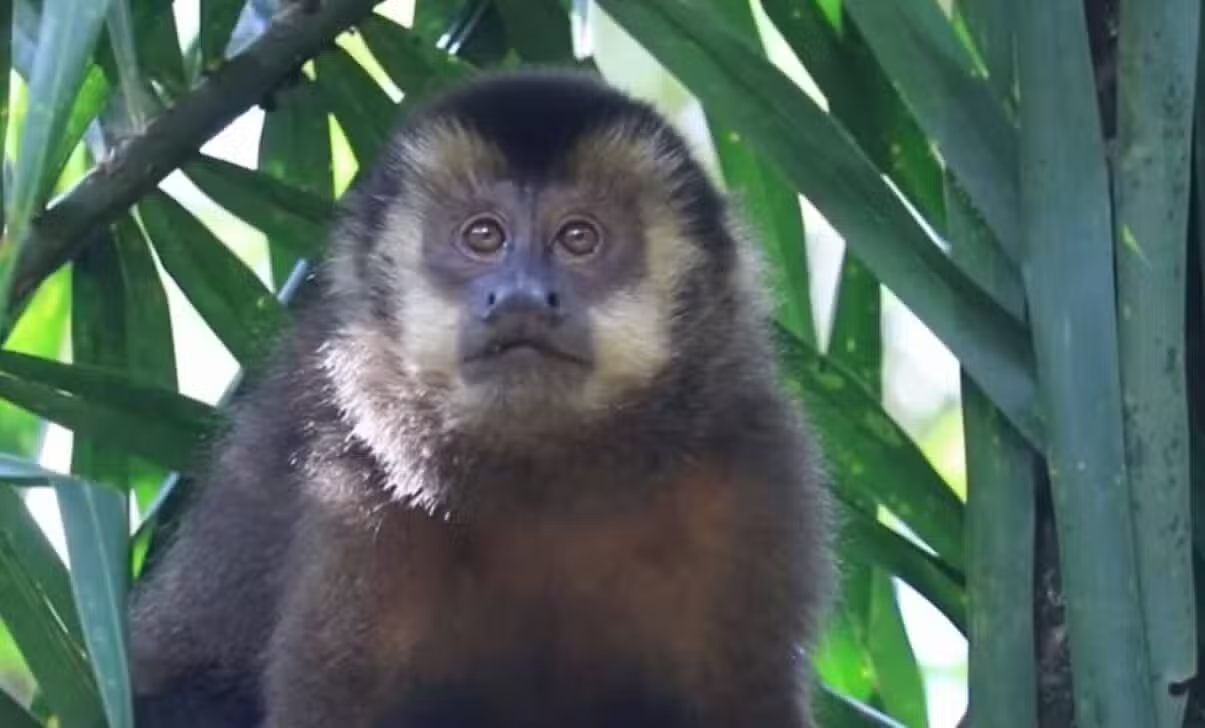
Researchers have observed alarming behavior among female capuchin monkeys in Costa Rica: the abandonment of their young. This phenomenon, previously considered rare, is directly linked to the intensification of extreme weather events, such as prolonged droughts and heat waves. A recent study, published in the journal Nature Ecology and Evolution, reveals how changes in the global climate are unbalancing the social dynamics and survival of these primates. The initial observations that triggered the alert date back to 2015, during an atypical drought driven by El Niño, in the Lomas Barbudal region.
Impact of the climate crisis on cub survival
Evolutionary anthropologist Susan Perry, from the University of California, Los Angeles, witnessed these episodes in 2015. According to Perry, capuchin monkey mothers are typically very dedicated. However, she witnessed cubs crying on the floor, abandoned, while their mothers appeared resigned and walked away. “I saw babies crying pitifully on the floor. And the mothers just looked down, like ‘too much work’, and walked away, abandoning their babies”, reported the researcher.
This unexpected behavior, which would seem impossible under normal conditions, highlights the severe stress the animals face. Perry emphasizes the urgency of paying attention to this problem, as climate forecasts point to more unpredictability and climate extremes in the future. El Niño, in particular, is one of the main drivers of these anomalies, causing droughts and intense rains that drastically alter ecosystems.
Long-term study maps capuchin monkey behavior
To understand the extent of these impacts, Odd Jacobson, a behavioral ecologist at the Max Planck Institute for Animal Behavior, led an in-depth investigation. Jacobson’s initial focus in 2016, a year after the severe drought, was to understand how Lomas Barbudal’s twelve different groups of capuchin monkeys moved through the forest. The research evolved to analyze how climate extremes affect the social structures and behaviors of these animals.
The work by Jacobson and his co-authors, including Perry, is notable for its analysis of 33 years of capuchin geolocation data, an exceptionally long period that offers a robust perspective on the correlation between climate variability and group dynamics. This extensive database has allowed scientists to trace patterns and predict changes that would be invisible in shorter studies, offering invaluable value in understanding the long-term impact of global warming.
The team of researchers established a detailed methodology to understand the relationship between group size and interactions within and outside them. Initially, variables such as daily fruit intake, the size of the group’s home range and the distance traveled daily to find food were observed. To analyze the interaction between the groups, a “hierarchical model of social relations” was used, which made it possible to predict the movements and territorial overlap between two distinct groups of monkeys.
This process was repeated for all twelve capuchin monkey colonies in the Lomas Barbudal region. Later, the climate data layer was added, allowing scientists to predict how overlapping home ranges and encounter rates (times of interaction, often violent, between capuchins from different groups) would change with the seasons.
Social dynamics of capuchin monkey groups under environmental pressure
Generally, larger groups of capuchins present both advantages and disadvantages in the forest environment. One of the main advantages is the ability to control resource-rich areas, such as fruit tree patches. On the other hand, the main disadvantage lies in the increased competition for food within the group itself, which results in a lower daily fruit intake for each individual. The research revealed that during periods of climatic extremes, whether intense drought or excessive rainfall, this intra-group competition increases. Such intensification makes the group less efficient in the general search for food, compromising the well-being of its members.
Behavior between groups also undergoes significant changes with climate change. In a typical dry season, for example, larger groups often dominate smaller ones to take control of areas with greater fruit availability, such as riverbanks. However, the new study made a surprising discovery: during extreme weather events, such as a dry season exacerbated by the effects of El Niño, capuchin monkeys did not try to accumulate resources in the best quality areas.
“We don’t know exactly why,” admitted Jacobson. He speculates that “perhaps there isn’t as much heterogeneity in the landscape during these periods of resource scarcity, and so there isn’t much that larger groups can monopolize.” This observation challenges established notions about group dynamics in stressful environments.
Consequences in other species and the importance of research
The research suggests that climate extremes may be throwing off the optimal size for monkey groups. With global warming intensifying events such as El Niño and La Niña, it is crucial to understand how these changes will affect animal societies in general.
Other species are also suffering from the effects of the climate crisis. Filippo Aureli, an ethologist at Universidad Veracruzana in Mexico, although not involved in this study, has investigated the effects of extreme weather events on spider monkeys in Mexico. He also recorded the infant mortality rates of capuchin monkeys and spider monkeys in the tropical dry forest of Costa Rica during the 2015 drought. While capuchin monkey populations had high infant mortality, spider monkey populations showed a tendency to stop reproducing, demonstrating different response strategies to environmental stress.
The importance of baseline data is highlighted by Perry. “We know what’s normal,” she said. “If you try to just go into all the chaos now that we’re starting to feel across the planet, then you can’t really study it.” This underlines the need for continuous monitoring to differentiate natural variations from those induced by climate change. The impacts of climate change on animal communities are complex and multifaceted, requiring a rigorous approach to predict and mitigate its effects.
Key findings on climate impact on capuchin monkeys:
- Abandonment of offspring by mothers in periods of extreme drought.
- Intensification of competition for food within groups.
- Changes in the dynamics of territorial occupation and interactions between groups.
- Increased infant mortality in some species and reproductive cessation in others.
- Imbalance in the ideal size of primate groups.
Aureli warns that “with climate change, [weather extremes] will be more frequent and intense.” He concludes that although some species have resisted well so far, the duration of this resilience is uncertain. The results of this research underscore the critical need for continued monitoring and research to understand and, ideally, mitigate the devastating effects of climate change on wildlife.