Robotic dog climbs stairs and forests in adaptation of movements by new AI

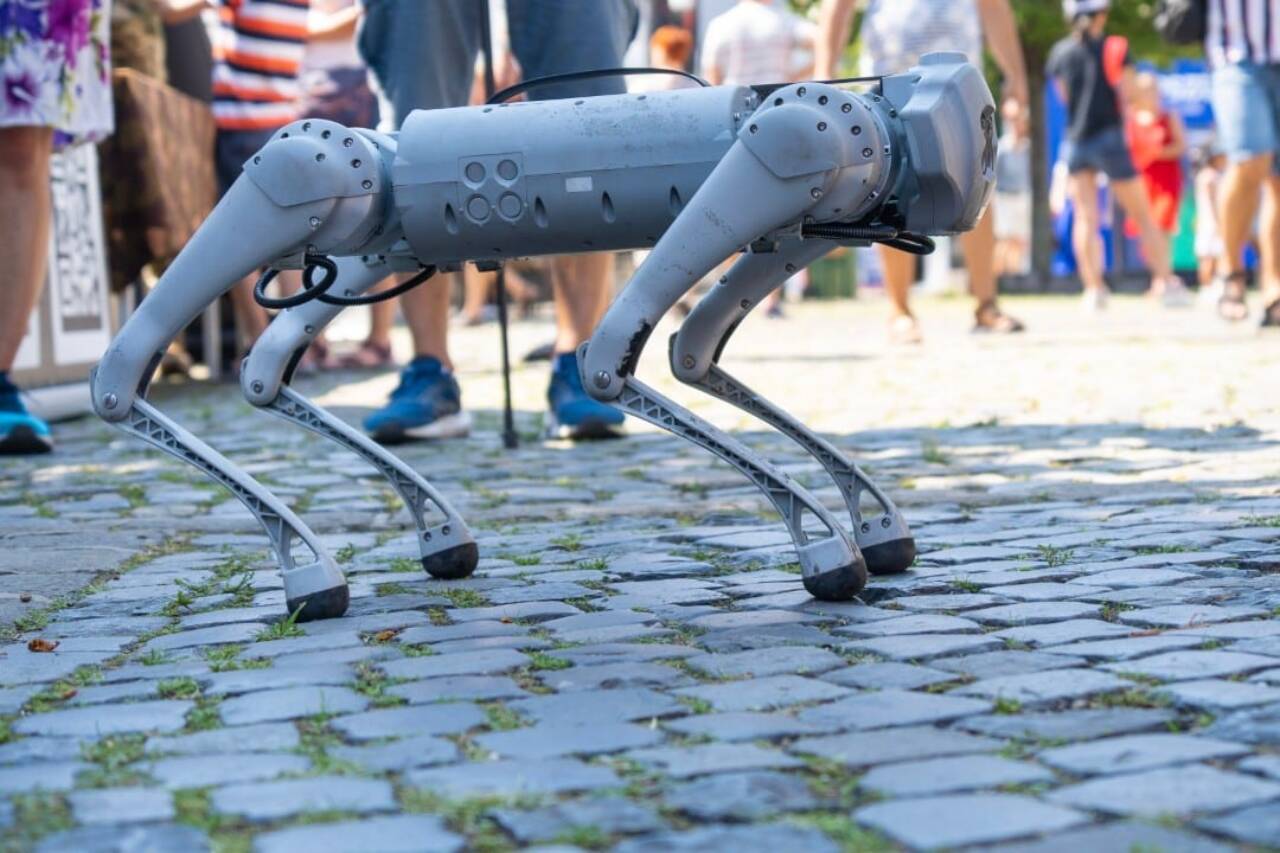
An advanced quadrupedal robot known as KAIST HOUND has demonstrated an unprecedented ability to navigate complex terrain, including stairs and forests, adjusting its movements autonomously and fluidly. The feat is the result of a new and fast artificial intelligence training technique, which allows the robotic dog to switch between different forms of locomotion without any human intervention. The research was detailed in the renowned journal Science Robotics, marking a significant advancement in robotics.
This development is a crucial step towards overcoming one of the biggest barriers in modern robotics: the ability of machines to move with dexterity and adaptability in unstructured and unpredictable environments. KAIST HOUND’s performance suggests a future where robots can operate with greater independence and effectiveness in scenarios that were previously considered exclusive to biological locomotion.
The challenge of autonomous robotic locomotion
The movement of robots in controlled environments, such as factory floors or laboratories, is already well established. However, the challenge of replicating an animal’s agility on uneven, dynamic terrain — such as a debris field, dense forest, or difficult-to-access staircase — remains complex. Traditionally, robots are programmed with specific “gears” for different surfaces or speeds.
The difficulty arises when the robot needs to quickly change from one gear to another, for example, from a jog to a jump when encountering a log. Older systems often have a delay in these transitions, which can cause imbalance and outages. This limitation has been an obstacle to the deployment of robots in missions that require high versatility and resilience.
Details of KAIST HOUND and its field tests
Weighing around 45 kilograms (100 pounds), KAIST HOUND is no small robot. It is equipped with a combination of cameras and lidar sensors, which work together to create a detailed, real-time perception of the environment. While cameras provide visual information, lidar uses pulses of light to measure distances and create an accurate three-dimensional map of the terrain, identifying obstacles and surface variations.
This fusion of sensory data allows the robot to not only detect what is in front of it, but also understand the depth and texture of the ground. This way, he can select the most appropriate gait — whether a careful trot or a vigorous jump — and adjust his movements continuously, ensuring fluid navigation even in the most adverse conditions.
- An extensive 1.1 kilometers (0.7 miles) route within a university campus, crossing paved areas and lawns.
- A 0.3-kilometer (0.2-mile) forest trail characterized by ground covered in protruding roots, fallen logs, loose rocks, and slippery leaves, simulating complex natural terrain conditions.
- A series of irregular stone stairs, requiring precision and adaptation in each step.
The intelligence behind agility: the APT-RL system
The heart of KAIST HOUND’s adaptive capability lies in an innovative training system called APT-RL (action pretrained transformer–based reinforcement learning). Unlike previous approaches that relied on manual coding and separate specialized systems for each type of movement, APT-RL adopts a more organic learning strategy, inspired by the way animals learn to move.
The technique combines two powerful artificial intelligence tools: reinforcement learning and transformers. Reinforcement learning is a paradigm in which an agent (the robot, in this case) learns to make decisions when interacting with an environment, receiving “rewards” for desirable actions (successfully navigating) and “penalties” for undesirable actions (tripping or falling).
Transformers, initially developed for natural language processing, are neural network architectures capable of identifying complex patterns and long-distance relationships in large volumes of data. In APT-RL, they are used to analyze a wide range of example actions and understand transitions between different gears, allowing the robot to generalize and apply this knowledge to new situations. By integrating these two technologies, researchers created a system capable of learning to adapt its way of walking in a continuous and natural way, minimizing delay and the risk of failures during transitions.
Open horizons: applications and the future of quadrupedal robots
KAIST HOUND’s ability to quickly adapt to varied environments represents a significant advancement for robotics, extending the performance potential of these machines far beyond their usual controlled domains. Previously, robots with quadrupedal locomotion were more effective on predictable surfaces. With this new technique, they can be used in missions that require high versatility and resistance.
- Search and rescue:In disaster scenarios, such as after earthquakes or floods, KAIST HOUND can navigate through unstable rubble, locate victims, and even transport small equipment essential for rescue teams to access dangerous or human-inaccessible areas.
- Inspection and maintenance:To inspect critical infrastructures such as pipelines, bridges, oil platforms or even nuclear plants, the robot can travel over uneven terrain, collecting visual and sensory data without putting human lives at risk.
- Logistics and transport:In industrial environments or warehouses with obstacles, the robot can optimize load movement, especially in factories that do not have perfectly flat floors or that constantly change their configuration.
- Scientific exploration:In cave mapping missions, exploring archaeological sites or collecting samples in hostile environments, the robot offers a robust and autonomous platform capable of collecting valuable data.
This development not only increases the autonomy of robots, but also improves safety and efficiency in a range of sectors, bringing the reality of machines that interact with the real world in an increasingly natural and reliable way.
Scientific validation in the journal Science Robotics
Research detailing the KAIST HOUND robotic structure and the APT-RL technique was published in Science Robotics, one of the most respected and influential scientific journals in the field of robotics. Publication in a peer-reviewed journal of such caliber lends great credibility to the researchers’ work.
The peer review process ensures that study methods, results, and conclusions are examined and validated by other experts in the field before release. This ensures the scientific robustness of the discovery, confirming the originality and importance of the technological advancement for the global robotics and artificial intelligence community. The publication in Science Robotics therefore highlights the relevance and innovative potential of the work developed by the responsible team.