Egyptian archaeologists have made a remarkable discovery by unearthing 18 ancient tombs, containing dozens of golden “tongues”, at an archaeological site on Egypt’s Mediterranean coast. The research revealed these findings in an excavation that caught the attention of experts.
At least two human skeletons were located during work at the site, although there is no confirmation on the application of mummification techniques. The practice was common in ancient Egypt, but the status of these specific finds remains under review.
Recently, a team of archaeologists found the 18 tombs in a city located near the Mediterranean Sea, in Egypt. The discovery adds new information about the region.
The funerary structures, identified in Marina el-Alamein, approximately 100 kilometers west of the city of Alexandria, date from the Ptolemaic period (322 to 30 BC) or the Roman era (30 BC to 395 AD). The information was confirmed by the Egyptian Ministry of Tourism and Antiquities in an official statement.
Egypt, in the Ptolemaic phase, was governed by successors of one of Alexander the Great’s generals. The Roman period began after the death of Cleopatra VII, when Egyptian territory was integrated into the Roman Empire as a province.
Eleven of the tombs were excavated in deeper layers of soil, while the remaining seven were in shallower spots. Among the various artifacts found, 24 “golden tongues” stand out, which were possibly inserted into the mummies’ mouths, and an offering altar with a carved base to simulate a false door.
Hesham Hussein, undersecretary for archeology of Lower Egypt and Sinai, highlighted that the “false door” represents one of the oldest features of Egyptian funerary architecture. He explained that, for the ancient Egyptians, this element served as a connection between the earthly plane and the beyond, allowing the deceased to receive offerings from the living.
Hussein added that the presence of a false door carved into the altar indicates the permanence of the symbolism of this element, even with changes in architectural function over time.
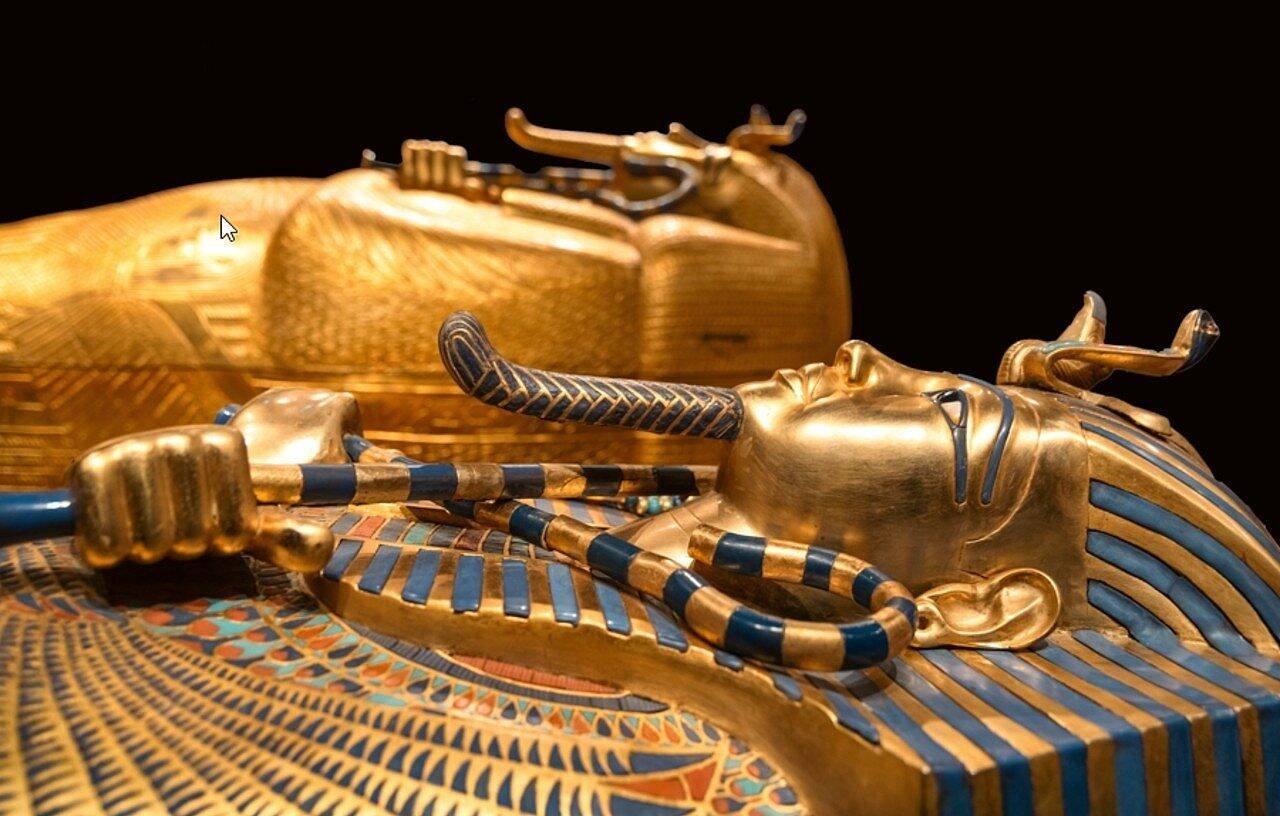
The Meaning of Golden Tongues in Ancient Egypt
Artifacts shaped like golden tongues have been found in mummies in several Egyptian locations. Gold was seen by the ancient Egyptians as the “flesh of the gods”, and the belief was that these languages helped the dead communicate with deities in the afterlife.
According to Hesham Hussein, “golden tongues” are a known feature in burials from the Ptolemaic and Roman periods in Egypt. They are interpreted as funerary amulets that would allow the deceased to communicate in the afterlife, especially during the trial before Osiris, or to recite sacred formulas in the afterlife.
Interestingly, one of the newly discovered golden tongues is shaped like the “Eye of Horus.” Horus, a deity associated with heaven and war, was represented with the head of a falcon. Artifacts shaped like his eye are common in Egypt and were used as protection against evil, according to the ministry’s statement.
Attilio Mastrocinque, a retired archeology professor at the University of Verona in Italy, has raised doubts about whether some of the artifacts are in fact golden tongues. He, who has extensive work on Greek and Roman religion, did not directly participate in this excavation.
After analyzing the images released by the ministry, Mastrocinque pointed out that one of the pieces resembles an ear of wheat. Images of ears of wheat were symbols of fertility and were quite popular in ancient times. He noted that the artifact bears resemblance to silver ears of wheat found in Roman shrines in Europe.
Questions about the altar with the false door
False doors are frequent features in ancient Egyptian tombs, and offering altars are often positioned nearby. In this find, the base of the offering altar has a shape that resembles a false door.
Krzysztof Jakubiak, professor of archeology at the University of Warsaw, who has already worked on excavations at Marina el-Alamein, but not the recent one, indicated that the discovery requires additional analysis.
Jakubiak expressed caution in drawing a direct comparison between the altar motifs and the false doors’ iconography. He suggested that the altar may not have been finished, and its current form may just be an accidental similarity.
Hala Mostafa, professor of archeology at Ain Shams University, expressed the belief that the altar could symbolize the “offering” hieroglyph, rather than a false door.
Additional finds, including a statue of Aphrodite
One of the tombs revealed an 8-foot-long granite sarcophagus, which had its lid intact at the time of discovery. Currently, the team is investigating the remains located inside.
Among other discoveries, there is an unfinished statue of Aphrodite, a Greek deity linked to love and beauty. During the Ptolemaic dynasty, Greek culture and religion gained significant popularity in ancient Egypt. Mastrocinque considered it relevant to investigate the existence of a structure dedicated to Aphrodite in the vicinity of the statue.
For Mastrocinque, “it is essential to know where this statue was found”, questioning whether there was any smaller place of worship for Aphrodite within the funerary complex.
Dorota Dzierzbicka, director of the Polish-Egyptian Archaeological Mission in Marina el-Alamein, highlighted that the recent discoveries, added to previous findings, indicate that the city was a “culturally diverse community”. In it, Egyptian and Greco-Roman traditions coexisted and were integrated both in daily life and in funerary practices. She also mentioned that the new revelations were made by Egyptian archaeologists working at the site.