Artificial intelligence enables robot dog to climb stairs, explore forests and jump over obstacles

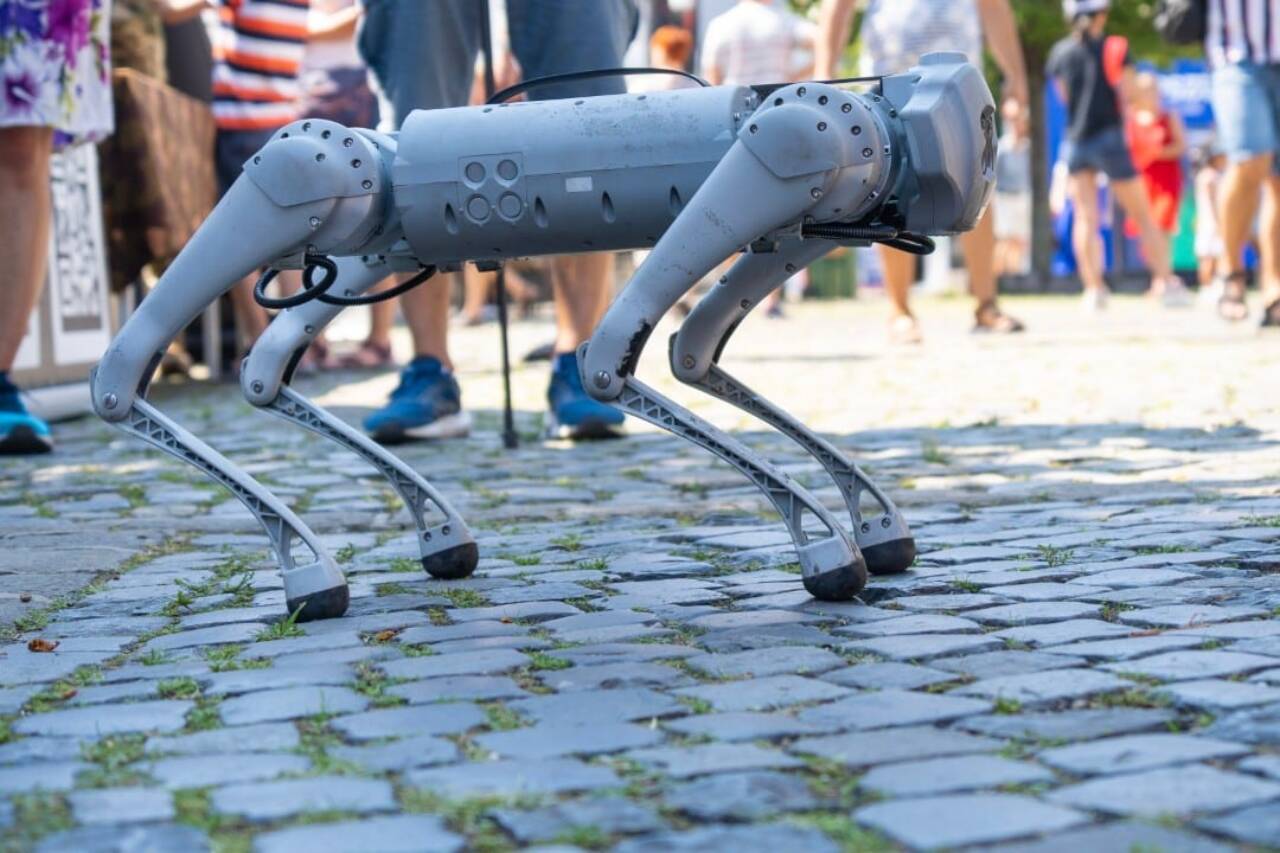
A quadruped robot demonstrated the ability to change its locomotion mode autonomously, adapting to challenging environments such as forests, staircases and routes with various obstacles. The machine can switch between a stable trot and a faster, bouncier stride without human intervention, marking a significant advance in robotic autonomy.
Known as KAIST HOUND, this 100-pound robot uses cameras and lidar technology to scan the terrain in front of it. Based on this data, it selects the most suitable gear and adjusts your movements in real time. In tests carried out outdoors, the robot successfully covered a 1.1 kilometer stretch on a university campus and a 0.3 kilometer forest trail, facing roots, trunks and slippery leaves. The researchers detailed the robotic architecture July 15 in the journal Science Robotics.
Adaptability in robot locomotion and its training technique
The ability of animals to change their gait depending on speed and terrain is a natural behavior — a dog, for example, may trot cautiously on uneven ground before jumping over a branch. Replicating this adaptability in robots is a challenge, as different movements are usually controlled by different coding systems, and the transition between them can cause delays and imbalance in the robot.
To overcome these difficulties, researchers developed an innovative training method called reinforcement learning based on pre-trained transformers in action (APT-RL). This artificial intelligence system is designed to study vast examples of actions, use a transformer to identify patterns in those actions, and then optimize performance through a system of rewards and penalties.
The training process began with a simplified two-dimensional computational model of the robot. Employing trajectory optimization – a technique that calculates physically feasible movements for the robot – the team generated an impressive 180,000 short sequences of trots and jumps. These sequences included the joint forces required for the robot’s legs and represented approximately 15.5 hours of movement, created in just eight minutes.
During the reinforcement learning phase, the artificial intelligence learned to choose and adapt these skills, navigating simulations of stairs, rocks, obstacles, gaps and rough terrain through trial and error. This is a crucial element that adds value to the news, showing the efficiency and adaptability of the system.
In digital simulations, the robot dog went beyond simply copying previously recorded movements. It demonstrated the ability to perform corrections for three-dimensional terrain and respond to unforeseen situations, such as jumping over a log, a behavior that was not part of the original training data for flat terrain.
The researchers later configured the system to integrate the robot’s depth camera and lidar scanner directly into the simulation, enhancing its perception of the environment.
In an indoor test, HOUND overcame a 60-centimeter-high obstacle, briefly reaching a speed of 15 km/h. The robot also managed to climb down a three-step staircase. It was observed that he generally chose to trot at lower speeds and on uneven terrain, while jumping became more frequent at higher speeds or when encountering steps, obstacles or larger gaps. The version of the AI system that could freely choose between gears showed more consistent performance across different simulated environments, compared to versions restricted to just jogging or jumping.
The researchers suggest that this technology has the potential to assist robots in navigating disaster zones or other locations that are difficult for wheeled machines to access, highlighting the practical impact of this innovation. However, the current structure of KAIST HOUND only allows for two gait options and focuses primarily on forward movement. Rapid turns, lateral movements and other behaviors such as crawling remain next goals for the research team. This point represents “what is not yet known”, providing a complete overview of the research.