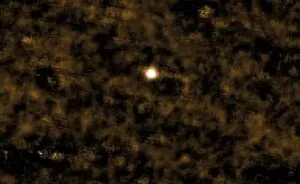
Interstellar object 3I/Atlas defies physics by braking near Mars

An astronomical event recorded in October 2025 is forcing the scientific community to rethink the laws of orbital mechanics. The celestial body 3I/Atlas, classified as the third interstellar visitor to cross our Solar System, showed unprecedented behavior by interrupting its movement for several days while orbiting Mars. NASA experts, who monitor the object’s trajectory, confirmed that the anomaly is not a failure in measuring equipment, but rather a real phenomenon documented by several probes and telescopes. The abrupt break in inertia transformed the neighborhood of the red planet into a true astrophysics laboratory, raising questions about invisible forces acting in deep space.
Before the arrival of this new celestial body, only the enigmatic ‘Oumuamua (1I) and comet Borisov (2I) had been confirmed as intruders from other corners of the galaxy. However, none of its predecessors presented such challenging behavior for theoretical physicists. The star’s temporary standstill requires an immediate review of the concepts that govern the movement of bodies in a vacuum, creating a historic milestone in contemporary space observation.

On the same topic: Interstellar comet 3I/ATLAS travels at 58 km/s and will have its route altered by Jupiter
Challenge to the laws of motion and confirmation of the phenomenon
According to classical physics, a body with the enormous kinetic energy of 3I/Atlas could never simply stop in the vacuum of space without the application of a colossal counterforce. The near-total standstill relative to background stars has left researchers perplexed, since the lack of friction in space dictates that objects maintain their speeds unless they interact gravitationally with much larger masses. Inertia should have guaranteed a fluid and uninterrupted passage through our planetary neighborhood.
Given the unusual situation, the technical teams carried out a complete scan of the telemetry and observation systems. After ruling out any instrumental error or optical illusion caused by the Earth’s viewing angle, the American space agency validated the data received. The proximity to Mars was a lucky coincidence for science, as the fleet of satellites currently studying the red planet served as an advanced surveillance network, capturing precious data in real time and attesting to the veracity of the cosmic brake.
Theories under debate to justify temporary immobility
To try to unravel the enigma, scientists began analyzing spectroscopic data collected during the days of inertia. The readings revealed that the star’s core had subtle vibrations, which opened the way to some intriguing hypotheses. The main one suggests that the celestial body may have undergone a type of temporary electromagnetic anchoring. As the object’s surface has a significant amount of metallic grains, it may have interacted violently with local magnetic fields or pockets of interstellar plasma, creating a natural magnetic brake.
A second line of investigation points to the visitor’s own fluid mechanics. Unlike conventional comets that eject material in a chaotic manner, 3I/Atlas may have released microplumes of gas in a perfectly symmetrical manner. This controlled and simultaneous exhaust in multiple directions would function as a spacecraft’s maneuvering thrusters, nullifying the forward vector and keeping the space rock static. Both theories show that the internal architecture of this traveler is much more complex than that of the icy boulders that inhabit the edges of our system.
Chemical analysis reveals an artifact older than the Sun
In addition to the bizarre dynamic behavior, the chemical signature of the coma — the cloud of dust and gas that surrounds the nucleus — brought surprising revelations to astronomers. The spectrometers detected a very high concentration of carbon dioxide, accompanied by almost zero levels of water. This specific proportion is a strong indication that the star was forged in the most extreme and icy regions of a very distant planetary system, where the water would be completely frozen and inactive during its formation phase.
See Also

Electrical discharge knocks man off roof in Jaguaruana after contact with power lines

Global auction raises US$11.9 million and Brazil’s historic currency reaches record value

Former fighter Prichard Colón dies at age 33 after decade in a vegetative state
More on this story: Destruction of celestial body 3I/ATLAS by solar heat reveals chemistry of distant galaxies
The dimensions of the core are also impressive, varying in estimates between 320 meters and an impressive 5.6 kilometers in diameter, all hidden beneath a dense shell of volatile material. However, the most striking fact concerns his chronological age. Cross-referencing decay and structural degradation information, astrophysicists calculate that the object is around 10 billion years old. This makes it a galactic fossil that predates the formation of our Sun itself, carrying intact secrets about stellar genesis in the early universe.
- The coma has massive levels of carbon dioxide, completely different from local comets that are rich in water vapor.
- An estimated 10 billion years old, the celestial body acts as a time capsule, preserving the youthful chemistry of the cosmos.
- Despite the unpredictable route and sudden stops, trajectory calculations ensure that there is no risk of collision with planet Earth.
Forced update to astronomical simulation software
The unplanned rest of 3I/Atlas highlighted a critical gap in the tools humanity uses to map the cosmos. Until now, orbital simulation software has relied almost exclusively on the laws of gravity to trace the path of threats or space visitors. Now, programmers and theoretical physicists are racing against time to insert non-gravitational interaction variables into their source codes, seeking to predict similar anomalies in the future.
This methodological review will be vital for planetary defense protocols and long-range exploration. If electromagnetic forces or symmetric gas emissions can stop a kilometer-wide object, hazardous asteroid interception calculations will need a completely new margin of error. The event makes clear that deep space still harbors force dynamics that modern science has barely begun to understand and catalogue.
The final itinerary before saying goodbye to the Solar System
After the period of stagnation that intrigued the world, the celestial body resumed its cosmic journey at its normal speed. The new trajectory points directly towards perihelion — the point of closest approach to the Sun —, which is mathematically scheduled for October 29, 2025. This dive towards our mother star is expected to further heat the object’s surface, possibly generating new gas emissions that will be closely monitored by ground-based observatories and space telescopes.
Learn more: Radio emissions from comet 3I/ATLAS make NASA activate planetary defense system
The system’s escape route includes strategic passages to other giant planets to gain momentum. In November 2025, the star will cross the orbit of Venus, using the planet’s gravity to accelerate. It will then make its last major appearance near Jupiter in March 2026. The gas giant will serve as a final cosmic slingshot, hurling 3I/Atlas back into the interstellar void and ending one of the most spectacular visits ever documented by humanity.