

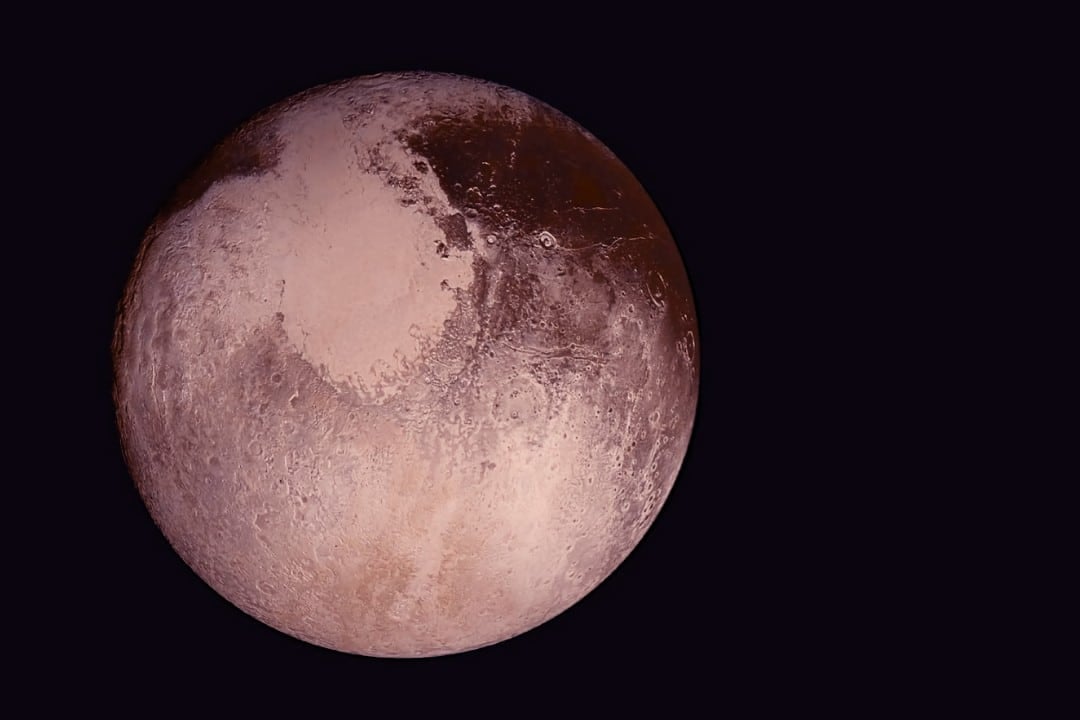
New evidence indicates that Pluto, considered an icy and inactive world, has more intense geological activity than previously imagined. A recent study, published in the scientific journal Icarus, reveals the discovery of large landslides on the surface of the dwarf planet. The surprising findings were released on Friday, July 17, 2026, and reinterpret data collected by the New Horizons probe in 2015, suggesting that the dwarf planet is not a geologically “dead” celestial body.
Discovery of multiple occurrences in distant craters
Scientists who analyzed images from New Horizons identified the presence of six landslides in specific areas of Pluto. The phenomena were observed on the inner walls of the Coughlin and Giclas craters, as well as a third crater that does not yet have an official name. All of these geological formations are located on the western edge of the region known as Sputnik Planitia, a vast basin of frozen nitrogen.
The marks left by debris on Pluto’s terrain
The landslides analyzed left a significant trail of debris, which spread across the crater floors. The material traveled considerable distances, varying between 10.1 and 14.5 kilometers from its points of origin. The images, captured by the probe’s LORRI (Long-Range Reconnaissance Imager) instrument, were able to detect structures on the surface with dimensions starting at 300 meters, allowing detailed analysis.
- They have a very irregular surface, suggesting the existence of large blocks of solid ice mixed with the debris.
- In the areas where the material detached, well-defined concave cliffs are visible, indicating the exact point of separation of the material.
- The largest of the deposits identified covered an area of 130 square kilometers, an area that could cover a medium-sized city.
Pluto may have more geological activity than previously imagined
The discovery of these landslides is a strong indication that Pluto is not a geologically dead planetary body. Although similar events have already been recorded elsewhere in the solar system, such as Mars, this is the first time such phenomena have been documented on the dwarf planet. This type of activity suggests the presence of dynamic internal or surface processes that continue to shape its icy landscape, which expands understanding about the evolution of distant celestial bodies.
The mystery behind the causes of landslides on Pluto
Even though the occurrence of the landslides is confirmed, the team responsible for the study points out that the exact cause of these phenomena remains a mystery. Different hypotheses are being investigated to explain the origin of these earth movements on Pluto, an environment so different from Earth’s.
One possible explanation for the slide in Coughlin Crater suggests that it may have been triggered by a smaller impact nearby. Another theory raises the possibility of thermal stresses in surface ice. These tensions would be generated by small, but continuous, temperature variations that cause the sublimation and periodic condensation of Pluto’s volatile materials, such as molecular nitrogen, carbon monoxide and methane. These state change cycles could destabilize the slopes and generate landslides.




