
T. rex auction at Sotheby’s raises debate about the future of science and valuable fossils

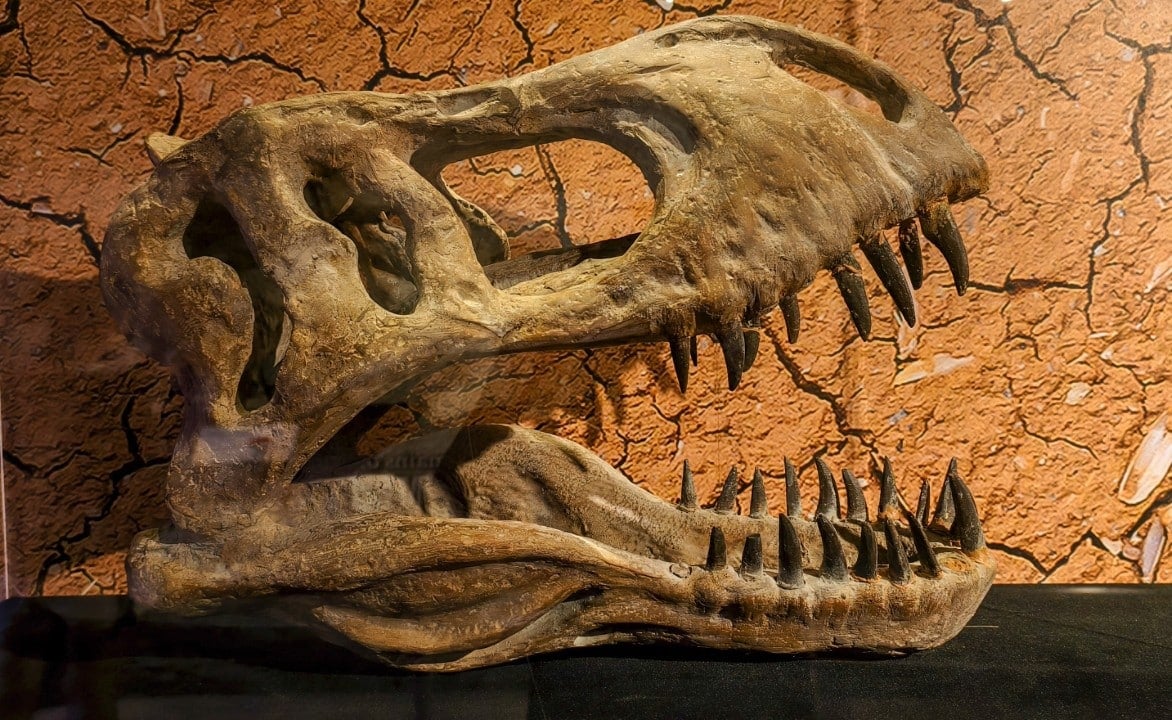
The auction house Sotheby’s began bidding on several rare fossils on Tuesday, July 14, with emphasis on the skeleton of a 67-million-year-old Tyrannosaurus rex. The specimen, named Gus, is considered one of the largest and most complete T. rexes ever discovered. Gus is expected to fetch up to $30 million, but its sale, regardless of the buyer, intensifies the debate about the growing acquisition of fossils by private collectors and the impact of this trend on scientific research and public access.
The scientific importance of dinosaur fossils
Gus’ discovery, made on a ranch in South Dakota, revealed a “spectacular” specimen, according to Thomas Holtz, a tyrannosaur expert at the University of Maryland. With 183 fossilized bone elements, representing about 61% of the complete skeleton, Gus is considered “scientifically significant” for the quality and integrity of his bones. Fossils like this are crucial to paleontology, as they provide invaluable information about the evolution of life on Earth, the biology of extinct species, prehistoric ecosystems, and even climate change over millions of years. They are like windows into the distant past, essential for understanding our own planet.
The advancement of private collectors in high-value auctions
The trend of dinosaur fossils being auctioned in the United States gained momentum in 1997, when Sotheby’s auctioned Sue, the most complete T. rex ever recorded at the time, for around $8.4 million. Cassandra Hatton, vice president and head of Sotheby’s science and natural history department, explained that Sue’s sale helped clarify property law in the US: whoever owns the land owns the fossils found on it, unlike in many other countries where the state owns it. Since then, the fossil market has grown exponentially, driven by the appreciation of these pieces as luxury assets and the attention of auction houses.
Stratospheric prices and the disadvantage for public institutions
In recent years, the scales have tipped considerably toward ultra-wealthy individuals, who often outbid museums and research institutions. This disparity in purchasing power has driven rare fossils into private collections, making them inaccessible for study and public display. Recent examples include:
- The sale of a Stegosaurus named Apex to hedge fund billionaire Ken Griffin for $44.6 million in 2024.
- The acquisition of the world’s only known juvenile Ceratosaurus by an anonymous buyer for $30.5 million the previous year.
These astronomical values prevent most museums and universities, with limited budgets, from competing effectively at auctions, resulting in the loss of material vital to science. A 2025 study revealed that there are more T. rex fossils in private collections than in public collections.
The impacts of fossil privatization on knowledge and education
When fossils of great scientific relevance are acquired by private collectors, the implications go beyond simple ownership. There is a significant loss to society on several levels:
- Search access:Paleontologists and other scientists may be denied access to crucial specimens, limiting their ability to conduct detailed studies, make new discoveries, and deepen knowledge about prehistoric life.
- Public education:Fossils in private collections are often not displayed in museums, depriving the public, especially children and students, of the opportunity to see these natural wonders up close and learn about the planet’s history.
- Future inspiration:Exposure to these ancient remains in public environments inspires new generations of scientists, historians and enthusiasts, an impact that is minimized when the pieces are kept in private collections.
- Data integration:The fragmentation of data between different private collections prevents researchers from building a complete picture of biodiversity and evolution.
The sale of Gus at Sotheby’s reinforces the discussion about the balance between the commercial value of historical pieces and their irreplaceable importance as scientific and educational heritage of humanity.





