
Evidence of lost wind is detected in Sagittarius A*, the Milky Way’s black hole

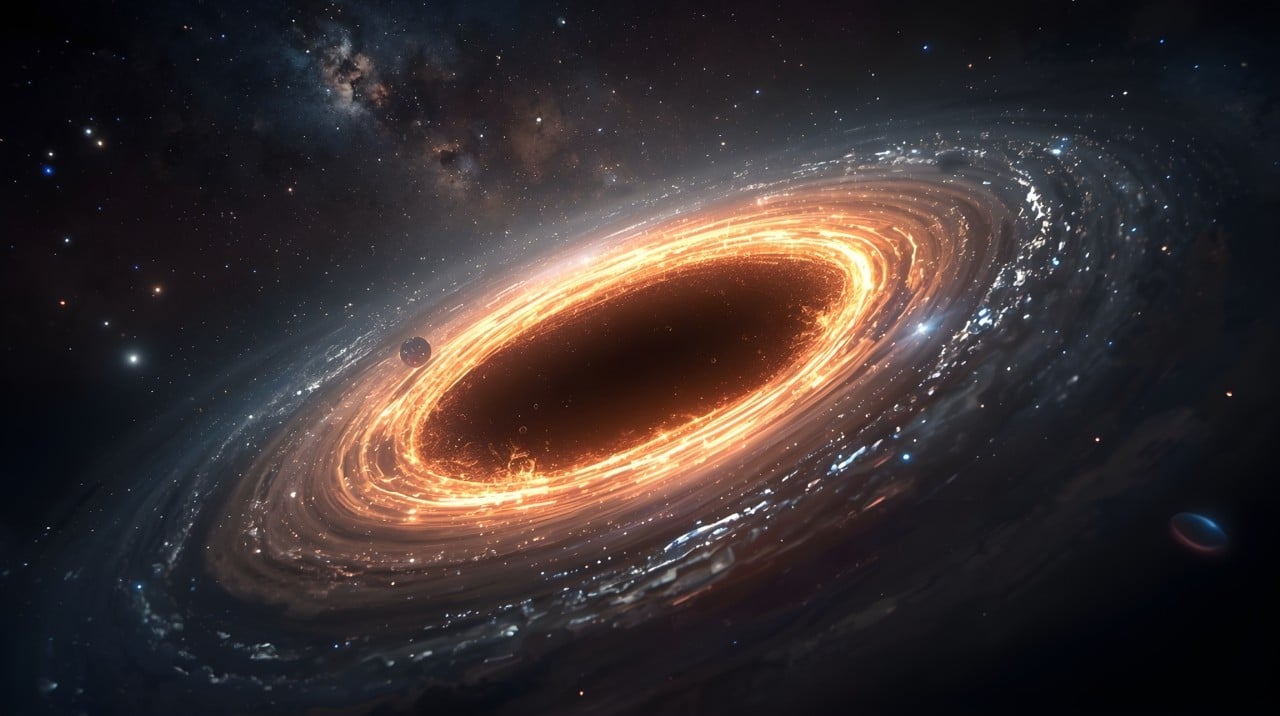
New research reveals the detection of evidence of a cosmic-scale flow of particles emanating from a supermassive black hole located in the core of the Milky Way, as announced on Tuesday, June 16, 2026. This discovery could solve a puzzle that has intrigued the astronomical community for decades.
Sagittarius A*, a colossal formation that weighs the equivalent of 4 million solar masses, has been an object of fascination and perplexity to scientists for more than half a century. Cosmological theories indicate that black holes not only absorb matter, but should also eject some of it in the form of winds or energetic jets. However, Sagittarius A* contrasted with this expectation, remaining mysteriously inactive. Despite extensive research over the last few decades, the only evidence of wind emissions went back to periods longer than 20,000 years, with no records of recent activity, which made the object a fundamental anomaly for understanding black holes in general.
Mark Gorski, assistant research professor at Northwestern University in Evanston, Illinois, highlighted the Sagittarius A* singularity as the closest and most thoroughly analyzed black hole. According to him, despite being the only one that allows you to observe its surrounding physics in high resolution, the apparent absence of a wind was a significant paradox, since the majority of black holes in the cosmos exhibit such behavior.
After a five-year period of intense observations, Gorski, in collaboration with Lena Murchikova, also an assistant professor of physics and astronomy at Northwestern, said they discovered evidence of the wind that was absent. Using a highly detailed graphical representation of the region surrounding the black hole, the two researchers identified an extensive conical formation, notably empty of cold gas.
According to the researchers, both co-authors of a detailed study on the discovery, published on June 4 in The Astrophysical Journal Letters, the existence of this structure can only be explained by the action of a flow of hot gas emitted directly from the black hole itself.
“The wind emanating from the black hole operates in a similar way to a hair dryer,” said Gorski. He explained that this current of hot, turbulent air acts on colder, denser matter, removing and heating the surrounding gas without completely disintegrating it. In this way, the hot gas in the flow left an evident mark when dispersing the cold gas nearby, as pointed out in the study.

The role of energy flows in galactic growth
Similar energy flows, manifesting as concentrated jets or expansive winds, have been observed in supermassive black holes located at the centers of other galaxies. Christopher Reynolds, a professor of astronomy at the University of Maryland, College Park, who was not involved in the study, emphasized that these flows are essential to how black holes transfer energy to their respective galaxies and control their development.
In his assessment, Reynolds noted that detecting these flows in our own supermassive black hole was historically challenging, but that situation has changed with the new research. He described the study as presenting compelling evidence that a wind originating in Sagittarius A* spread through the surrounding gas and dust. Although scientists have not directly visualized the wind, its existence is unquestionable, a result that required a meticulous analysis of almost five years of data from the most sensitive radio telescope on the planet, constituting an extraordinary feat.
Understanding the Characteristics of Black Holes
Black holes are cosmic objects whose gravitational force is so intense that not even light can escape their domain. Most large galaxies harbor a central supermassive black hole, with masses that can be billions of times greater than that of our Sun. While smaller black holes are the remnants of massive stars that have died, the origin of supermassives is still a topic of intense investigation and little understanding.
The event horizon marks the point of no return for a black hole, from which nothing can escape. However, the material that orbits these celestial giants can heat up and radiate energy as a result of friction and powerful tidal forces, generating radio waves and
Using the advanced Atacama Large Millimeter/Submillimeter Array (ALMA) radio telescopes located in Chile, Gorski and Murchikova created the most accurate map ever made of the cold gas surrounding Sagittarius A*. After eliminating all radio interference emanating from the object, the resulting image revealed a vast cavity, measuring approximately 3 light-years in length and with an opening angle of 45 degrees, that converges directly towards the black hole.
The research team later employed NASA’s Chandra X-ray Observatory to see whether the cold gas in that area was being shaped by hot plasma, i.e., electrically charged gas, that originates from the galactic center. Gorski explained that a strong correlation between cold gas and hot plasma would be non-existent if one were not in direct relationship with the other. He added that although they did not observe the wind particles in direct motion, they were able to determine their direction and energy.
Gorski pointed out two fundamental reasons for the delay of more than fifty years in confirming the existence of this wind, since the first observation of Sagittarius A* in the 1970s. Firstly, technological equipment has only recently reached the necessary capacity to penetrate the interstellar gas and dust that lie between the Earth and the galactic center. Secondly, Sagittarius A* is going through a phase of less activity, which makes its wind weaker and, consequently, more difficult to detect, a cyclical behavior common in supermassive black holes, which vary their intensity depending on the availability of matter.
“Our findings demonstrate, in essence, that this black hole also expels a wind, which aligns it with expectations from black hole physics in general,” Murchikova said. She added that detection was a challenge due to the extreme weakness of the wind, something unprecedented in previous observations of flows from these cosmic objects.
Murchikova highlighted that although observations of supermassive black holes in distant galaxies have revealed the presence of extremely powerful jets, such manifestations are infrequent. In most cases, these objects remain in a condition of relative calm, emitting only a gentle “breeze”, whose identification is more complex due to the absence of spectacular events.
The researchers’ next step includes expanding the cold gas mapping to cover a larger area, allowing for a more complete analysis of the wind’s impact. The group also aims to create an “animation” of the movement of the gas as it approaches the black hole, in order to monitor the dynamics of the clouds and quantify the volume of gas that the black hole absorbs.
Impact of the revelation on the study of black holes
There are still many unknowns about the mechanisms by which supermassive black holes expel winds, but the current hypothesis suggests a relationship with the interaction of magnetic fields that rotate around the object as the gas orbits. This explanation was put forward by Dan Wilkins, a research assistant professor in the astronomy department at Ohio State University, who was not part of the research.
In his statement, Wilkins noted that the detection of evidence of winds driven by black holes in our own galaxy offers an innovative perspective for understanding their generation. Furthermore, the discovery reaffirms that supermassive black holes continue to project winds into their host galaxies, even during less active phases of accelerated growth.
Priyamvada Natarajan, professor of Astronomy and Physics at Yale University, who was not involved in the study, classified as “exciting” the confirmation that the central black hole of our galaxy finally exhibited the activity of jets and winds, phenomena already known in physics and frequently observed in other supermassive black holes.
Natarajan highlighted that Sagittarius A* represented, for a long period, a source of great frustration in the astrophysics of the galactic center. Despite its proximity allowing for extremely detailed studies, it remained recalcitrantly inactive, with no evidence of winds. She emphasized that “this work completely changes that perception”, exemplifying the success of patient and thorough astronomical observation.
Despite the discovery, Natarajan added that several issues still need to be clarified, which is expected in an exploratory article. “The authors introduced a new observable variable for the scientific community, and future studies will be of great value”, he concluded.





