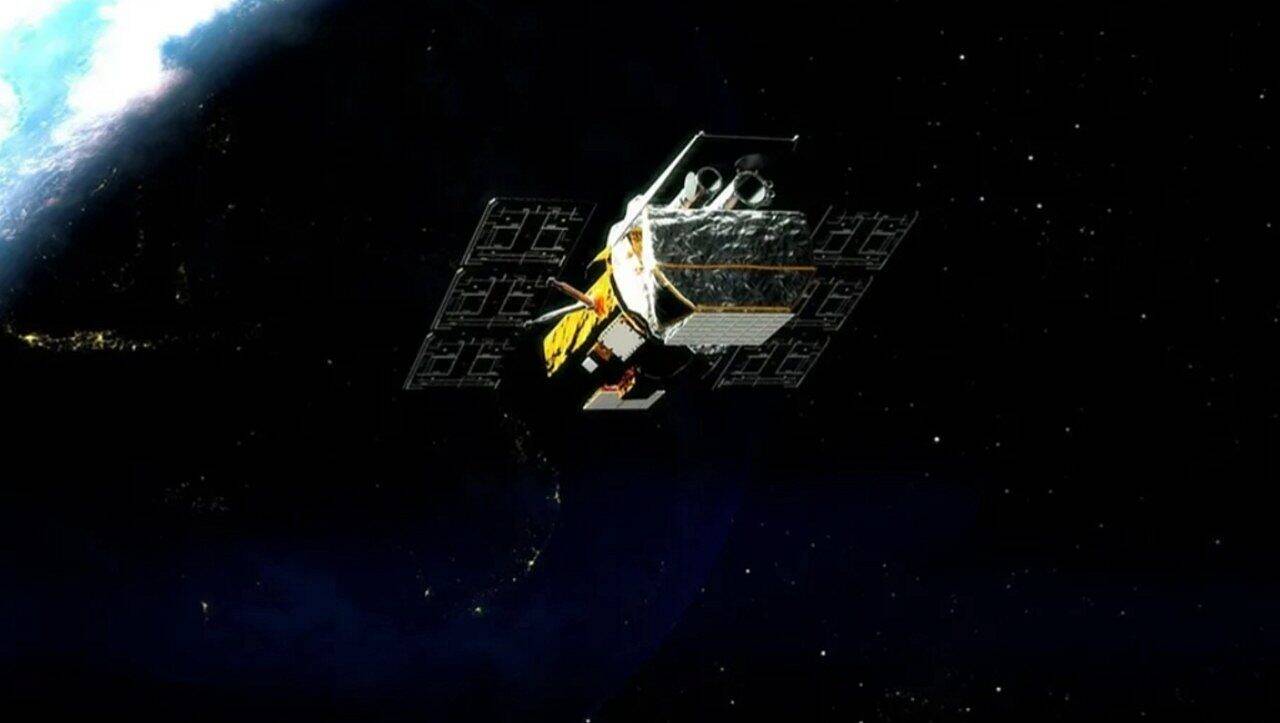
The North American space agency NASA is about to begin a complex mission to save one of its most valuable scientific instruments in orbit. Starting Thursday, an L-1011 Stargazer aircraft will take off from the Marshall Islands, 2,300 miles southwest of Hawaii, carrying a rocket that will launch the LINK probe into space. The main objective is to rescue the Neil Gehrels Swift Observatory, known to astronomers as “Swift”, one of the most productive astronomical facilities in operation today.
The Swift telescope, which has been orbiting the Earth every hour and a half for more than 20 years, is in gradual decline. Friction with particles in the upper atmosphere caused its orbit to deteriorate, and intense solar activity in recent years has accelerated this process in an unusual way. If no measures are taken, the spacecraft and its three telescopes run the risk of disintegrating in the Earth’s atmosphere in a matter of months.
To prevent the loss of Swift, NASA hired Arizona-based company Katalyst Space Technologies to develop the LINK probe. In just nine months, Katalyst needed to design, build, test and launch a satellite capable of performing an unprecedented maneuver: capturing a ship that was not designed to be repaired and then boosting it back to its original orbit. The success of the initiative will not only extend the life of Swift by decades at a significantly lower cost and time than building a new observatory, but will also set a crucial precedent for robotic maintenance in space, paving the way to extend the life of other aging satellites and optimize future investments in space exploration.
The importance of the observatory became apparent to the scientific community in February when Swift’s ability to respond to “targets of opportunity” (ToO) requests was suspended. Astronomers, who routinely ask the telescope to point out urgent celestial events such as newly discovered supernovae, have been unable to obtain crucial X-ray and ultraviolet data. Swift, despite its considerable size, has the ability to direct its instruments to any point in space in a matter of minutes, a vital resource for studying transient astronomical phenomena before their brightness fades.
The capture phase represents the greatest risk to the LINK mission. The tentative plan involves using the probe’s robotic arms to grab solid metal panels at the ends of the Swift. However, the observatory is coated with a foil-like material for thermal insulation, and the exact condition of this layer is unknown, as no one has observed it closely in the last 20 years.
Upon reaching orbit, the LINK probe will initially take a series of detailed images of Swift, in various orientations and light conditions, to determine the ideal sticking point. The impulse stage, although less risky than capture, also presents complexities. After attachment, LINK will use its ion thrusters to gradually lift the pair to higher altitudes over the course of several months. During this period, specific positioning rules will be followed to ensure the solar panels are charged and the Swift’s mirrors and instruments are protected. Once an altitude close to the telescope’s original orbit is reached, LINK will be released, allowing astronomers to resume control to restore the observatory to its crucial role in the astronomy of transient phenomena.
Transient astronomy is dedicated to the study of short-lived cosmic phenomena, such as stellar explosions known as supernovae. Originally, Swift was designed to investigate the rare “gamma ray bursts” (GRBs), second-long flashes of gamma light that come from the most energetic explosions in the universe. The telescope has already cataloged around 2,000 GRBs, transforming understanding of their origins and demonstrating that they can come from both neutron star mergers and explosions of single stars, including the first stellar generations.
Additionally, Swift has contributed to the discovery of new and surprising phenomena, driven by the flexibility of astronomers around the world to submit ToO requests with little warning. A notable example occurred in 2018, when the ground-based optical facility ATLAS identified a transient event so fast and bright that it was initially mistaken for a nearby source in the Milky Way. Liliana Rivera Sandoval, then an assistant professor at the University of Texas Rio Grande Valley, requested the Swift to reveal intense X-rays, confirming its distant and energetic nature. That event, called AT2018cow, became a prototype for a new class of transient phenomena, including events nicknamed Camel, Tasmanian Devil and Whippet, which would have taken weeks to understand without Swift.
No other current or planned telescope has the ability to simultaneously observe multiple bands of the electromagnetic spectrum at such short notice. Swift also demonstrates a remarkable willingness to take scientific risks. In 2023, 87% of its time was dedicated to ToO observations, receiving an average of five requests daily that are evaluated by a small operations team. Swift racks up more annual observation requests than any other NASA facility except the James Webb Space Telescope, and its science portfolio ranges from comets to planets in other solar systems.
Swift’s features are becoming increasingly indispensable. To date, astronomers have cataloged approximately 200,000 cosmic explosions, mostly detected by optical telescopes days or weeks after they occur. However, the scenario of discoveries is undergoing complete transformation. With the imminent commissioning of new facilities, a substantial number of transient phenomena will be discovered in unexplored regions of the electromagnetic spectrum. Examples include Israel’s ULTRASAT (Transient Ultraviolet Astronomy Satellite), to be launched in 2027, and NASA’s UVEX (Ultraviolet Explorer), scheduled for 2030, both dedicated to high-energy ultraviolet. The Rubin Observatory in Chile, opened last year, expects to discover ten times more transients than its optical predecessors. Gravitational wave detectors will also locate black hole and neutron star mergers in remote regions of the universe. The discovery of explosions just a few minutes old will become more common, thanks to facilities like the Argus Array under development in Texas.
However, simply discovering millions of potential transient phenomena per night is not enough. Swift’s presence is vital for measuring its fundamental properties, such as temperature and explosion magnitude. The telescope will also help in the exact location of these events, guiding other equipment for complementary observations and identifying those that are unusual and deserve further study. If the LINK mission is successful, Swift will gain new life at a crucial time in the advancement of astronomy.