

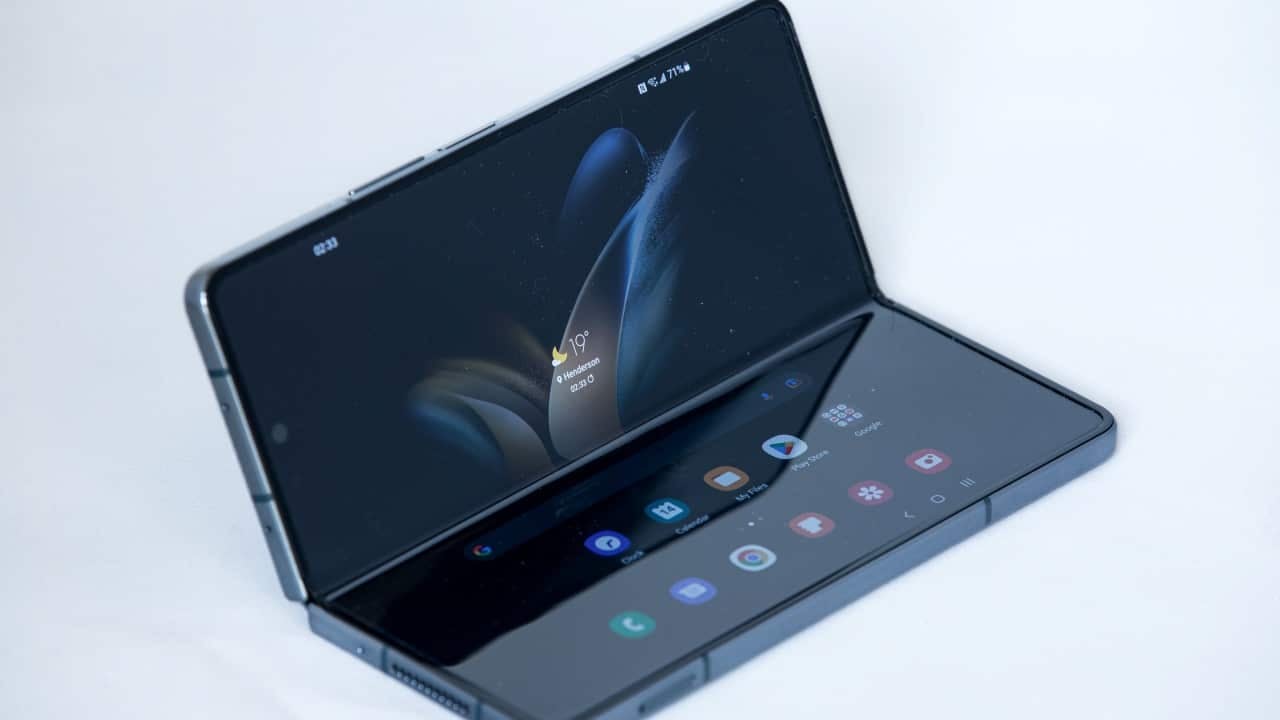
Samsung’s mid-year Galaxy Unpacked event is usually a milestone for tech enthusiasts. While the first edition of the year focuses on the Galaxy S line, the summer version is traditionally dedicated to new foldable smartphones and smartwatches, promising a presentation full of launches.
As the date of the event approaches, scheduled for next Wednesday, July 22nd, a vast volume of information and leaks have already brought to light practically all the details about what will be presented.
Innovations in durability and reduced folding in foldable screens
The last few weeks have been marked by an incessant series of leaks regarding Samsung’s next foldable cell phone models. Three new variants are expected to be launched. The main improvement in all devices should be the inclusion of Flex Titanium technology, which aims to increase the resistance of the screens and, at the same time, reduce the visibility of the internal fold.
The new Galaxy Z Flip 8 is expected as a successor to the Z Flip 7. Images and complete details about this clamshell foldable were released by specialized technology sources. Although there were expectations for a thinner device, the Z Flip 8 should be slightly thicker, but lighter, at 180 grams compared to the 188 grams of its predecessor. The other features will remain similar, except for the integration of a newer Exynos 2600 chip. Rumors indicate that the Z Flip 8 will have a 6.9-inch Dynamic AMOLED 2X internal screen with a 120Hz refresh rate, a 4.1-inch Super AMOLED external screen, and a three-camera system: a 50-megapixel main camera and a 12-megapixel ultrawide on the outside, in addition to a 10-megapixel front lens. The battery will be 4,300mAh, the same capacity, but with faster 45W charging. Storage options include 256GB or 512GB, accompanied by 12GB of RAM.
The expectation is that the Galaxy Z Fold 8 will be the intermediate model between foldables, featuring a shorter and wider format. This device is seen as Samsung’s answer to Apple’s upcoming foldable iPhone. Leaked images of the Z Fold 8 have been circulating for weeks, and now the full specifications have also been revealed by industry sources. Opened, the Z Fold 8 should be 4.5mm thick and weigh 201g. The device should come with a 7.6-inch 120Hz Dynamic AMOLED 2X internal screen and a 5.5-inch external screen. Its camera system will include two 50-megapixel rear lenses and two 10-megapixel front cameras, one on the external screen and one on the internal one. The expected processor is the Qualcomm Snapdragon 8 Elite Gen 5 for Galaxy, with storage options of 256GB (with 12GB of RAM) or 512GB and 1TB (with 16GB of RAM). The battery would have a capacity of 4,800mAh, a value considered respectable.
In the premium segment, the expectation is for the launch of the Galaxy Z Fold 8 Ultra. As the name suggests, this model should feature superior cameras, including a 200-megapixel main camera, a 50-megapixel ultrawide camera and a 10-megapixel telephoto camera with 3x optical zoom, as well as a longer-lasting 5,000mAh battery. Leaks indicate that the foldable will have its thickness reduced by 1mm (from 4.2mm to 4.1mm), but will gain 3g in weight (from 215g to 218g). The proportions of the screens will be similar to those of the Z Fold 7, with an 8-inch internal screen and a 6.5-inch external screen, both with a 120Hz refresh rate. The chipset, storage and RAM configurations should be the same as the Galaxy Z Fold 8.
New versions of smartwatches with improved batteries
In the Samsung smartwatch category, two new models are expected: the Galaxy Watch Ultra 2 and the Galaxy Watch 9. Both devices should be thinner and lighter than their predecessors, incorporating Qualcomm’s Snapdragon Wear Elite chip, accompanied by 2GB of RAM, as shown in the information obtained.
The Galaxy Watch Ultra 2, in turn, should come equipped with an 800mAh battery, representing a considerable increase compared to the 590mAh of the first generation Watch Ultra. Leaked specs include a titanium body, 10ATM water resistance, a 1.5-inch display, Bluetooth 6.0, NFC, and LTE connectivity.
The Galaxy Watch 9 should again be offered in two sizes: 40mm with a 1.3-inch screen and 44mm with a 1.5-inch screen. In contrast to the Galaxy Watch Ultra 2, the Galaxy Watch 9’s water resistance may be lower, limited to 5ATM. Improvements in battery life may be more modest annually, maintaining 325mAh in the smaller model and 445mAh in the larger version (a 100mAh increase over the Galaxy Watch 8’s 435mAh).
Apparently, Samsung will not launch a new version of the Galaxy Watch 8 Classic, a model that returned last year with a physical rotating bezel. It is possible that the smartwatch, with its more robust design, did not have the expected popularity.
Expansion of functionalities with Galaxy AI artificial intelligence
One point that seems almost certain is the announcement of new additions to Galaxy AI, Samsung’s set of artificial intelligence features. Whether bringing features already present in the Galaxy S26 Ultra to new foldable cell phones and smartwatches, the company has taken advantage of each recent Unpacked event to integrate AI into its applications. It wouldn’t be surprising to see the inclusion of more predictive AI, automations using agentic AI, and generative AI tools for photo editing. The usefulness of these new functions for the end user, however, is still a question.
Possible surprises and unexpected releases
This year stands out for the smart glasses market, and Samsung has kept its plans under wraps. Aside from a collaboration with Google that resulted in the announcement of “smart glasses” created in partnership with Gentle Monster and Warby Parker during May’s Google I/O, little additional information has been released. It is known that both models will integrate cameras for photos and videos, as well as speakers for music, calls and audio notifications, features similar to competitor AI glasses. However, the cost and privacy policies to be implemented are still unknown, the latter being a crucial aspect given the sensitivity surrounding wearable devices with recording capabilities.
Another possibility is the mention of smart rings. Would a glimpse of the Galaxy Ring 2 be possible? It’s been two years since the launch of the original Galaxy Ring. Competitors already present thinner models with greater autonomy, and other devices promise significant innovations in health monitoring, potentially replacing equipment such as blood pressure meters. It remains to be seen what Samsung’s next steps will be in this smart ring segment.





