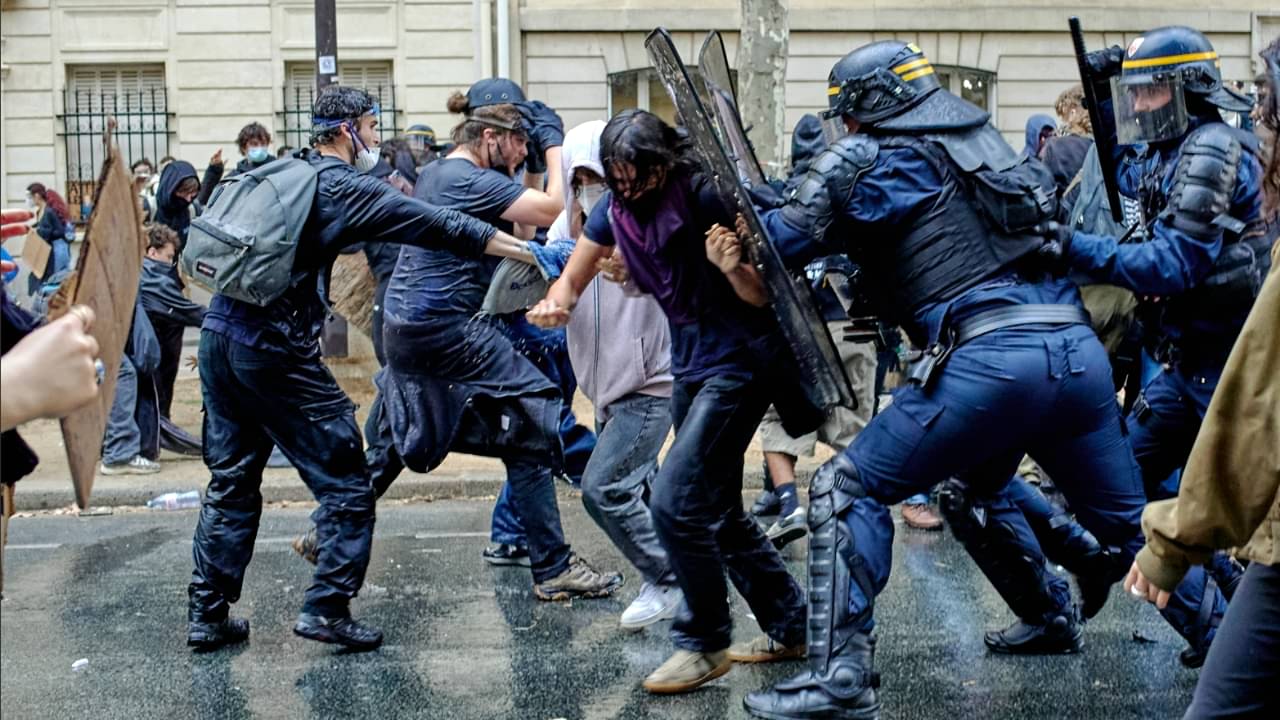
Law enforcement authorities across France detained approximately 400 people and recorded 60 injured police officers on Saturday (17) as nationwide demonstrations over purchasing power and deteriorating public education descended into urban clashes. Two of the wounded officers were transported to the hospital unconscious following violent confrontations with groups of demonstrators. French Interior Minister Laurent Nuñez stated that around 550,000 people participated in 110 registered marches across the country, including 110,000 in Paris.
Labor unions and student groups offered a higher turnout assessment for the mobilization, which brought together the General Confederation of Labor (CGT, one of the country’s largest trade union federations), high school organizations, and members of the yellow vest movement. Organizers estimated that 800,000 people took to the streets across the nation. According to Laurent Nuñez, adults with no connection to the student movement represented 90% of the roughly 400 detainees. The interior minister attributed the assaults on government buildings to radical far-left groups and opportunistic offenders who broke into and looted 270 shops across major cities, including Paris, Rouen, Nantes, Toulouse, Lyon, Strasbourg, and Marseille.
Transport disruptions in Paris and assaults on municipal buildings across France
Masked groups in Paris hurled paving stones and fireworks at security forces in the Place de la République while setting fire to cars, bicycles, trash bins, and a newspaper kiosk. Riot police responded with tear gas and water cannons to clear the square. The unrest forced major adjustments to public transit and cultural venues across the French capital throughout Saturday (17):
- Paris public transport operator RATP (the state-owned transit authority) temporarily suspended traffic on more than 10 metro lines and shut down multiple stations near government ministries and the Champs-Élysées.
- The Louvre Museum imposed a cap on visitor admissions for the day.
- The Orangerie Museum restricted entry exclusively to ticket holders with advance reservations.
Outside the capital, city halls and regional state administration headquarters—known in France as prefectures—came under attack or faced break-in attempts in Angers, Marseille, Bordeaux, Lille, Calais, and Limoges. In Angers, where 10,000 demonstrators marched, a crowd of 300 to 400 people forced its way into both the city hall and the Maine-et-Loire regional government building. A municipal employee used a fire extinguisher to put out a blaze started in the mailroom. “The entrance to the city hall was targeted. These acts are unacceptable and I condemn them with the utmost firmness,” Angers Mayor Christophe Béchu said in a statement.
In Bordeaux, rioters broke into and looted the official residence of the regional state representative, prompting the deployment of the RAID, an elite tactical unit of the French National Police. Arsonists in Lyon shattered windows and set fire to a historic tourist office, an act Mayor Grégory Doucet described as a tragedy for the city. In Limoges, flames damaged part of the town hall after an intrusion, while Lille Mayor Arnaud Deslandes reported that vandals broke into the municipal Mediation House, which offers free legal assistance to residents. In Marseille, vandals damaged the facade of the city hall, leading the national government to dispatch police reinforcements.
Police intervention at 4:30 p.m. in Toulouse and severe injury in Saint-Étienne
Demonstrations in southern and central France also resulted in severe injuries and political friction. In Saint-Étienne, Mayor Régis Juanico reported that a young man lost his hand when a grenade exploded during the local rallies. In Toulouse, turnout reached 32,000 people according to regional authorities, while labor unions counted 80,000 participants as protesters erected barricades and police cordoned off the Place du Capitole following a small fire.
At 4:30 p.m. local time, security forces moved in to halt the march in Toulouse, triggering a confrontation that left four female union leaders injured and required their evacuation from the area. Following the police charge, Cédric Caubère, secretary-general of the Haute-Garonne departmental branch of the CGT, criticized the operational command. “We hold the regional prefect and his chief of staff, as well as the prime minister, directly responsible for the orders given to the police,” Caubère said. Conversely, Toulouse Mayor Jean-Luc Moudenc used the social media platform X to accuse the left-wing party France Unbowed (LFI) and its allies within the CGT of shielding vandals.
Timeline from the 2018 yellow vest protests to the October 2026 mobilization
The demonstrations on October 17, 2026, coincided with wider European rallies against living and housing costs in Lisbon, as well as street clashes with police in Milan, Bologna, and Brussels. In France, the escalation followed weeks of high school blockades that began in September; between the start of the student movement and the eve of the national marches, police recorded more than 6,800 arrests nationwide, 86% of whom were minors. During that same period, the General Inspectorate of the National Police (IGPN, the internal affairs agency that investigates law enforcement misconduct) opened between 24 and 36 inquiries into allegations of police violence.
- 2018: The yellow vest movement emerges across France, initially triggered by fuel tax hikes during President Emmanuel Macron’s first term in office.
- September 2026: High school students in the northern suburbs of Paris launch school blockades over teacher shortages and decaying facilities, a platform that subsequently expands to include household purchasing power and fuel prices.
- October 5, 2026: A 15-year-old teenager loses a hand in the blast of a police grenade during a school blockade in the northern city of Lens, prompting a temporary ban on stun grenades during student rallies.
- October 16, 2026: President Emmanuel Macron appeals for calm on the eve of the nationwide marches, while Interior Minister Laurent Nuñez authorizes police to resume using stun grenades in situations of severe urban violence.
- October 17, 2026: Nationwide marches across 110 French locations draw between 550,000 and 800,000 participants, ending with roughly 400 arrests, 270 looted businesses, and 60 injured officers.
In response to the property destruction, French Prime Minister Sébastien Lecornu activated an interministerial crisis cell at the Interior Ministry and traded blame with France Unbowed leader Jean-Luc Mélenchon, who held police commanders responsible for the disorder in Paris. “Peaceful demonstrations have their full place in our Republic. Arson, looting, and attacks have none,” Lecornu stated. President Emmanuel Macron also condemned the riots on X: “We will stand united against those who sow chaos, whose only goal is to tear down our institutions and who prevent others from peacefully expressing their grievances,” he wrote, adding that those who attacked government offices and looted town halls will be identified, prosecuted, and punished.