
Volvo EX30 Cross Country’s potential blocked by tariffs and anti-China policies in the US


The increasing trend in the size of new vehicles in the United States, with an increase of 25 mm in width and 558 mm in length between 2013 and 2023, reflects a search for greater safety, but raises concerns about energy consumption and impact in collisions. Amid this scenario, the Volvo EX30 appears as a promising alternative, a compact electric vehicle that could reverse this trend, but its availability is limited.
This compact and efficient electric crossover, which stands out for its low carbon footprint and commitment to safety, would be ideal for current market demands. However, Volvo chose to suspend imports of the model to the USA, which means that, once the approximately 1,200 units remaining in stock are exhausted, there will be no new imports.
Launched by Volvo in 2023 with great expectations, the EX30 initially attracted attention for its affordable price of US$34,950 in the rear-wheel drive version, before any tax incentives. This value positioned it as one of the most economical electric vehicles on the American market with the brand’s premium seal, but geopolitical issues have significantly altered this panorama.
Model details and the impact of trade barriers
The Volvo EX30’s low initial cost was a reflection of its production in Zhangjiakou, China. However, the scenario changed with the imposition of high tariffs on cars manufactured in China by the Biden administration in 2024, followed by similar measures by the Trump administration the following year. This situation forced Volvo to postpone imports and relocate the production of vehicles destined for the American market to its factory in Ghent, Belgium.
Still, even European-made vehicles are subject to a 25% tariff, bringing the EX30’s starting price to $40,345, including destination charge, for the rear-wheel-drive version. The variant with four-wheel drive and two engines costs US$46,345, reflecting the increase in prices generated by commercial policies.
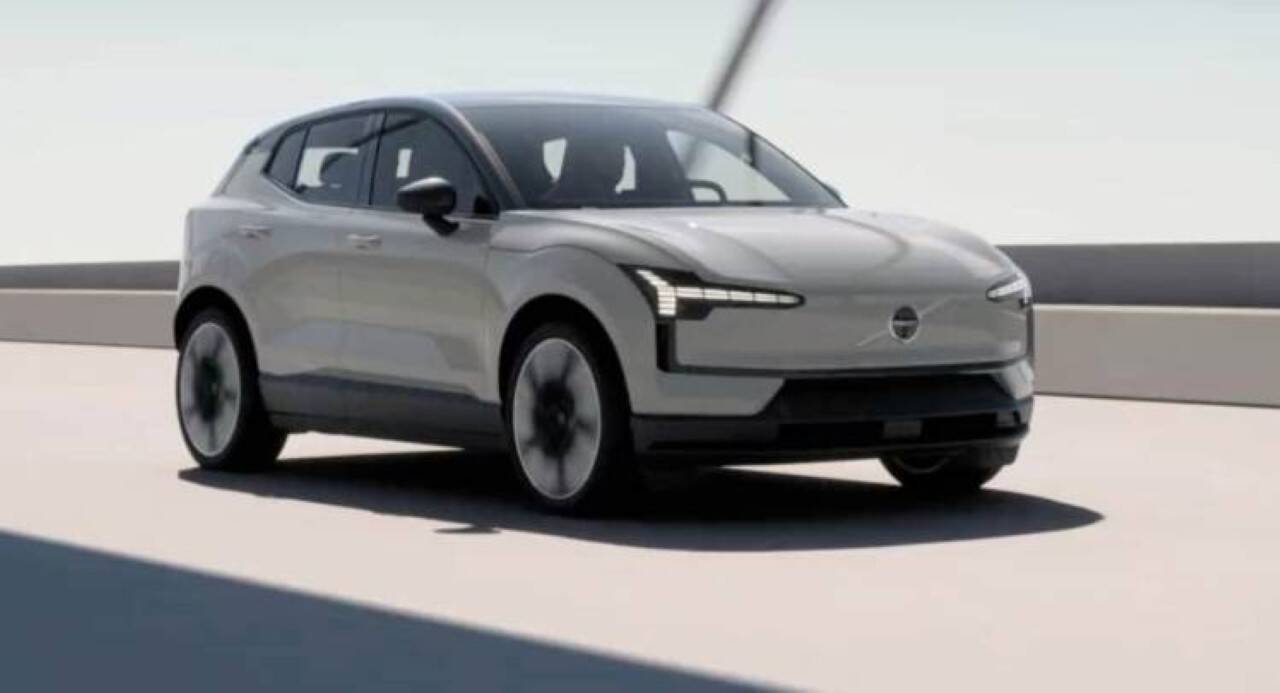
The EX30 Cross Country model, which is the version tested, builds on the all-wheel-drive EX30, adding extra ground clearance, cladding and underbody protection. These features raise the starting price to almost US$50,000, a value considered high for a compact SUV in the American market, especially for an electric vehicle with a range of around 365 km.
Performance and technical characteristics of the electric vehicle
In terms of power, the EX30 Cross Country, with its two-motor powertrain, delivers 422 horsepower (315 kW) and 542 Nm of torque. This configuration allows acceleration from 0 to 100 km/h in just 3.7 seconds, although the presence of the 18-inch all-terrain wheel kit, optional for US$3,495, may slightly influence this time. The vehicle’s Range mode, which moderates power and smooths throttle response, also contributes to a more controlled drive.
Power is provided by a 65 kWh net (69 kWh gross) lithium-ion battery, which supports direct current (DC) fast charging at up to 153 kW. The estimated time to charge from 10% to 80% capacity is approximately 27 minutes. Unlike Volvo’s plans in 2023, the EX30 for the American market maintained the CCS1 plug, instead of the NACS. In a practical test, the vehicle charged from 49% to 82% (25.6 kWh) in 21 minutes, indicating an estimated range of 245 km with the air conditioning active.
Interior design and functionality without physical buttons
In line with Volvo’s cost strategy, the EX30’s interior adopts a minimalist, buttonless design and does not have a separate instrument panel. Speed and driving mode are displayed at the top of the infotainment system’s central screen. The user experience is enhanced by the integration of the Android Automotive operating system, with support for Android Auto and Apple CarPlay, allowing cell phone mirroring.
Despite the simplicity and lack of physical controls, the EX30’s internal environment is pleasant. Volvo designers have demonstrated skill in choosing textures and materials that are tactile and visually appealing. The storage space integrated into the center console, with a retractable upper tray and movable cup holders, as well as a lower compartment with an articulated floor for loose items and USB-C cables, is a highlight for its functional intelligence.
With compact dimensions of 4,233 mm long, 1,838 mm wide and 1,573 mm high, and a wheelbase of 2,650 mm that optimizes internal space, the EX30 is a small car. However, for those looking for ample space for passengers in the rear seat, which offers just 821 mm for legs, or for luggage, with 318 liters of cargo volume with the seats in use, the model can be considered small.
It’s important to note that long-term reviews of the EX30 have been negative. Edmunds, for example, described living with the vehicle over the course of a year as a “very frustrating” experience, indicating that, despite its qualities, the car can present challenges in continuous use.





