
Aston Martin launches new chassis and updates in Hungary to reverse bad phase in F1
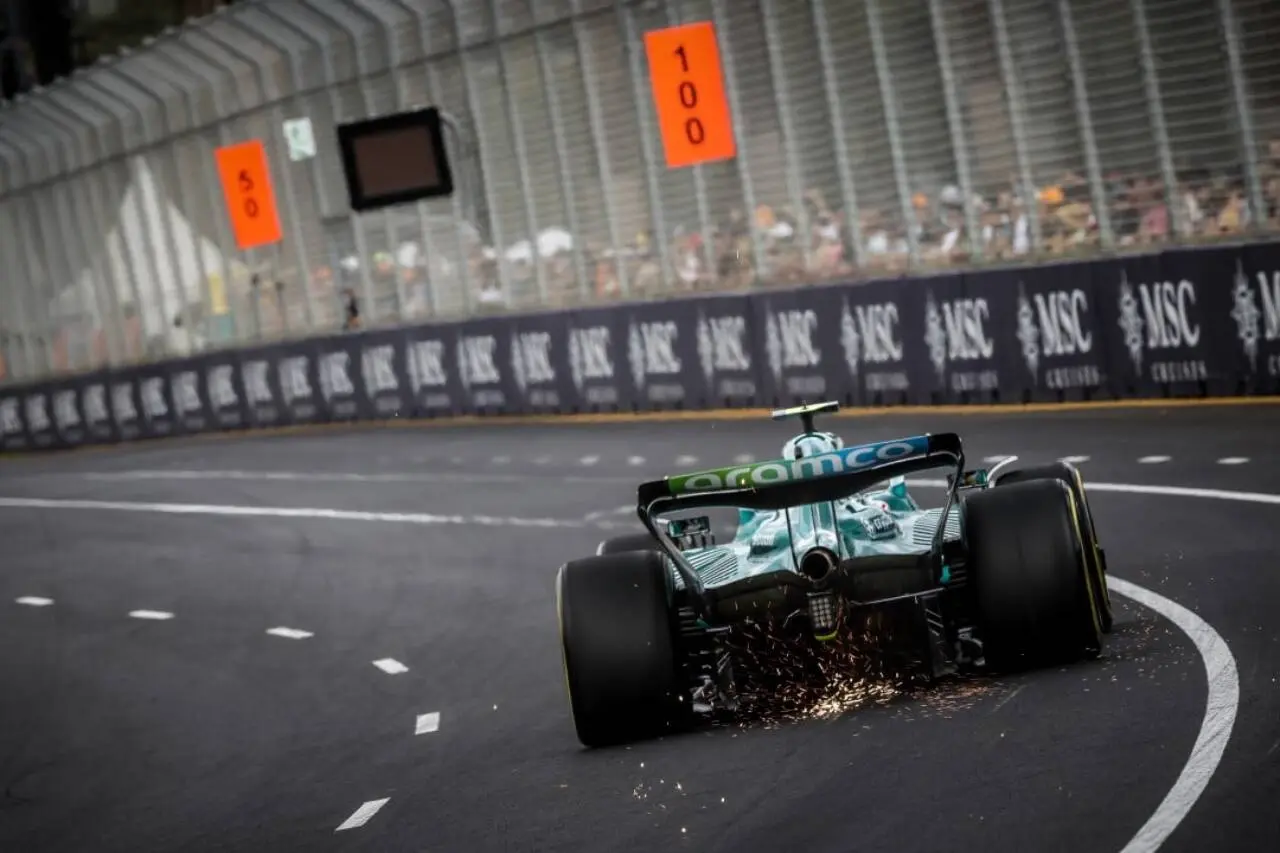
Aston Martin will unveil a significant package of improvements to the AMR26, its current car, during the Hungarian Grand Prix. In the face of a season with results below expectations and a deliberate strategy of not introducing many new features, the British team will arrive at the Hungaroring with an entirely new chassis and several aerodynamic modifications, the full details of which have not yet been released.
The team’s chief operating officer, Mike Krack, expressed optimism, stating that “the period where we didn’t see improvements for a long time is over.” He added that “the future is promising, and we are all looking forward to going to Budapest to see what we have”, indicating the expectation generated by the new pieces.
The improvements mainly aim to reduce the vehicle’s weight and improve its stability in curves. Recently, at Silverstone, videos were noticed of Lance Stroll having visible difficulty controlling the car in corners, circling widely. With these innovations, Aston Martin hopes to surpass its current performance and compete with midfield teams such as Williams, Haas, Alpine and Audi.
On the same topic: Frequent punishments affect Lewis Hamilton, who vents after new setback
Persistent difficulties for the team at each stage of the season
In recent years, Aston Martin has faced one of the worst performances in Formula 1, a surprising situation given the huge investment made by its owner, billionaire Lawrence Stroll. The team also counts on the talent of two-time world champion Fernando Alonso and the genius of renowned designer Adrian Newey in technical leadership and development of the car. This contrast between potential and current results highlights the urgency of the changes implemented.
The initial expectation for the season was that Aston Martin could at least challenge the leading teams, with speculation from names like Max Verstappen and Charles Leclerc the previous year. However, the current reality is very different, as evidenced at the Belgian Grand Prix, where Fernando Alonso finished more than a minute behind Valtteri Bottas, from the debutant Cadillac, who occupied the penultimate position.
For in-depth analysis, current and historical data from Q1, the initial stage of the ranking sessions, was examined. This period is the only one where all vehicles compete simultaneously, doing their best, under consistent conditions and using new tires.
Subsequent calculations considered each team’s time difference in relation to the fastest car on each circuit. Based on these individual deficits, recorded in each race, a general average performance per season was established for each team.
The analysis revealed that, in 2026, Aston Martin has recorded an average delay of 2.717 seconds compared to the fastest team in Q1. This data does not include the downward trend in the times of teams that progress in the classifications; If the comparison were made with the leaders of Q3, the final phase, the scenario would be even more unfavorable.
This year, the numbers show that Aston Martin is almost half a second slower than Cadillac, with an average deficit of 2.717 seconds compared to the best team in Q1. This positions the English team as the worst performing among the manufacturers evaluated.
Considering the last four races, a period marked by the progression of the other teams and engine-demanding circuits, the situation worsens: Aston Martin’s delay reaches 3.382. At Spa-Francorchamps, the difference was the biggest of the season, with 4.093 seconds behind Red Bull, who led the start of the classification.
Although the current number is below the worst ever recorded, such as Manor’s 5.160 in 2015, it is enough to place Aston Martin in fifth place on this list, surpassing teams that didn’t even score in entire seasons, such as Williams in 2020 and Haas in 2021. This scenario represents a major setback, especially given the high expectations for the team this year.
Read also: McLaren’s victory in Hungary intensifies competition in Formula 1 and raises expectations
Even Cadillac, a rookie team that built its structure from scratch, shows better performance. The newcomer is approximately half a second faster than Aston Martin in the standings, with a total deficit of 2.222 seconds in 2026.
A point of consolation for the British team came from Fernando Alonso, who took 10th place in the challenging Monaco Grand Prix, securing a point. This puts Aston Martin ahead of newcomer Cadillac, which has yet to record points.
Factors that contribute to low team performance
The AMR26, Aston Martin’s current car, faces challenges in all three main components of a Formula 1 single-seater: chassis, aerodynamics and engine. This disharmony is the result of a vehicle development process that was quite turbulent, as stated by the team members themselves in interviews throughout the season.
While most teams began development of their cars for this season as early as 2025, Aston Martin was only able to take its prototype for aerodynamic testing in the wind tunnel in April, three months after the other teams, which began in January.
More on this story: Charles Leclerc leads opening practice at the Hungarian GP, and Bortoleto is 6th
Additionally, Honda, which had divided its team in 2022 when announcing its departure from Formula 1, faced a challenge. After reversing the decision, many of its engineers were already involved in other projects, which negatively impacted the development of the engine supplied to the British team. For Adrian Newey, this lack of organization came at a high cost.
Newey declared that “weather was a huge part of it, but not the only one.” He added, explaining that “we have a very talented group of people, but we weren’t working as well as we would like as an organization and operating as a cohesive unit.” He concluded by explaining that “expectations were through the roof, but the reality of where we were didn’t reach that.”
The first signs of problems appeared in the pre-season, with incidents such as constant breakdowns, shortages of battery components and exaggerated vibrations in the engine. The team manager warned that these vibrations could even cause permanent neurological damage to the pilots’ hands.
Furthermore, the integration of the chassis with the car’s other systems did not occur ideally. Despite a compact aerodynamic concept, designed by Newey, the AMR26 is “well above the minimum weight” of 768kg allowed in Formula 1. Although the exact weight has not been disclosed, a heavier car represents a loss of crucial tenths of a second on each lap.
The perspectives and changes expected for the next stages
Aston Martin arrives at the Hungaroring with a sense of urgency and importance. The team chose a strategy of not keeping up with the constant pace of updates from competitors, preferring to implement all modifications to the car at once. This moment will coincide with the Hungarian GP, the last race before the summer break in European Formula 1.
Understand the case: Gabriel Bortoleto classifies the first phase of F1 with ‘grade 8’ and projects the future of Audi
The team’s main focus with the next updates is weight reduction, both in the chassis and gearbox, with the aim of reaching the minimum limit of 768kg. The team remains optimistic, although there is still uncertainty as to whether it will be possible to apply these modifications to both cars in the first stage.
Mike Krack commented on the intense effort, saying, “Everybody works hard to get the parts, to get the cars ready. It’s a big challenge if you decide to do it like that.” He continued: “You always try to push deadlines back as much as you can. So it’s a big effort going on at AMRTC (Aston Martin Technology Campus) at the moment.” Ending optimistically, Krack said: “And I’m a positive person. So I think we’ll have two cars ready to go. But I don’t think we’ll have five spares of each, to be honest.”
At the end of June, Adrian Newey provided detailed information on some of the upgrades designed to generate aerodynamic gains.
Newey clarified that “the front suspension remains unchanged” while “the rear suspension has undergone minor revisions.” He added that they have developed “a new nose and substantially revised the aerodynamic surfaces.” He concluded by explaining that, “although the basic structure is similar, it is a great aerodynamic package combined with a significant weight reduction”.
Additionally, Honda is developing a new engine, which is scheduled to debut at the Dutch Grand Prix, the first race after the summer break. However, the Japanese automaker is confident in Aston Martin’s improved performance in Hungary, as the Hungaroring is a circuit that demands less power.
Shintaro Orihara, chief engineer of Honda’s motorsport division, stated: “For the Hungarian Grand Prix, Aston Martin will introduce the chassis upgrade.” He added: “We are working closely with them to support integration with the engine. The Hungaroring is less sensitive to the power unit, so we can expect better performance despite not having our ‘B’ engine here.”
More news in Latest News (EN)
See more → Sony clarifies launch timing and hardware price plans for PS6
 Sony PlayStation 6 cost nears $950 as memory prices climbAfD state election triumph prompts urgent review of Germany’s democratic foundationsAaron Judge returns to Yankees lineup, igniting playoff push after three-month rib injury absenceHigh-altitude tragedy: Climber perishes after fall on Aspen-area 14er summitEgyptian TV personality and 11 co-defendants condemned to death for large-scale synthetic drug trafficking
More news on Mix Vale
- 1Somali piracy resurgence threatens shipping lanes amid regional conflicts and Red Sea disruptions
- 2Kyiv faces renewed ballistic missile assault after U.S. envoys’ peace mission concludes
- 3Families turn to online networks for flood victim data amidst official silence near Tibet border
- 4Indian civil servant gains widespread social media fame leading aggressive food safety crackdown
- 5PlayStation 6 component bills surge to $960 amid memory crunch
- 6Rockstar North adds canine waste throwing to GTA 6 world
- 7Rockstar North details dog mechanics and street combat in GTA 6
- 8Corporate ChatGPT users gain custom text style replication
- 9Workplace ChatGPT starts copying individual writing styles
- 10Top Ukrainian prosecutor resigns following probe into vast illegal call center network scheme