

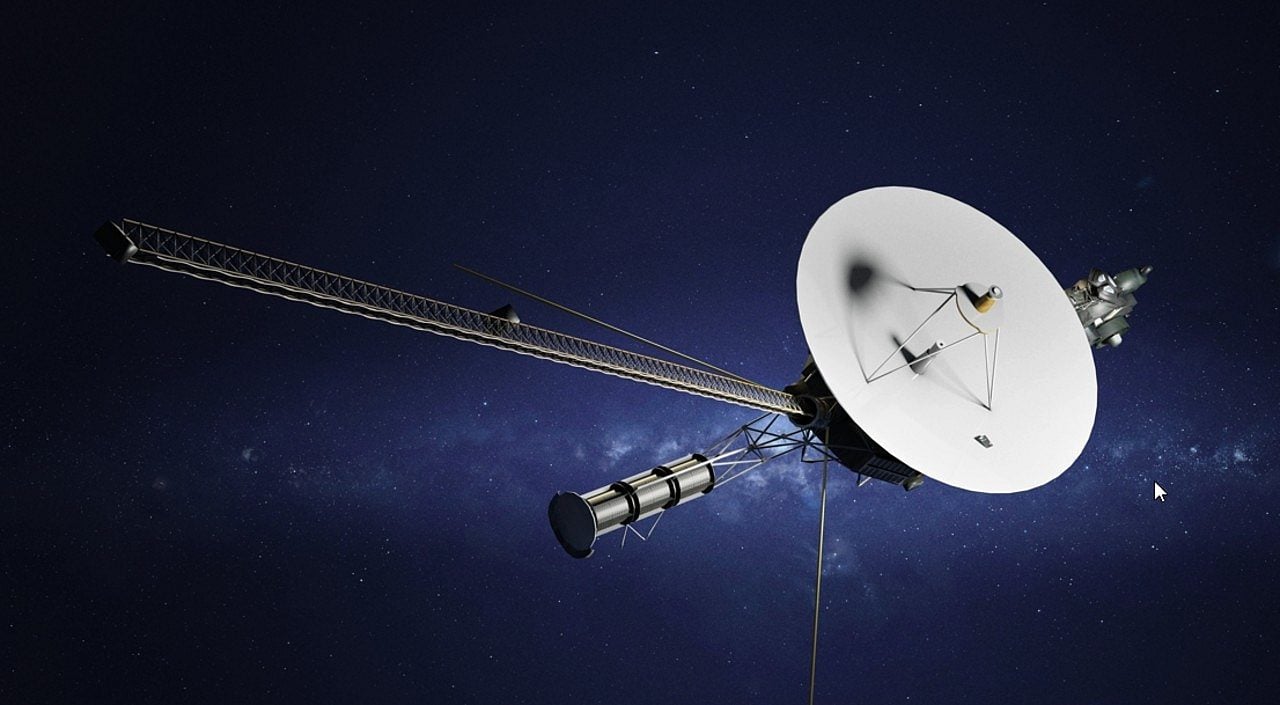
Traveling the vast expanses of interstellar space, the iconic Voyager 1 spacecraft carries a processing system that totals a meager 68 kilobytes of storage. To get an idea of how restricted this capacity is, a simple click made with the camera of any modern cell phone requires more space than all the artificial intelligence embarked on the mission, proving the extreme durability of past engineering.
Sent into the cosmos in 1977, the machine defies the logic of modern computing by remaining operational at the borders of the solar system using minimal resources. The North American space agency designed the vehicle with this 68 KB limitation, which has been enough to guide the metallic structure for more than four and a half decades of continuous exploration.
How the spacecraft’s dual electronic brain works
Far from having a very high-performance central chip, the digital heart of the device is made up of three independent modules that always work in pairs. This redundancy strategy was the solution found by the project’s creators to guarantee the survival of the mission: if a plate burns out or presents an error, its clone immediately takes control, preventing the vehicle from being lost in the cosmic darkness.
Each of these pairs takes on vital and completely separate tasks to maintain contact with Earth and stabilized flight. While one of the blocks takes care exclusively of the information captured by the scientific sensors, the second manages the engines and the route, leaving the third with the responsibility of interpreting the orders received from the land base. The exact division drawn up by the scientists was structured in this way:
- Command and Control Module (CCS): responsible for general guidelines, operating with two backup units and 4,096 words of memory each.
- Flight Data System (FDS): focused on information packaging, containing two 8,192-word memories and total redundancy.
- Attitude and Articulation Control (AACS): responsible for physical navigation, also equipped with duplicate systems and 4,096 words of capacity.
The technological gap between the 1970s and the present day
The total value of 68 KB represents the combination of all RAM memory available in the circuits of the interplanetary equipment. To put this into perspective, a very low-resolution image file saved on any desktop computer usually takes up at least 100 KB. This means that the machine performs orbital maneuvers and astrophysical calculations with a volume of data less than that required by a social network avatar.
During the assembly phase, the industry was not yet manufacturing the tiny silicon semiconductors we know, forcing the use of magnetic components and hand-twisted wires. Because storage space was a luxury, developers needed to write extremely clean lines of code, operating at a processing speed of only about 250 kHz. Interestingly, it is precisely this rudimentary and almost analog nature that shields the circuits against intense cosmic rays.
The complex task of fixing software in deep space
Carrying out repairs on an object that travels more than 24 billion kilometers from our planet requires monumental patience from engineers on the ground. When a processing error occurs, experts must dig up paper documents yellowed by the years to understand the original programming logic. Furthermore, any command typed into the base takes a long 22 and a half hours to cross the vacuum to the vehicle’s antenna, requiring the same waiting time for confirmation.
Recently, in early 2024, a serious problem interrupted the transmission of readable data, forcing NASA to create an unprecedented cyber rescue plan. The recovery maneuver had to be performed with surgical precision to isolate the failure without erasing vital functions, following a strict script:
- Accurate mapping of the bad sector within the flight data system.
- Slicing operating software into smaller, independent blocks.
- Transferring these code fractions to healthy areas of memory.
- Update all paths and read pointers to the new addresses.
- Sending test commands to confirm that communication has been restored.
Why old equipment is so resistant to radiation
The secret behind so much durability lies precisely in the rusticity of the pieces, which contrast strongly with the fragility of contemporary smartphones. Today’s processors have billions of microscopic transistors that would easily fry when hit by high-energy cosmic particles. Hardware manufactured in the 1970s has large, physically spaced circuits, making it immune to much spatial interference.
Another factor that works in the probe’s favor is the lack of a heavy operating system or background updates that tend to slow down modern machines. The commands run natively and directly in machine language, obeying binary orders without any abstraction layer. This extreme simplicity eliminated the risk of software conflicts that could have ended the mission prematurely.
The inevitable end of energy and the interstellar legacy
Although the logic part remains intact, the spacecraft’s real enemy is the constant loss of power from its plutonium thermoelectric generator. In an attempt to save every watt of electricity, controllers have been systematically disabling heaters and secondary sensors. The current goal is to extend the life of the main meters as much as possible to extract the latest unprecedented data from the interstellar medium.
The team’s calculations indicate that, between 2025 and the end of this decade, the nuclear battery will become too weak to power the communications antenna. When the signal finally drops and the computers freeze, the scientific mission will come to an end, but the metal shell will continue to wander the Milky Way. Carrying the famous Golden Record with sounds and images of Earth, the probe will become a silent, eternal monument to human curiosity roaming the cosmos.





