
Secrets of the Voyager 1 probe to operate in space with just 68 KB of memory

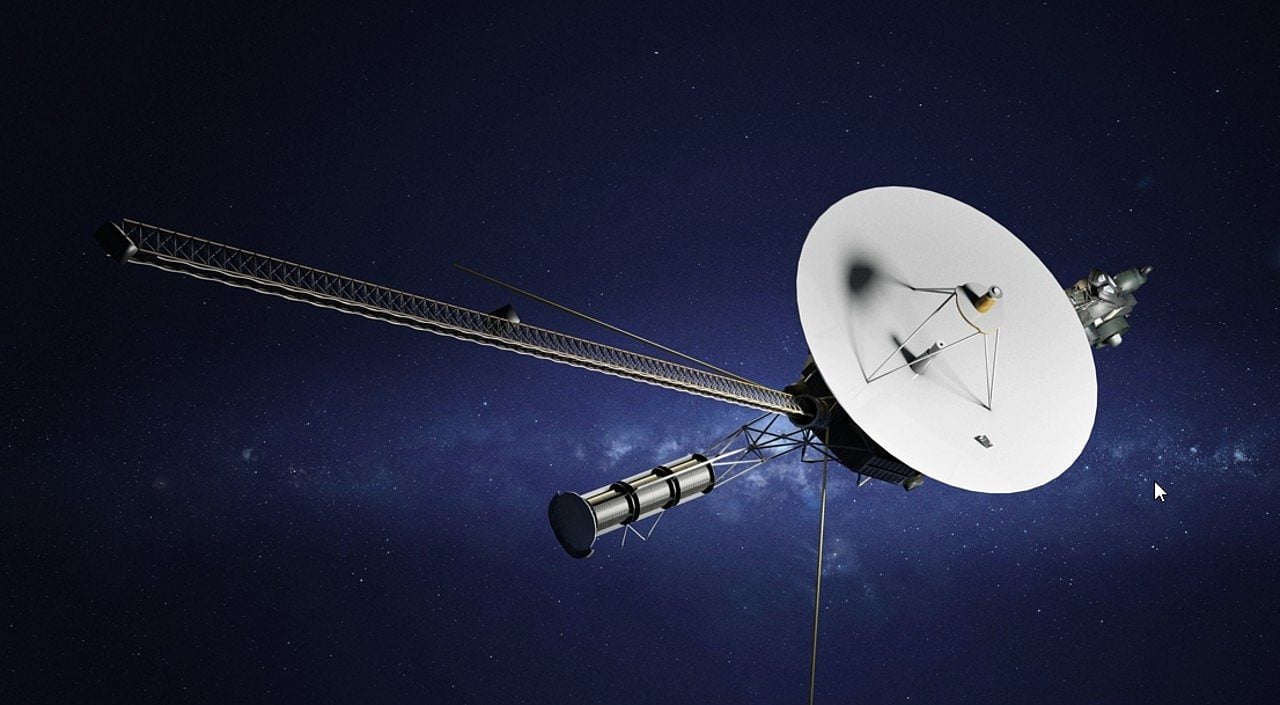
Crossing the furthest reaches of the known universe, the legendary Voyager 1 probe runs its daily operations supported by a mere 68 kilobytes of storage. To illustrate the size of this technological bottleneck, it is enough to note that a basic photograph captured by any contemporary smartphone occupies considerably more space than the mission’s entire digital brain, highlighting the impressive resilience of aerospace engineering in the last century.
Launched into outer space in 1977, the metallic structure goes against the expectations of current computing by continuing to send data from the edges of our star system with an almost invisible processing capacity. The United States space agency designed the equipment with this restriction of 68 KB, a volume that proved to be perfectly capable of guiding the spacecraft during more than four and a half decades of uninterrupted journey.

The redundant architecture that keeps mission computers active
Instead of relying on a single cutting-edge processor, the intelligent core of the equipment is made up of three distinct systems that invariably operate in pairs. This method of duplication was the alternative designed by engineers at the time to ensure the continuity of the expedition: if a component suffers an irreversible breakdown, its identical copy comes into action at the same moment, preventing the probe from drifting in the interstellar void.
Each set of processors manages critical and completely isolated functions to support communication with our planet and the stability of the path. While one of the modules only processes the metrics collected by the research instruments, the second controls the propulsion and steering, leaving the third with the task of decoding the instructions transmitted by the terrestrial antennas. The tactical scheme defined by the development team was organized as follows:
- Command Computer (CCS): responsible for main management, working with two reserve devices and a capacity of 4,096 words each.
- Flight Data Subsystem (FDS): aimed at formatting telemetry, housing two storage areas of 8,192 words with dual support.
- Articulation Control (AACS): focused on the spatial orientation of the structure, also provided with spare parts and a limit of 4,096 words.
The brutal processing contrast between the past and the smartphone era
The amount of 68 KB is equivalent to the sum of all the random access memory installed on the boards of the interplanetary ship. For comparison purposes, a simple text document or a very low quality image saved on a current notebook easily exceeds the 100 KB mark. In practice, the artifact performs complex route corrections and space plasma analysis using a smaller data package than needed to load an application icon.
During the construction phase, the market was still unaware of high-density silicon microchips, which forced technicians to use magnetic core memories and manually soldered wiring. Because every byte was precious, programmers wrote extremely lean instructions in classical languages like Fortran and Assembly, running at a modest frequency of 250 kHz. Ironically, it is exactly this robust, analog format that protects the machinery against lethal radiation from deep space.
The logistical challenges of updating codes billions of kilometers from Earth
Carrying out maintenance on a vehicle that travels more than 24 billion kilometers away demands extraordinary resilience from scientists in the control center. Faced with any anomaly in the code, the team needs to consult manuals printed almost half a century ago to decipher the system’s original architecture. Added to this, a simple packet of instructions takes around 22 and a half hours to cross the cosmos to the probe’s receiver, requiring an identical interval for the response to return.
In the first months of 2024, the degradation of a single memory chip caused a severe failure that scrambled scientific telemetry, forcing NASA to devise an unprecedented digital rescue operation. The remote intervention had to be designed with extreme caution to bypass the burned part without compromising the life support systems, following a highly methodical schedule:
- Accurate identification of the corrupted area in the flight packaging subsystem.
- Division of the operation code into smaller, self-contained segments.
- Migration of these parts of the software to intact sectors of magnetic storage.
- Reconfiguration of all reading routes to point to the new allocated locations.
- Triggering verification packets to check that readable contact has been reestablished.
Why old hardware survives cosmic perils
The real asset for such longevity lies in the raw construction of its components, a reality opposite to the delicacy of the electronic devices we use today. Modern microprocessors house billions of nanometer-scale transistors that would be instantly destroyed by the impact of highly energetic particles. On the other hand, the plates developed in the 1970s have wide tracks that are physically distant from each other, which makes them practically shielded against solar storms and external interference.
An additional detail that guarantees the stability of the mission is the total absence of a complex operating system or background update routines, which are largely responsible for crashes today. The directives are executed directly in machine language, responding to binary sequences without any intermediate graphical interface. This purely functional architecture mitigated any chance of software incompatibility that could have shortened the project’s lifespan.
The depletion of the nuclear battery and the future of the artifact in the universe
Although the computational structure remains healthy, the biggest threat to continued operations is the natural decay of the plutonium-powered thermoelectric generator. To save every fraction of available energy, the engineering team adopted the strategy of progressively turning off internal heaters and minor instruments. The central objective of this rigorous economy is to stretch the functioning of the main detectors as much as possible, guaranteeing the collection of unprecedented data about interstellar space.
Scientists’ mathematical projections indicate that, at some point between 2025 and the end of this decade, the nuclear source will no longer have the strength to sustain the radio transmitters. When contact finally ceases and the circuits freeze in a vacuum, the research phase will be completed, but the aluminum chassis will continue its unchanging trajectory through the Milky Way. Carrying on board the iconic Golden Record, full of greetings and earthly music, the ship will consolidate itself as an eternal archaeological artifact of our civilization wandering among the stars.





