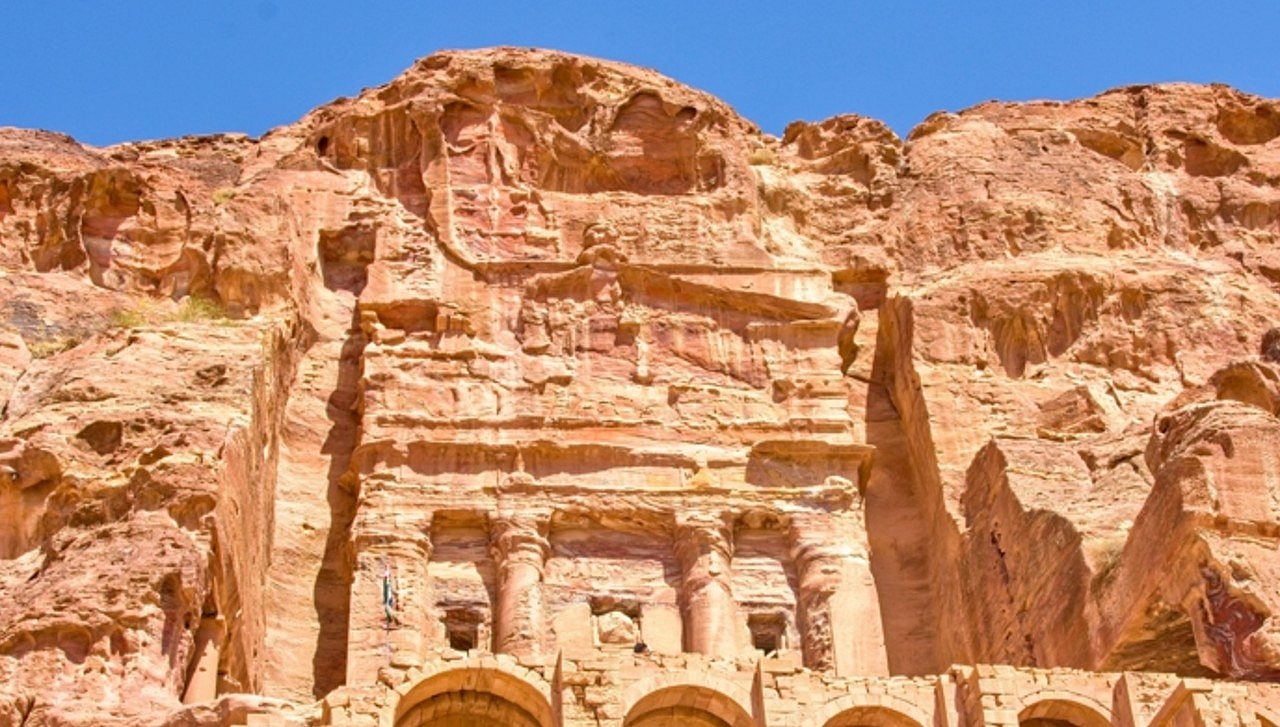
As visitors venture into Petra, crossing the Siq gorge, they are greeted by the majestic facade of Al Khazna, known as the Treasury, a stunning structure carved directly from the pink sandstone. For many tourists, the journey through the ancient city in southwestern Jordan may seem complete there. However, Petra holds much greater wealth, with more than 600 stone facades and a series of fascinating clues about its ancient inhabitants.
This metropolis served as the capital of the Nabatean people for centuries, before being annexed by the Roman Empire around 106 AD. The historic commercial center was home to tens of thousands of people. However, the city’s population had already declined considerably when Swiss explorer Johann Burckhardt, disguised as a Muslim pilgrim searching for the tomb of the Prophet Aaron, was guided by a Bedouin to the city in 1812, which for many Westerners was just a myth. Since then, Petra’s reputation has only grown. The city’s ruins were designated a UNESCO World Heritage Site in 1985, and scenes from the film “Indiana Jones and the Last Crusade”, released in 1989, were set there.
Zeyad Al-Salameen, an archaeologist at the Mohamed Bin Zayed University of Human Sciences in Abu Dhabi, United Arab Emirates, said that “if you want to visit Petra, you won’t be able to see it in a single day.” From the top of Umm al-Biyara, an archaeological site located on the highest mountain in Petra that contains Iron Age ruins, visitors can have a panoramic view of the city’s main street, the organization of the temples and the movement of tourists. Al-Salameen, who is native to the region and spent his youth exploring its temples, monuments and houses, said: “You will see a living city before you.”
Much of the ancient city remains unexplored, and written records by the Nabataeans are scarce. Megan Perry, an anthropologist at East Carolina University in Greenville, North Carolina, reported that “the Nabataeans left no written records of their own.” Despite this, researchers were able to reconstruct aspects of life in Petra through Greek and Roman texts, commercial papyrus documents and the ruins found themselves.
How the Nabataean Empire Prospered and Built Petra
In their role as traders, the Nabataeans acted as a link between the producers of goods in southern Arabia, Africa and India, and the Greek and Roman consumers. Their camel caravans transported valuable products such as incense, spices and silk. Wealth was accumulated primarily through the collection of taxes, with a historical record indicating that the Nabataeans taxed imports at 25%. “This wealth is reflected in Petra,” said Al-Salameen, explaining that it enabled the construction of the grand city, including its temples, baths and colonnaded streets.
Most of the archaeological finds in Petra are tombs, according to Al-Salameen. He suggests that the Nabataeans placed great value on the afterlife, viewing earthly existence as a “short journey.” Some tombs have elaborate facades cut into the rock, such as the Treasury, where archaeologists located 12 skeletons in 2024. Other tombs are simpler, consisting only of shafts cut into the sandy stone.
Certain tombs feature funerary inscriptions in Aramaic, the predominant language of the time. These recordings indicated who had the right to be buried in the tomb, described prohibited acts, and established punishments or curses for transgressors, Al-Salameen explained. Other sites contain memorial inscriptions, which functioned as a guestbook for travelers and could include a name and a supplication to a deity.
Inscriptions at Petra and other sites offer glimpses into the polytheistic religion of the Nabataeans. Among the deities were Dushara, the male supreme god, and Allat, a female figure, whose representations evolved over time, Perry said. Initially, they were geometric and non-human shapes, which gradually became more anthropomorphic. Later, Dushara was associated with Zeus, while Allat came to be represented as Aphrodite. Despite the clear Greco-Roman influence, it is still not known exactly what motivated the change in the way these deities were represented.