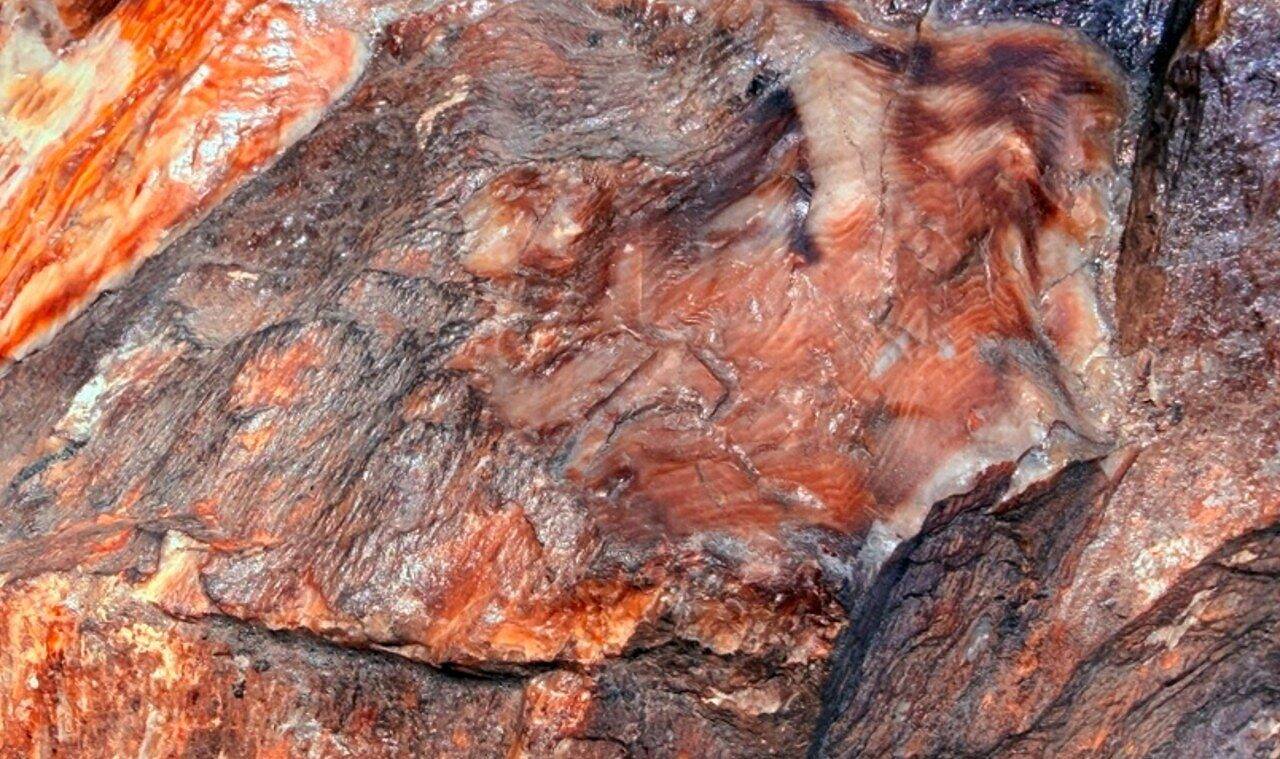
Far beyond a mere decorative object, fossilized wood reveals itself to be an unexpected repository of crucial geological information. A team of scientists led by geologist Dr. Steffen Trümper from the University of Münster in Germany has demonstrated that this material can record the history of entire regions for hundreds of millions of years, offering a new perspective on the planet’s evolution.
The recent discoveries considerably extend previously known timescales for wood mineralization. They indicate that these fossils are capable of documenting the history of subsidence in geological basins and revealing important tectonic events over hundreds of millions of years. The study focused specifically on the Saale Basin, a sedimentary formation that emerged approximately 300 million years ago in present-day central Germany.
The results of this research were detailed and published in the prestigious journal Scientific Reports.
Analysis of ancient trunks in reddish deposits
For the analyses, the researchers examined fossilized wood found in the Kyffhäuser mountains, located in northern Thuringia, Germany. Known since the 18th century, these fossils are trunks that can reach up to 20 meters in length, embedded in the beds of ancient rivers with a reddish color. This peculiar hue is the result of the presence of iron oxides, indicating a climate that was hot and dry in certain seasons.
These trunks, which were submerged during periods of flood, are remnants of tropical dry forests from the supercontinent Pangea. In that era, the region was positioned close to the equator and was home to extinct relatives of today’s conifers, around 300 million years ago. The Kyffhäuser area is recognized as a reference site for a specific type of deposit that has repeatedly formed in several European basins, constituting one of the largest occurrences of fossilized wood in the Northern Hemisphere. Its rocks are among the oldest deposits in the Central European Basin System, a sedimentary system of great economic relevance that still holds raw materials, underground water reserves and significant potential for geothermal energy.
Understand how quartz preserves deep burial records
The key to this extraordinary preservation lies in the quartz, which gradually permeated and replaced the wood during the fossilization process. Initially, the dissolved silicic acid penetrates the dead wood, shaping the cell walls and thus maintaining the most delicate anatomical structures. Over millions of years, these initial siliceous deposits crystallized into quartz, progressively replacing the original tissue.
The study indicates that the preservation of these fossils is substantially more intricate than previously imagined, considering their structure, geochemistry and the age of the quartz phases. The research team was able to identify five consecutive generations of silicic acid. Each of these generations contains specific information about the temperature, pressure and composition of the solutions from which they developed. Scientists have documented five stages covering a period of 200 million years, from the Late Carboniferous to the Early Cretaceous. When considering the subsequent uplift of the Earth’s surface, this period extends up to 300 million years, representing the longest sequence of successive stages of wood mineralization recorded to date.
Uncovering five stages from a single fossil
To deepen the analysis of these authentic “time capsules”, the team used a combination of sophisticated techniques. Using quartz cathodoluminescence, fluid inclusions, oxygen and silicon isotopes, Raman thermometry, electron probe microanalysis and scanning electron microscopy, in addition to in situ U-Pb dating – a geochronological method for determining the age of rocks and minerals –, it was possible to reconstruct the five stages.
“The tiny fluid inclusions in the quartz were particularly revealing, as they preserve information about the exact conditions during the crystal’s growth,” said Trümper. For example, the team demonstrated that parts of the wood were at a depth ranging between 3 and 5.5 kilometers, subject to temperatures of 160 to 240°C.
Factors that influence the applicability of the new technique
The discoveries have relevance that goes beyond the Kyffhäuser location. “It is surprising that a fossil, often no larger than the palm of your hand, can encapsulate the geological history of an entire region over hundreds of millions of years,” Trümper said. “Never before has a sequence of five stages of mineralization been documented in fossilized wood. As fossilized wood is found in many rock formations around the world, this opens up a valuable source of information and provides science with a new tool for tracking the evolution of continents.”
However, analyzes indicate that the suitability of fossilized wood for watershed analysis depends more on the climatic and sedimentological conditions during its burial than on the tectonic context.
In addition to the University of Münster, the Georg August University of Göttingen, the Karlsruhe Institute of Technology, the Museum für Naturkunde Chemnitz and the TU Bergakademie Freiberg contributed to the study.