
3I/Atlas could be an asteroid with ice volcanoes, new scientific research shows


Since its first detection on July 1, 2023, interstellar object 3I/Atlas has been a focal point for scientists globally. As it continues its trajectory towards Earth, researchers Josep M. Trigo-Rodríguez, Maria Gritsevich and Jürgen Blum published a recent study that suggests a reclassification: the celestial body, which was thought to be a comet, may, in fact, be an asteroid.
In-depth analysis revealed that this cosmic visitor expels jets from specific areas on its surface. For scientists, this activity indicates the existence of “ice volcanoes”, also known as cryovolcanism. This phenomenon is characterized by the release of gases and frozen materials, different from the behavior expected from typical comets.
The study highlights that usual comets have a dust envelope that serves as an insulator for the ice below the surface, regulating the flow of gas and preventing an uncontrolled increase in luminosity. However, the scientists involved in the research believe that 3I/Atlas does not have this protective layer.
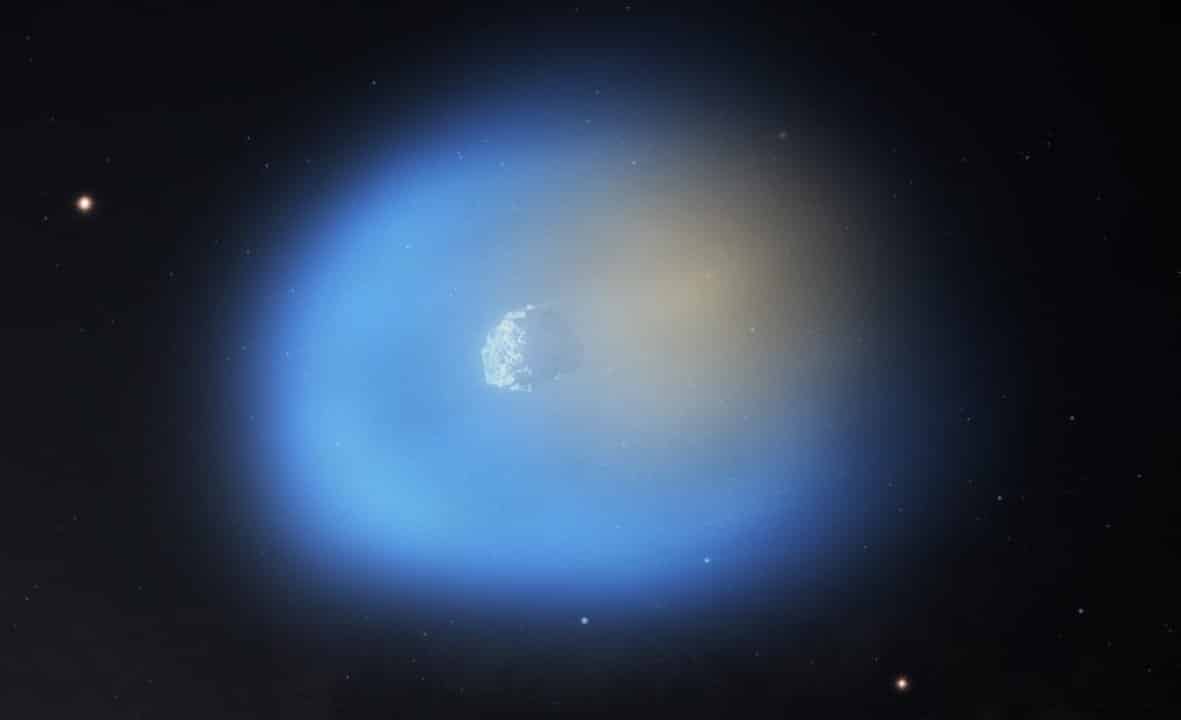
The authors explain that, even when a common comet has an eruption, the dust blanket usually seals itself quickly, or the system reaches thermal equilibrium, causing the brightness to return to its previous pattern. 3I/Atlas, considered primitive and not thermally processed, probably does not have such a mantle, according to the study text.
Another aspect that caught the attention of experts was the high speed with which 3I/Atlas entered the Solar System. This fact suggests that the object may have been thrown into space after a “violent encounter” in its home star system.
All these characteristics lead to the hypothesis that the object is an asteroid with a large amount of carbon and metal, presenting a solid composition similar to that of certain asteroids already identified in our own Solar System.
However, NASA maintains the classification of 3I/Atlas as an interstellar comet and guarantees that it does not pose any risk to planet Earth. The celestial body will make its closest approach to our planet on December 19, 2023, passing at a distance of approximately 270 million kilometers.
First sighted on July 1, 2023, 3I/Atlas aroused interest due to its speed and peculiar trajectory, which indicates that it is not under the gravitational influence of the Sun. It is notably the third interstellar object confirmed by the scientific community to date.





