
Milky Way may have rotated 90 degrees in the past and changed the position of the Solar System

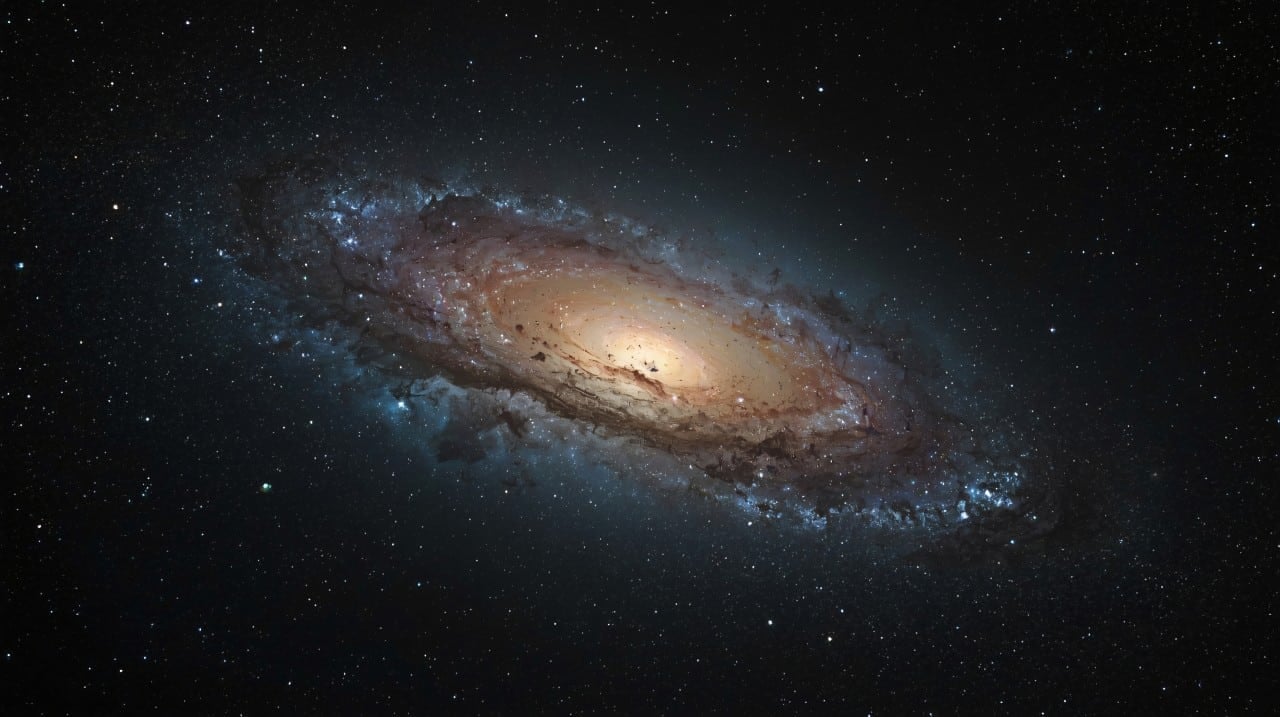
Recent research suggests that the Milky Way’s spiral disk may have performed a 90-degree turn long ago, an event that possibly redefined the Solar System’s trajectory around the galaxy’s center.
Spiral galaxies like the Milky Way are made up of two main structural parts: a disk, which concentrates most of its stars, gas and the central black hole, and a more diffuse halo of older stars that surrounds the disk.
However, the Milky Way’s stellar halo has always presented unusual characteristics. The European Space Agency’s Gaia mission had previously detected that halo stars rotate slowly compared to the material in the spiral disk. Now supercomputer models, led by Kirill Batrakov of Durham University, reveal that galactic mergers and the rotation of disks could explain this peculiarity.
In their simulation studies, Batrakov and his team tracked the evolution of 25 Milky Way-like galaxies over billions of years. They found that galaxies with slowly rotating halos were also those that suffered head-on collisions with other galaxies and had their galactic disks altered at some point.
“We already know that the Milky Way had a large head-on collision in the past with a galaxy known as Gaia-Shaggy-Enceladus,” Batrakov said in a statement. “So we believe the Milky Way’s disk probably rotated in the past.”
Gaia-Sausage-Enceladus was a dwarf galaxy with a mass greater than 10 billion times that of our Sun, which collided with the Milky Way about 8 to 11 billion years ago. Evidence for this collision also came from the Gaia mission’s stellar motion measurements. The colliding galaxy’s peculiar name derives from the fact that, as it was fragmented by the Milky Way’s gravity, its stars were directed into elongated, sausage-shaped streams that were incorporated into our galaxy’s halo.
This collision was the last major impact the Milky Way suffered, but perhaps it was not the last major event. At some point, the galaxy’s disk appears to have tilted, but the exact cause is still uncertain. It is worth noting that the simulations indicated that not all galaxies whose disks rotated had previously undergone a merger.
“We believe there may be different mechanisms driving the disk flips,” Batrakov said. He explained that at this time, the team is unsure which scenario applies specifically to the Milky Way and that further investigation into the precise mechanics of the disk’s tilts is needed.
Both melting and disk tilt mechanisms contributed to the slower rotation of the halo. The head-on merger resulted in many stars in the Gaia-Shaggy-Enceladus galaxy being flung into the halo on trajectories significantly misaligned with the disk, causing them to collectively rotate more slowly relative to the disk.
Disc tilt causes a similar situation. In the simulated models, rotation is measured relative to the space around the galaxy, but as the disk’s orientation changes relative to the halo, it does not immediately reorient itself and takes time to synchronize its rotation with the disk. This lack of alignment results in a less cohesive rotation of the halo relative to the new disk orientation.
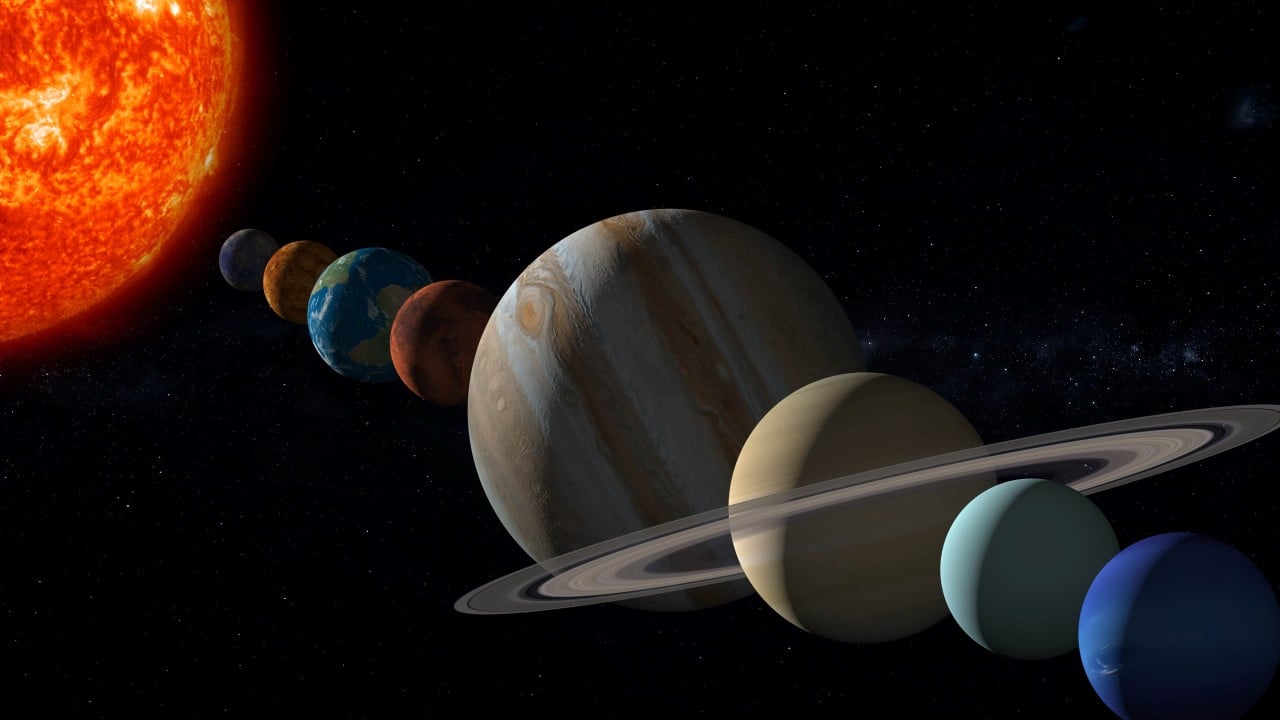
If the disk tilt had occurred during the existence of the Solar System, it could have affected our own orbit around the center of the galaxy.
“A disk tilt means that most of the Milky Way’s stars moved on very different trajectories than today, possibly including our Sun, which indicates that our ‘stable point’ in the galaxy may not have been so stable throughout the life of the Solar System,” Batrakov said. This revelation is crucial, as it changes the perception about the stability of our cosmic region.
Much of what we understand about other galaxies is derived from knowledge about the history of the Milky Way.
“Discovering that the disk has tilted adds a new chapter to this story, one that we must consider when positioning the Milky Way in a broader context of other galaxies,” Batrakov said. He also recognizes the incredible ability to reconstruct such a complex history from careful observations, billions of years after the events.
“What excites me most is that this complex history can be reconstructed just from current observations,” said the researcher.
Batrakov presented his work at the Royal Astronomical Society’s National Astronomy Meeting, which took place at the University of Birmingham between 20 July and 24 July 2026.





