

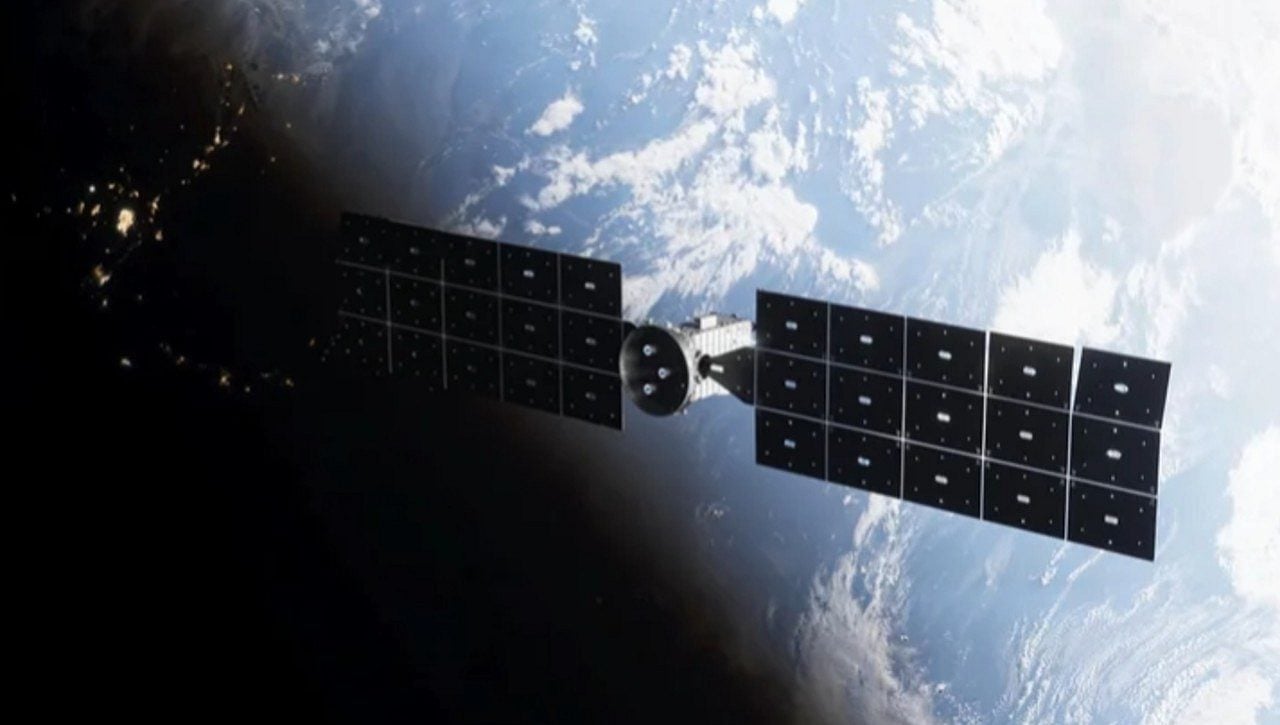
A mission by the US space agency NASA to rescue an orbiting telescope faces its own operational challenges. Launched on July 3, the LINK probe, developed to extend the useful life of the Swift observatory, experienced technical failures on July 28, a few weeks after being sent into space.
The launch of the Swift Boost mission took place on July 3, using a Pegasus XL rocket from Northrop Grumman. The LINK spacecraft, built by Katalyst Space Technologies of Arizona, was intended to connect to NASA’s Swift observatory. The latter is a successful scientific satellite dedicated to detecting gamma-ray bursts, high-energy cosmic events in the universe.
However, LINK began to experience problems after a few weeks in orbit. NASA said in a statement on July 28 that Katalyst’s service spacecraft “experienced problems with attitude control, causing the spacecraft to spin and resulting in sporadic communications.” Despite the failure, the space agency clarified that the vehicle’s other systems operate normally and its general health remains good.
More on this story: NASA plans robotic operation to save the Swift telescope and extend its useful life
Initial analysis of the situation revealed that two of the LINK probe’s three reaction wheels are inoperative. Furthermore, the equipment’s cold gas propellant system also recorded some loss of functionality, according to the first data collected about the incident.
The failure of LINK’s reaction wheels is particularly notable given the irony of the situation. The Swift observatory itself faced similar problems with its reaction wheels in 2022. On that occasion, NASA had to put the telescope in safe mode due to small deviations in its movements, resulting in a temporary shutdown.
Mission teams will now focus on using the spacecraft’s electric propulsion system to stabilize the spin and regain control. From there, NASA and Katalyst will make an assessment to determine whether the remainder of the mission can proceed as planned, considering the new technical challenges.
Swift’s orbit has been progressively decreasing for years, and the observatory does not have its own ability to propel itself. Therefore, LINK was designed to rendezvous with Swift in low Earth orbit, study its conditions, and then use three robotic arms to dock. After connection, the goal was for LINK to use its own thrusters to raise Swift to a higher orbit, extending its useful life.
Learn more: NASA plans robotic mission to prevent Swift space telescope from falling to Earth
The Swift observatory, whose official name is Neil Gehrels Swift Observatory, was launched in 2004 at a cost of 250 million dollars. In contrast, the current Swift Boost mission with LINK had a budget of $30 million, highlighting the perceived value in extending the telescope’s useful life.
Over its 22 years, Swift has been instrumental in the search for gamma-ray bursts and other high-energy astrophysical phenomena in the cosmos. In 2022, the observatory detected an explosion known as “BOAT” (acronym for Brightest of All Time), the brightest ever recorded and considered the most powerful space explosion to date.