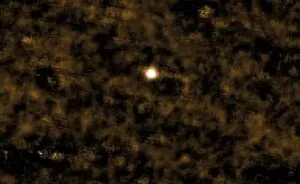
European mission captures interstellar comet 3I/ATLAS ejecting 175 million liters of water daily

The exploration of the cosmos has just registered an impressive milestone with the detailed observation of a celestial body from outside our cosmic neighborhood. The interstellar comet 3I/ATLAS was spotted releasing a colossal amount of water, estimated at a volume capable of filling around 70 Olympic-size swimming pools every 24 hours. This extraordinary event provides astronomers with an unprecedented opportunity to investigate the fundamental building blocks that gave rise to exoplanets in remote star systems. Experts believe that the ejected material carries chemical signatures from a time possibly before the formation of our Sun itself.
What makes the passage of the celestial body 3I/ATLAS a historic event for science
The unprecedented record was made possible by the Jupiter Icy Moons Explorer spacecraft, known worldwide by the acronym JUICE, operated by the European Space Agency (ESA). Although the mission’s final destination is the gas giant Jupiter and its frozen moons, the cruise trajectory allowed a visual encounter with 3I/ATLAS, classified as the third confirmed object of external origin to cross our planetary system. Data captures took place throughout the month of November 2025, requiring a complex calibration maneuver by flight engineers.
More on this story: Interstellar visitor 3I/ATLAS is at risk of disintegration as it approaches the Sun
To ensure the success of the venture, the scientists activated two cutting-edge pieces of equipment on board the probe. The MAJIS imaging spectrometer and JANUS high-resolution camera worked together to map the visitor’s structure. Behaving identically to local icy stars, the interstellar body reacted violently as it approached our host star. The extreme heat of solar radiation reached the frozen core of the object, triggering a sublimation process where the ice instantly transforms into gas, without going through the liquid state.
Chemical analysis reveals the composition of worlds formed beyond our system
This abrupt phase transition generated an explosion of matter that formed the classic bright coma, also called coma, and the long tail characteristic of comets. The thermal phenomenon caused a peak in luminosity that was completely unforeseen by the initial mathematical models. During this period of intense activity, the MAJIS instrument’s sensors were able to isolate and identify clear signatures of water vapor molecules mixed with carbon dioxide.
Such chemical compounds are categorized in astrophysics as volatile elements, precisely because they have an extremely low evaporation point in the vacuum of space. Giuseppe Piccioni, a researcher linked to the National Institute of Astrophysics (INAF) in Italy, highlighted that continuous readings prove that deep layers of ice were exposed and launched into space shortly after the object reached perihelion, which is the point of closest proximity to the Sun. The team’s calculations indicate a frightening ejection rate, reaching the mark of two tons of matter thrown into the vacuum every second.
See Also

Electrical discharge knocks man off roof in Jaguaruana after contact with power lines

Global auction raises US$11.9 million and Brazil’s historic currency reaches record value

Former fighter Prichard Colón dies at age 33 after decade in a vegetative state
Logistical challenges and long waiting times for receiving data on Earth
The most surprising aspect of this observation campaign is that it did not exist in the European Space Agency’s original timeline. The task force had to be hastily assembled and inserted into the operations agenda shortly after the official discovery of the comet, recorded on July 1, 2025. The control team had to overcome severe technical obstacles, dealing with extremely short tracking windows and the initially weak brightness of the target’s emissions.
Due to the immense distance between the probe and terrestrial reception antennas, in addition to transmission bandwidth limitations in deep space, the scientific community had to exercise patience. The complete package of telemetry and raw images only finished being downloaded onto ESA servers in February 2026. According to aerospace engineers, the months-long wait was amply rewarded by the crystal-clear quality of the information obtained.
Learn more: European probe spots comet from another star system ejecting water into space
Unprecedented morphological structures captured through the lens of the European mission
Pasquale Palumbo, the main researcher responsible for operating the JANUS camera, highlighted that the digital files show, in an unprecedented way, the chaotic behavior of an alien comet under maximum thermal stress. The wealth of details allowed scientists to catalog various visual formations around the nucleus. Among the main physical characteristics recorded by the instruments, the following stand out:
- An expansive and dense coma, formed by the continuous release of volatile gases.
- A kilometer-long tail driven by the pressure of solar winds.
- Light rays and directional jets of dust ejected from fissures in the surface.
- Complex filaments that help understand the rotation of the celestial body.
This entire collection of data will serve as the basis for prolonged studies on the morphological evolution and variation in brightness of the object over time. For mission directors, the absolute success in tracking such a fast and distant target serves as a perfect acid test for onboard systems. The sensors’ impeccable performance ensures that the spacecraft is fully capable of fulfilling its primary objective when it finally reaches Jupiter’s orbit and begins mapping the subsurface oceans of its icy moons.