
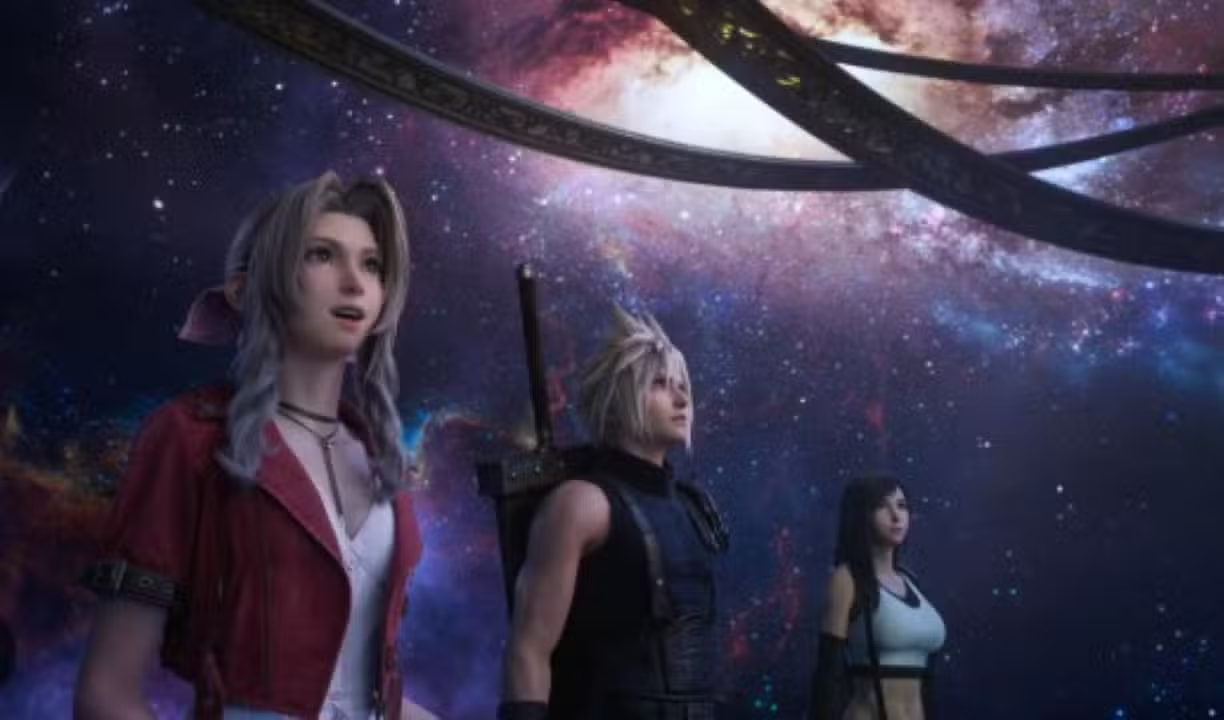
The computer gaming community has just gained a powerful alternative to overcome the graphical limitations of Final Fantasy VII Rebirth. Recently launched, the second version of the Shader Injector tool delivers an aesthetic overhaul so profound that it has been compared to an unofficial remaster, drastically improving the title’s lighting system. The project was created by programmer David Matos, who goes by the pseudonym frostbone25, and can now be downloaded for free to redefine the journey through the world of Gaia.
How the new tool changes the lighting of Square Enix’s RPG
Since the arrival of the first part of the project in 2020, the community criticized the opaque appearance of the lighting, which took away the shine of the franchise’s classic locations. To solve this obstacle, Shader Injector 2.0 works by intercepting commands from the DirectX 12 programming interface, exchanging the original files for optimized codes. This method ensures that the rendering of lights and shadows takes on a much more realistic appearance, without requiring absurdly more powerful hardware.
Among the new techniques applied are contact shadows and micro-shadows, which work in both directional light and local lighting, accompanied by a refined diffuse reflection system. The visual impact is especially evident when exploring closed environments, where the base game used to deliver artificial clarity that broke the immersion of the narrative. On the project’s official page hosted on Nexus Mods, the creator highlights that the code structure was designed precisely to raise the shading standard to a new level of quality.
Main graphical and usability additions of the update
In addition to focusing on aesthetics, the new edition of the injector brought practical facilities for those who consume this type of content. The installation process has undergone a complete review to become more intuitive, allowing users with less technical experience to apply changes without frustration. Another important gain was the improved integration with Async Mod, a utility famous for reducing the texture compilation issues that plagued previous versions of the software.
Looking at the visual part, the package introduces new codes that transform the perception of depth both inside buildings and in open areas. The highlight of this update is the redesign of the oceans and rivers, which abandon the original static texture to adopt a fluid behavior consistent with the current generation of consoles and video cards. This type of intervention carried out by enthusiasts reinforces an old culture in the computer ecosystem, where consumers themselves correct flaws left by studios.
Experimental Technologies and Performance Hurdles
The project also opens the door to the use of screen space-based ambient occlusion (SSGI) and next-generation global illumination. These cutting-edge tools aim to simulate the bounce of light with photorealistic precision across the vast maps of the continent. However, whoever installs the file will notice that these two specific options are turned off in the default configuration.
The justification for keeping these resources inactive comes up against technical limitations of the current version, as the effects lose quality on monitors with very high resolutions and suffer from the lack of suitable filters, generating graininess in the image. Despite this setback, the person responsible for the modification assured that the next update packages will have as their main focus the polishing of these technologies, seeking to deliver maximum graphical fidelity without sacrificing the frame rate per second.
How to download system compatibility files and rules
Those interested in applying this visual transformation can find the step-by-step tutorial in the official GitHub repository. All files have undergone security scans on the Nexus Mods portal, ensuring that there is no risk of malicious software for the user’s machine. The modification was programmed to run perfectly alongside other tools recognized by the community, such as FFVII Hook and the Reunion manager, not conflicting with already installed high definition texture packs.
- Simultaneous use with the popular ReShade can cause unexpected crashes, but the developer has already published an alternative method to get around the error.
- Players who use the Linux operating system or the Steam Deck do not yet have official and stable support to run the application.
- Access to the files is completely free, there is only an optional link for anyone who wants to contribute financially to the programmer’s work.
The importance of the community in preserving major releases
The collective effort to produce works of the caliber of Final Fantasy VII Rebirth highlights a historical pattern in the computer market, reminiscent of classic cases such as the FAR mod for NieR: Automata, also from the same publisher. It is common for big-budget adaptations to arrive at mice and keyboards with performance bottlenecks or underutilizing the processing power of modern machines. Given this scenario, the technical dedication of independent programmers ends up being the salvation for those looking for the definitive experience.
More than a simple adjustment of reflections in the water, the initiative proves that public engagement can make up for companies’ lack of official polish. While Square Enix directs its efforts towards closing the saga with Final Fantasy VII Revelation, scheduled for 2027, the question remains whether the Japanese producer will absorb these community solutions in its future projects. Until an official positioning takes place, the computer edition of the RPG, boosted by this injection of codes, reaches a level of visual excellence that would hardly be achieved with the studio’s routine updates alone.