

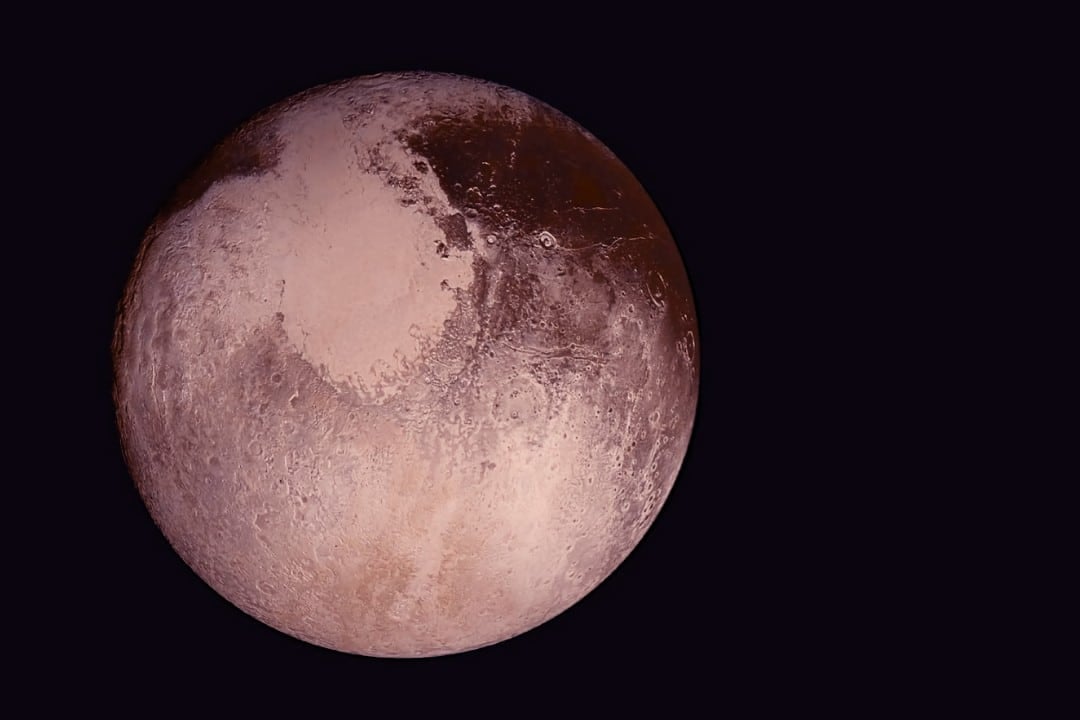
Pluto is on a trajectory of gradual cooling as it moves away from the Sun. Every 248 Earth years, the dwarf planet completes an elliptical orbit, moving considerably away from our star, and will only return to its original point in 2114. Since its discovery in 1930, this is the first time that Pluto has moved so far out in the Solar System, which could lead to the progressive freezing of its atmosphere.
A team of researchers, led by Amanda Sickafoose, senior scientist at the Institute for Planetary Science, observed in detail Pluto’s atmospheric changes during this period. The studies indicate the detection of the first signs of a collapse in the dwarf planet’s atmosphere.
In a recent article, published in the Planetary Science Journal, Sickafoose and his group described the transformations in Pluto’s atmosphere between the years 2017 and 2023. The research showed that, after the passage of the New Horizons probe in 2015 until mid-2021, the dwarf planet’s atmospheric pressure remained stable. However, from mid-2021 to July 2023, an average drop of 16% in pressure was recorded, based on models that consider a hazy atmosphere, similar to that seen by the probe.
How Pluto’s atmosphere is analyzed using stars
Currently, no spacecraft is close enough to Pluto to directly monitor its atmosphere. Seen from Earth, Pluto appears as a tiny dot, even with the use of powerful space telescopes. However, due to the continuous movement of Pluto, Earth and the stars, chance alignments, known as stellar occultations, occur. By observing the change in a star’s light as Pluto passes in front of it, scientists can characterize the composition and density of the dwarf planet’s atmosphere.
Collecting data on these phenomena is a complex process. When a star is occulted by Pluto, the resulting shadow is cast on Earth. These projections can extend over vast areas, including oceans and uninhabited regions. Therefore, researchers create maps of shadow trajectories to plan observations. Since 2017, Sickafoose and his team have monitored ten separate occultations, but only four have allowed observation of the same event from multiple points on Earth. This multicentric approach made it possible to confirm results among nearby observers and to analyze different regions of the Plutonian atmosphere by more distant teams.
“Often, our preference is to observe expected occultations that have shadow trajectories over large observatories, since this equipment and data have already proven their effectiveness,” Sickafoose said. She added that the team seeks to “improve these datasets by collaborating with local observers on shadow trajectories.”
Although Pluto has a faint brightness, which will decrease further as it moves away, the crucial point in these observations is the star’s luminosity. Telescopes take precise measurements of the amount of light captured before, during and after occultation, to record how the starlight fades and returns to visibility.
In an occultation event, the star’s brightness progressively dims. This happens because Pluto’s atmosphere bends light, and haze particles, if present, can scatter it like mist. The star then disappears entirely as it passes behind the dwarf planet’s icy body.
“It constantly amazes me how the uncomplicated technique of watching the brightness of stars dim and reappear enables us to investigate a tenuous atmosphere, equivalent to a few millionths of Earth’s atmosphere, on a celestial body that is two-thirds the size of our Moon and thirty times further from the Sun,” said Sickafoose.
By observing several occultations over several years, Sickafoose and his team were able to measure the fluctuation in atmospheric pressure.
Understanding pressure drop and fog on the dwarf planet
Pluto’s atmosphere consists predominantly of nitrogen, accompanied by other carbon-based elements such as methane and carbon monoxide, which can give rise to hazes. As atmospheric pressure decreases, these mists are expected to disperse and accumulate at lower altitudes. The precise physics of the atmosphere is not yet fully understood, but it is strongly connected to the characteristics of Pluto’s surface ices, as Sickafoose explained. Research like this, carried out during Pluto’s orbit that lasts several human generations, is essential to unraveling these mysteries.
“We live in an especially intriguing period for Pluto,” said Sickafoose. She added that “our work indicates that atmospheric pressure has recently started to decrease. I am hopeful that we will be able to collect more data in the coming years or decades to confirm or refute this trend.”




