

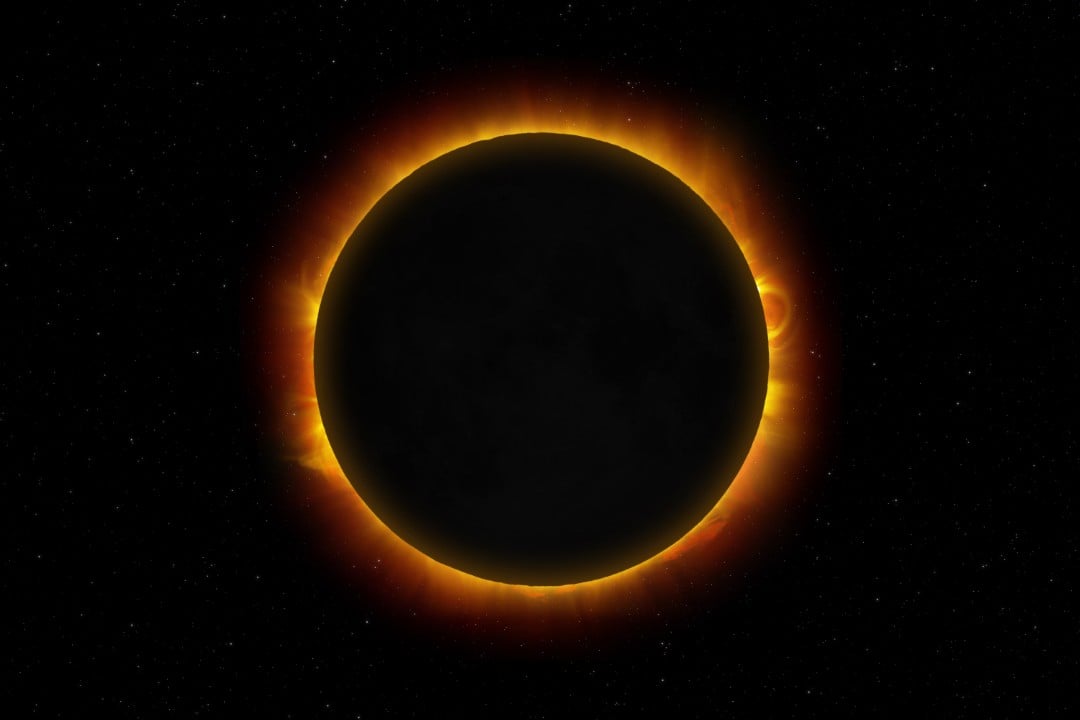
An astronomical spectacle awaits observers in Spain, Iceland and Greenland on August 12, with the occurrence of a total solar eclipse that promises more than two minutes of daytime darkness. For the first time in more than a century, the continental Iberian Peninsula will be the stage for this rare celestial alignment, which coincides with other landmark cosmic events. Expectations are high for scientists and enthusiasts who are preparing to closely monitor the perfect overlap of the Sun with the Moon.
The phenomenon, which will begin near the North Pole before heading south, will reach its point of maximum totality on the west coast of Iceland. The umbra, the Moon’s darkest shadow, will cover more than 8,260 kilometers, much of it over the Atlantic Ocean. When it reaches the coasts of Portugal and Spain, totality will last approximately one minute, ending its journey over the Mediterranean Sea. This event will serve as a prelude to an even longer eclipse next year, which will last about six and a half minutes, covering a vast area from Spain to North Africa and the Middle East.
Visibility in different regions and the importance of protection
In addition to the path of totality, a partial eclipse could be observed by hundreds of millions of people in different parts of the Northern Hemisphere. The scope of the partial phenomenon includes distant locations such as Alaska and Siberia, as well as Canada, the northern United States and much of Europe and West Africa. The intensity of solar coverage varies depending on the proximity to the main path:
- Dublin:You will see 94% of the Sun covered.
- Oslo (Norway):It will have 83% solar coverage.
- Montreal (Canada):You will experience an 18% reduction in coverage.
- New York (USA):It will record 9% decrease in sunlight.
- Norfolk (USA):You will observe 2% of the Sun’s coverage.
It is crucial to use special eclipse glasses, even when only a small portion of the Sun is visible, to ensure safe viewing.
Troubled Skies: Meteor Shower and Planetary Parade
August 12th will not only be notable for the solar eclipse. The cosmic spectacle will continue with a rare conjunction of events. Before dawn, six neighboring planets will arc across the sky, providing an unusual view for morning observers. After dark, the Perseid meteor shower will reach its peak activity under the new moon phase. The combination of a dark sky due to the totality or partiality of the eclipse and the intense activity of the Perseids may allow the observation of some of the brightest planets and stars in the background.
Eclipse cartographer Michael Zeiler expressed his excitement about searching for rare phenomena during the event. “What excites me is observing rare phenomena,” said Zeiler, who plans to point a video camera north from a cruise ship in Greenland, hoping to capture the Northern Lights during totality.
Global scientific efforts to study the eclipse
Several scientific institutions and universities are organizing observation and research efforts to maximize learning from this eclipse. The European Space Agency (ESA) scheduled a live broadcast on the internet, directly from the Javalambre Astrophysical Observatory, in Spain, in addition to a public celebration in the city of León. NASA will also carry out its own in-depth coverage, along with the Italy-based Virtual Telescope Project and other organizations.
Carole Mundell, ESA’s science director, highlighted the importance of the moment. “For me, it’s not just a scientific moment. It’s not just an incredible alignment of celestial bodies. It’s also a very human moment,” he said. Two ESA space telescopes, including Proba-3, which creates artificial eclipses, will be monitoring the Sun and its corona. Research teams from American universities will contribute by launching more than 60 high-altitude balloons from Spain and Iceland to study Earth’s atmosphere and momentary temperature changes caused by the eclipse, replicating on a smaller scale the extensive studies carried out during the 2024 total solar eclipse in North America.




