


On the night of Monday, August 3, 2026, the most popular messaging application on the planet began to experience severe instability. Millions of people around the globe report that the platform has lost the ability to process and deliver multimedia files. The defect directly affects the transfer of photographs, video recordings and documents in PDF format, although the exchange of short texts continues to operate intermittently for a portion of the public.
The tool belonging to Meta has established itself as a fundamental pillar of modern communication, replacing the old SMS text messages. Available for Android and iOS systems, in addition to having versions for computers, the software guarantees integration between personal contacts and work networks. When a breakdown of this magnitude affects servers, the routine of offices, businesses and families comes to an immediate halt.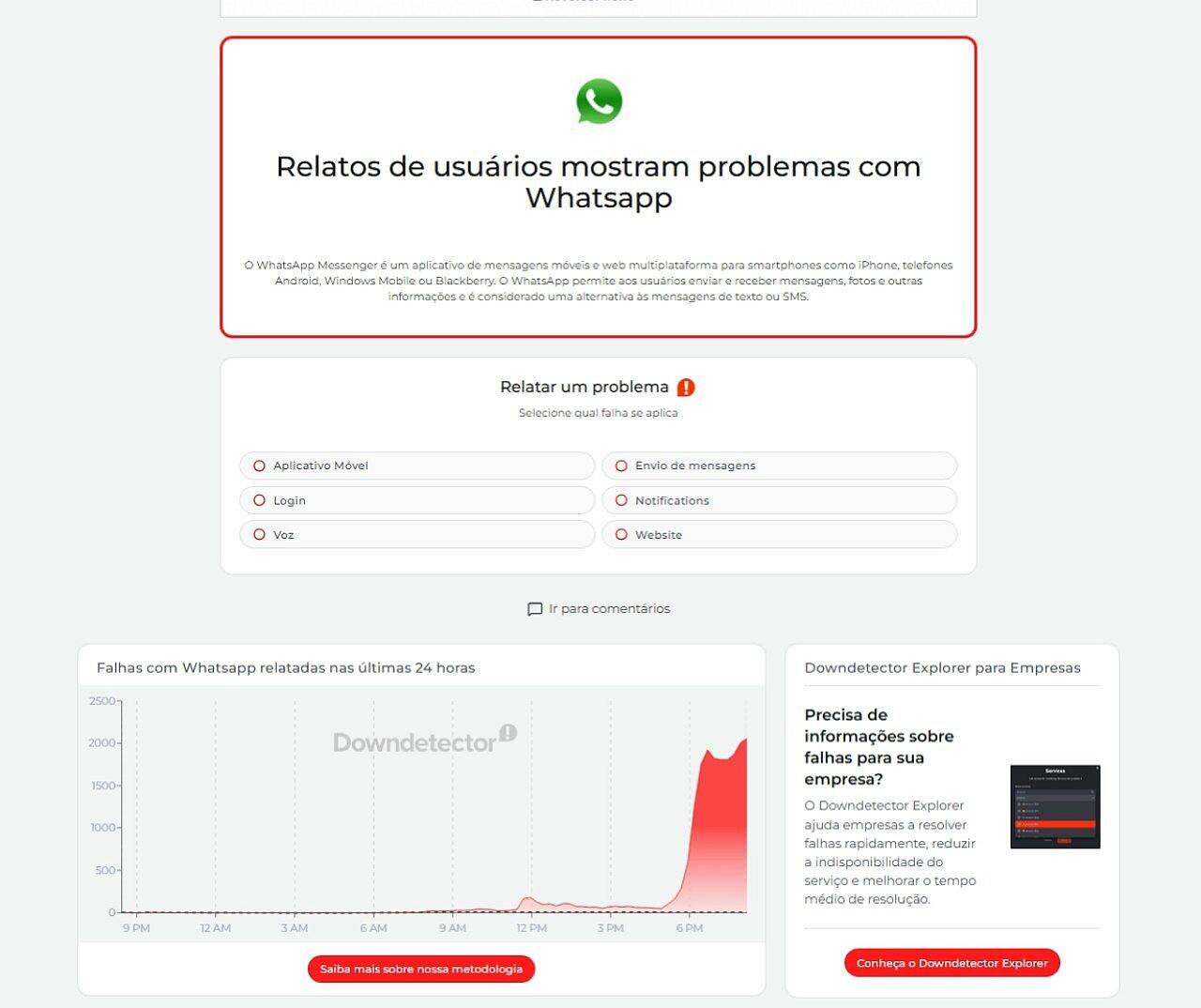
The inability to share attachments creates a huge production bottleneck, especially for entrepreneurs who depend on the virtual catalog and sending receipts. Faced with the infinite loading screen, the public quickly migrated to other social networks in search of answers and palliative solutions to keep the flow of information active during business hours and at night.
Network monitoring confirms spike in complaints about the messenger
The Downdetector portal, which specializes in tracking the status of digital services, documented an abrupt increase in error notifications during the night. The platform’s graph drew a sharp upward curve, showing that the failure is not restricted to a specific internet operator or an isolated region. This is a blackout on the servers responsible for hosting the system’s media content.
When analyzing the profile of complaints registered by internet users, it becomes clear what the core of the technical problem affecting Meta’s infrastructure is. The monitoring platform categorized the difficulties faced by people in the last few hours as follows:
- Approximately 64% of notifications indicate a complete blockage in sending messages with attachments, blocking the output of any large file.
- Around 32% of the records describe general instabilities in the functioning of the cell phone application, including slowness and unexpected closing.
- The remaining 2% point out obstacles to connecting or synchronizing the account through the web interface on computer browsers.
These numbers reflect a common pattern in content distribution networks (CDNs) outages, where the text, which requires little bandwidth, can pass through the servers, but larger data packets are retained at the source.
Consumers detail failures and notice variations between devices
Comment boxes on technology sites and online forums were flooded with reports of frustration. The main complaint lies in the fact that the text reaches the recipient, but the image remains with the clock icon, without ever completing the upload. Thales André Oliveira recorded at 8:11 pm that only written words reached his contacts, while the audiovisual material remained retained on the device.
A few minutes earlier, at 8:07 pm, Gabriela Grossmann expressed her irritation with the same limitation, confirming that text was the only functional route. Leandro Braz, at 8:06 pm, added an important technical detail: in addition to the photos, the sticker packs also stopped loading. He noted that the system was even able to receive files from those who had already sent them before the crash, but the exit route was completely blocked.
A curious aspect of the August 3, 2026 crash involves the behavior of the software on different brands of smartphones. Rafael Otto Tietjen reported at 7:49 pm a discrepancy inside his own home. While his wife’s iPhone operated without any restrictions, his Xiaomi device refused any attempt to upload images. This asymmetry suggests that the communication failure with Meta’s servers may be affecting specific routes from different operating systems.
Temporary tricks help keep the workflow active
Faced with the urgency to dispatch documents and approve artwork, the digital community began testing loopholes in the system to circumvent the blockade. Bruno Giordano, at 7:55 pm, made a complete mapping of what was offline, listing formats such as PDF, JPG and PNG. However, he found that the browser version and the Windows installable program maintained stability. When migrating to the computer, he was able to transfer all pending material, proving that the bottleneck was concentrated in the mobile application.
Other internet users validated this same escape route. Wilson Oficina da Alma Filhas, at 7:51 pm, instructed his peers to open the desktop interface to ensure the delivery of contracts and receipts. Synchronization via QR Code on the monitor proved to be the most robust alternative for those who could not wait for mobile servers to normalize.
User Luan, at 7:29 pm, found a creative outlet within his cell phone: setting the photograph to “single view” mode. For some technical reason linked to encryption or the temporary server for this function, images configured to disappear after opening continued to be processed normally by the network, offering immediate relief for urgent shipments.
Lack of company positioning prolongs public uncertainty
Despite the magnitude of the event and the direct impact on the lives of billions of individuals, Meta remained silent during the first hours of the instability. No official statement was released through press channels or corporate profiles on other social networks. This lack of transparency prevents information technology professionals and ordinary users from knowing whether they should wait for a quick fix or look for competing tools for the next day’s work.
The partial media blackout highlights the extreme global dependence on a single communications ecosystem. When content distribution servers fail, the damage goes beyond the personal sphere and directly affects the small business economy. Now, the community is waiting for the company’s engineering team to reestablish connections and, subsequently, release a technical report explaining what led to the abrupt drop in services this Monday.




