The end of the era of large reptiles, which occurred about 66 million years ago, involved a sequence of events much more lethal than science had calculated. When the celestial body hit the region of the current Yucatán Peninsula, in the Gulf of Mexico, the impact did not just cause prolonged global cooling. The collision generated flame storms on a planetary scale with devastating force, capable of charring the megafauna of the time in a matter of minutes, changing the way researchers understand the first moments of the tragedy.
Recent research details the first moments after the formation of the Chicxulub crater
For decades, the scientific community maintained that mass die-offs resulted primarily from a lack of sunlight and the resulting famine generated by atmospheric blockage. However, updated analyzes show that the annihilation began instantly and violently. The approximately 10 kilometer long meteoroid, traveling at an estimated speed of 20 kilometers per second, crashed into present-day Mexican territory. This colossal force opened the Chicxulub crater and launched billions of tons of vaporized Earth’s crust directly into space.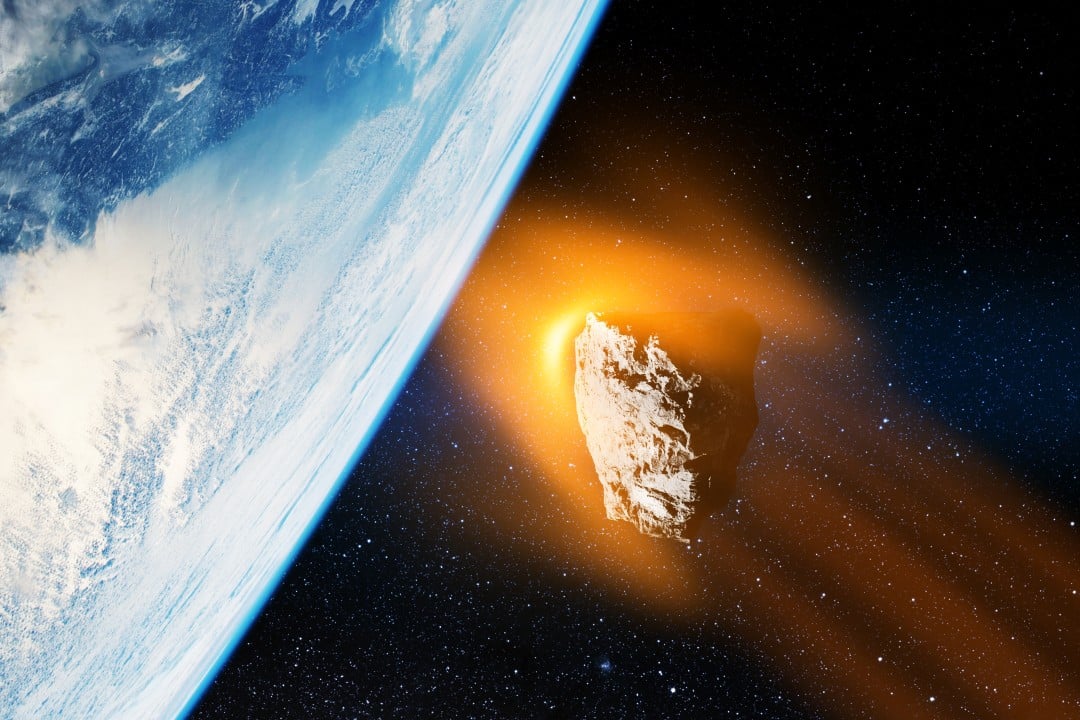
A gigantic fraction of this ejected matter cooled rapidly outside the atmosphere, forming small glass droplets called spherules. As they fell back towards the surface under strong gravitational pull, the friction with the air transformed the energy of the movement into a wave of extreme heat. Simulations carried out in the past indicated that this radiation would seriously affect unprotected creatures, but the numbers did not indicate enough energy to initiate the widespread burning of flora on all continents.
Presence of silicate in the atmosphere acted as a global thermal amplifier
The error in the old projections was the absence of a fundamental component during mathematical calculations: a dense cloud composed of microscopic silicate particles. This particulate material derived from molten rock that did not coalesce into spherules. Material proof of this atmospheric dynamics was documented in 2023, during excavations at the Tanis paleontological site, located in the state of North Dakota, where geologists mapped a band of this fine dust deposited just above the impact glass layer.
Identical traces of this mineral soot also appear on the K-Pg geological boundary, the stratigraphic mark dividing the Cretaceous from the Paleogene, found in the Raton Basin between Colorado and New Mexico. Purdue University planetary scientist Brandon Johnson, who led the survey, explained that the observation of these sediments motivated the team to investigate the behavior of the residual vapor. According to the researcher, understanding the fate of this cloud was the starting point for recalculating that day’s temperatures.
Radiation wave reached fatal levels far exceeding biological tolerance
Particles suspended in the air created an instantaneous and reverse greenhouse effect, blocking the dissipation of energy. Instead of the heat generated by the friction of the spherules being lost in the vacuum of space, the dust barrier bounced the thermal load back to the ground. The data processed by the team indicates that the temperature felt at sea level was three and a half times stronger than estimates based exclusively on the rain of glassy fragments.
This jump in temperature raised the radioactive load to a level of almost absolute lethality for life on the surface. The survey shows that fauna exposed to the open air absorbed an amount of thermal energy 17 times greater than the biological limit supported by a modern human being before dying. Johnson emphasized the aggressiveness of the phenomenon, stating that environmental conditions wiped out virtually any unprotected organism within the first two hours after the collision.
Although the initial irradiation did not have the strength to directly set fire to thick tree trunks, the heat easily surpassed the burning point of low vegetation. Dry foliage, mosses, lichens and small shrubs spontaneously ignited, creating a chain reaction that fueled uncontrollable forest fires. The scenario described by scientists points to lightning destruction caused by fire, long before darkness and cold took over the planet.
Underground refuges ensured the survival of species during the cataclysm
Escaping this open-air furnace required specific geographic conditions, limiting survival to groups of animals capable of hiding. Species that inhabited burrows deep in the ground or that lived submerged in rivers and oceans achieved sufficient thermal insulation to withstand the radiation peak. The geological paradox revealed by the study is that the exact same silicate cloud responsible for cooking the surface in the first hours acted, in the following years, as an impenetrable shield against sunlight, generating global freezing.
- The collision of the celestial body in the Chicxulub region marks the extinction event that occurred 66 million years ago.
- Microscopic silicate particles acted as a thermal mirror, trapping energy in the lower atmosphere.
- The heat load shot into the ground exceeded a human’s thermal survival limit by 17 times.
- The global fire started from the spontaneous combustion of small plants and dry foliage.
- The preservation of animal life depended strictly on isolation in terrestrial dens or aquatic environments.
A geographical obstacle still challenges the definitive consolidation of this hypothesis about the planetary firestorm: the main traces of coal and fossilized ash are concentrated in North America. Paleontologist Alfio Alessandro Chiarenza, a researcher at University College London who was not involved in the article, believes that science still needs to map other regions. He points out that future excavations may reveal records of fires on other continents, proving the truly global scale of the initial combustion.