
Unprecedented observation reveals how black hole expels half of the matter devoured into space

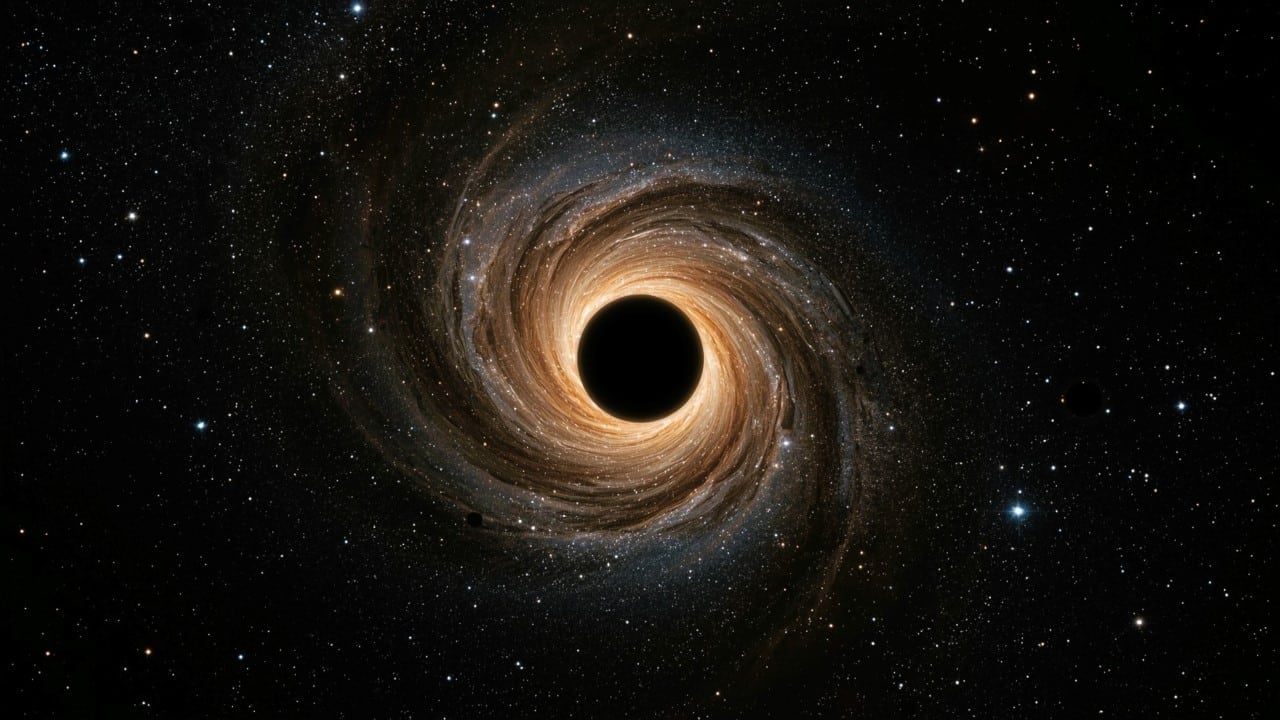
The Very Large Telescope (VLT), one of the world’s most advanced optical instruments operated by the European Southern Observatory (ESO) in Chile’s Atacama Desert, has captured stunning images of the behavior of a black hole located about 8,800 light-years from our planet. The detailed analysis of the binary system called Swift J1727.8−1613, which gained notoriety in the astronomical community after a colossal explosion recorded in the year 2023, shows that these gravitational giants are far from being perfect suckers. In fact, the most recent data prove that the process of absorption of stellar matter is extremely chaotic and results in an immense waste of energy and mass into outer space, rewriting what was known about the power of these anomalies.
Chaotic absorption dynamics challenge long-held theories about extreme gravity
During the peak of its recent activity, the study target quickly transformed into one of the most intense X-ray emitting spots ever detected from Earth, drawing the attention of global observatories. Experts noticed that, as the singularity tried to swallow the incandescent plasma of a neighboring star, a colossal amount of particles were thrown out through very strong winds and jets fired at very high speed. This phenomenon breaks the popular myth consolidated over decades that everything that approaches the event horizon disappears forever like a cosmic vacuum cleaner, evidencing, on the contrary, a highly sophisticated and turbulent feedback mechanism.
The functioning of the accretion disk and the continuous theft of stellar matter
The architecture of Swift J1727.8−1613 sets up a classic binary system, where the relentless gravitational pull of the densest object systematically strips away the outer layers of a companion star that has the misfortune of orbiting too close. Because of the natural rotation of the system and the conservation of angular momentum, this superheated gas does not plummet in a straight line into the darkness, but forms a flat, violent whirlpool around the central anomaly, known in astrophysics as an accretion disk. The extreme friction between subatomic particles in this ring generates unimaginable temperatures, resulting in the blinding glow that X-ray instruments can capture passing through the interstellar dust of the Milky Way.
The great difference of this survey, conducted by researcher Noel Castro Segura, linked to the University of Warwick, in England, was the technical capacity to monitor the structural changes of the disc over several months of continuous observation. Instead of just recording an isolated moment and trying to guess the rest, the team was able to create a kind of visual timeline of the astronomical event in real time. The follow-up proved that the spiral gas structure undergoes drastic mutations and changes shape exactly at the moment the radiation jets are fired into the cosmos, showing a direct link between what falls and what is ejected.
Space winds and the surprising mathematics of cosmic waste
One of the most intriguing findings of the research points out that the largest peaks in particle expulsion occurred at times when the black hole’s absorption rate was much lower than scientists expected. This means that “digestion” follows complex physical rules, where radiation pressure and intense magnetic fields act as essential escape valves to alleviate the accumulation of matter. The researchers were able to record the exact transition between material spiraling toward inevitable destruction and material gaining a magnetic boost, being ejected at speeds reaching a significant fraction of the speed of light.
To understand the magnitude of this ejection event, astronomers mapped the system’s mass balance during the long lull that followed the main X-ray burst. The processed data revealed impressive metrics about the behavior of dense gas and the singularity’s true appetite:
- Stellar wind production remained highly active long after the peak luminosity had disappeared from initial radars.
- The amount of matter flung back into deep space is virtually identical to the mass that crossed the event horizon.
- Calculations indicate that about fifty percent of all the “meal” stolen from the neighboring star was returned to the universe.
The impact of discoveries on the future of astrophysics and galactic evolution
After thoroughly analyzing these outflows, researchers realized that they will need to reevaluate current mathematical models that explain the survival, evolution and death of binary systems spread throughout the universe. If a black hole throws away half of its food even during periods of greatest gravitational instability, its actual growth rate is much slower and inefficient than traditional astrophysics calculated in academic textbooks. This feeding inefficiency completely changes how scientists project the future of massive stars orbiting compact companions, suggesting that these destructive partnerships could last millions of years longer than predicted.
Monitoring all phases of this feeding frenzy gave the scientific community an unprecedented view of fluid mechanics in extreme gravity environments, something impossible to replicate in terrestrial laboratories. According to Kyle Solomons, a researcher at the University of Cape Town in South Africa, the end of the absorption cycle proved to be as violent and full of valuable data as the initial flash that alerted telescopes last year. The study now serves as a fundamental basis for future space missions that will attempt to map and understand other similar systems, helping to uncover the role of black holes in recycling matter within galaxies.





