
Scientist calculates the golf swing needed to send a ball into the Milky Way’s black hole


NASA’s Voyager 1 probe currently takes 23 hours and 39 minutes to have its traveling light reach Earth in one direction. The spacecraft will reach the one full light day mark on November 18, 2026, which means that if there were astronauts on board, they would wait two days for a response to any request for information.
Currently, Voyager 1 is 25.53 billion kilometers away, a measurement that is equivalent to 170.68 times the distance between Earth and the Sun. For interstellar missions that extend far beyond this point, it is crucial that the spacecraft have autonomy in local decisions, without depending on control centers like NASA. This calls for the use of artificial intelligence (AI) in future deep space exploration. Voyager 1, however, was launched without this technology, and its 50th anniversary will be celebrated on September 5, 2027.
Voyager 1’s radioisotope thermoelectric generators (RTGs) are capable of providing electrical power for sending engineering data for another decade. When crossing the Oort Cloud and, subsequently, interstellar space, the probe should not suffer major damage from micrometeorites or dust particles. Its speed of 32.4 kilometers per second, about 0.001 the speed of light, is considered modest in relation to the Local Standard of the Rest of the Milky Way. Voyager 1’s speed is the result of the combination of its ejection speed from the Solar System, 17 kilometers per second, with the Sun’s speed in relation to the local galactic reference frame.
Voyager 1’s speed is an order of magnitude slower than the galactic rotation speed of the Sun, which is 240 kilometers per second around the center of the Milky Way, as measured by Mark Reid. This means the probe’s orbit will deviate from a perfect circular trajectory around the galactic center. Its motion can be described as a smooth guiding center in a perfect circle and a local oscillation around that center known as “epicyclic oscillation”. Over a period of one billion years, Voyager 1 will move to the opposite side of the Milky Way from the Sun, according to calculations by Shokhruz Kakharov and Avi Loeb.
The disk of the Milky Way contains about 30 billion Sun-like stars. Recent exoplanet research indicates that approximately one-tenth of these stars host a planet with a mass similar to Earth, located at a distance comparable to Earth’s orbit. The idea of cosmic modesty suggests that similar conditions should generate similar results. Thus, from chemical compounds in liquid water, the surfaces of these planets could develop space programs capable of launching ships like Voyager into interstellar space.
Half of the stars that resemble the Sun formed about 2 billion years before our own star. If a portion of these stars originated space agencies that sent an “N” number of Voyager-like ships, then there would be an estimated population of 150 times “N” million of these spacecraft gravitationally bound to the disk of the Milky Way. Most of the civilizations that launched them probably no longer exist, making the search for radio signals futile. However, its technological components could be crossing our “galactic backyard” as inactive interstellar objects, accumulating in interstellar space like “plastic in the ocean”, offering testimony to archaeologists and historians about the technological evolution of the Milky Way. Our own interstellar probes could, in the future, be remembered in the galactic historical record before the inevitable end of human civilization.
To date, the space agency NASA has launched five interstellar probes in the last 50 years: Voyager 1 and 2, Pioneer 10 and 11, and New Horizons.
Considering a typical civilization that contaminates interstellar space with ten million probes during its existence, and all of them become inactive space junk, the closest would be at a distance of 15 light days from us. This distance is only 15 times greater than that of Voyager 1 and would still be within the Oort Cloud.
Furthermore, if a substantial portion of these spacecraft were still active and some of them targeted the Solar System’s habitable zone for resources, we could find interstellar technology near Earth right now, analogous to how bees gather near a flower.
For probes to reach our system from the other side of the Milky Way, it is not necessary to travel faster than light. The 1970s rocket technology used by Voyager 1 would be sufficient for this journey.
Physicist Roy Kerr, who developed the spacetime concept of a rotating black hole, asked, “How many golf shots would it take to get a ball to the Galactic Center?” Scientist Mark Reid correctly realized that it would be enough to throw a ball in the opposite direction to the galactic rotation to nullify the orbit, causing the ball to fall in a straight line towards the Galactic Center. Assuming that a golf professional’s swing adds 80 meters per second to the ball’s speed, calculations indicate that 3,000 strokes would be needed for this task. One shot every 30 seconds would take just one day of “space golf” to negate the galactic rotation speed of 150 miles per second.
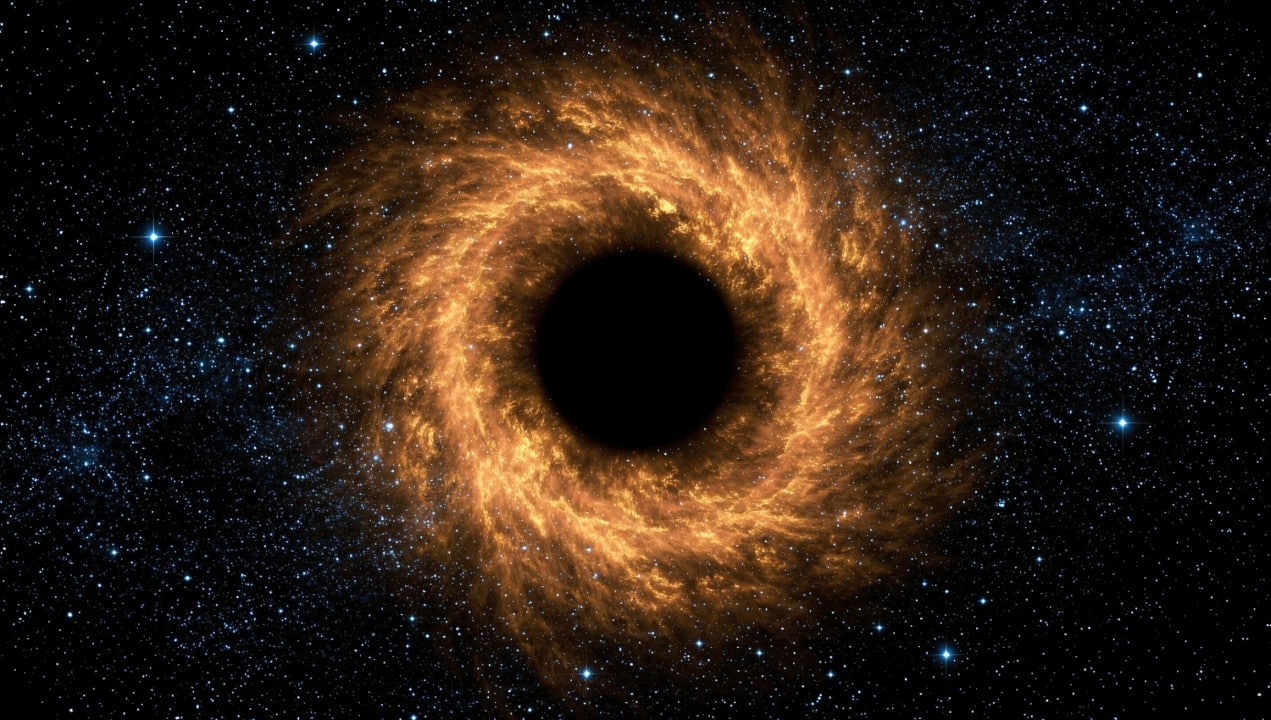
After speed cancellation, the golf ball would take approximately 50 million years to reach Sagittarius A*, the supermassive black hole at the center of the Milky Way.
Considering that a conventional golf course has 18 holes, it would be an extraordinary interstellar tournament if all the technological civilizations competed in the Milky Way, trying to direct their “golf balls” towards the central black hole.
A question that naturally arises is: what fraction of the interstellar matter currently accumulated in Sagittarius A* is in the form of “interstellar golf balls”? Answering that question should be a next goal for the Event Horizon Telescope, an initiative led by members of Harvard’s Black Hole Initiative project, of which Avi Loeb was founding director.
Estimating billions of civilizations, each launching a quadrillion “golf balls” throughout their existence, the average rate of mass accretion of these balls over a period of 10 billion years would be 10⁻¹⁷ solar masses per year, which represents about one billionth of the current rate of accretion in Sagittarius A*. For the “golf matter” to compete with the remaining matter entering the black hole, each civilization would need to launch 10²⁴ golf balls, consuming about one percent of Earth’s mass.





