
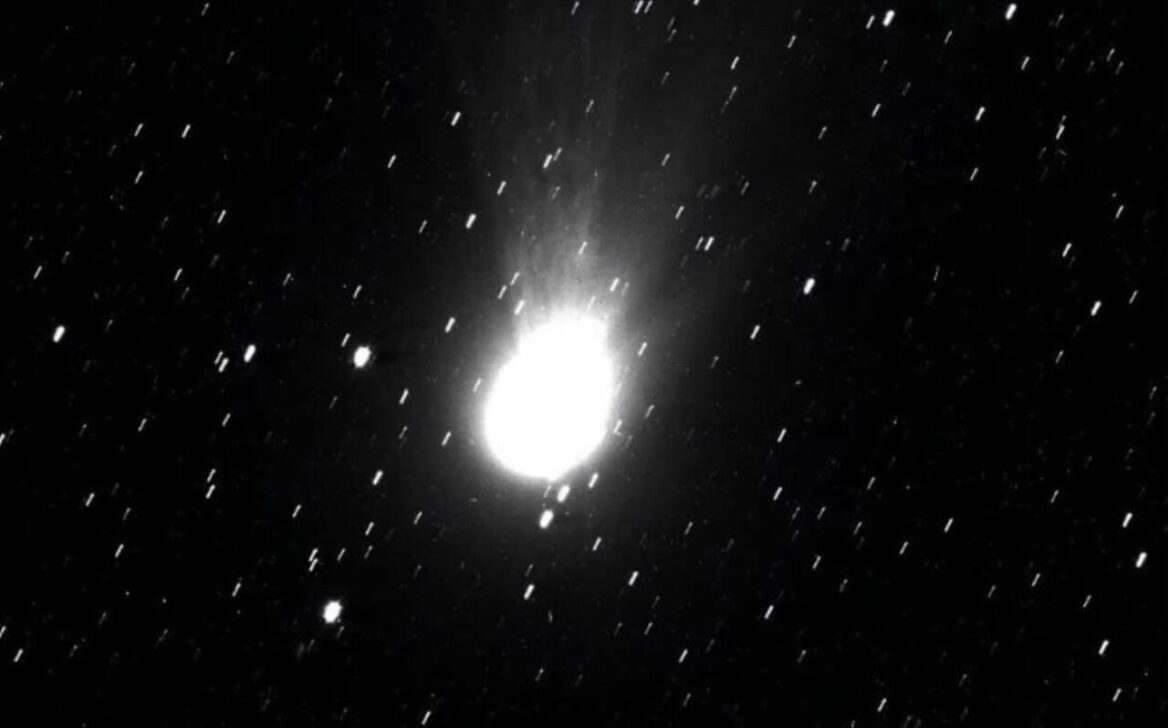
On August 5, 2026, the scientific community continues to reflect on the possibilities opened up by the detection of interstellar objects. Over the last decade, astronomers have identified three celestial bodies larger than football fields, 1I/`Oumuamua, 2I/Borisov and 3I/ATLAS, that crossed our Solar System. These events represented unique opportunities, seen in retrospect, for the implementation of technological devices, something that our civilization has not yet achieved.
Technology ambassadors for the Milky Way
If our technology had been more advanced, it would have been possible to have inserted a probe into these visitors. Such objects, like 3I/ATLAS, travel at speeds much higher than the five artificial probes that humanity has already sent into interstellar space. This rapid displacement capability could allow interstellar objects that approach Earth, before the Sun evaporates the planet’s oceans in a billion years, to transport hundreds of millions of Earthly messengers across the Milky Way. These technological emissaries could camouflage themselves as natural bodies, acting as “Trojan horses” to penetrate even protected areas of extraterrestrial civilizations.
These devices would be designed to activate when the light from a nearby star reaches a habitable level, around one kilowatt per square meter. The ideal maneuver would involve separating the interstellar host ship in a direction perpendicular to the gravitational acceleration at the point of closest approach to the star. An Oberth maneuver, contrary to the original ship’s speed, would be the most effective way to use its engines to slow down and reach the desired orbit. Subsequently, the search for planets with conditions for biological life could enable directed panspermia, seeding life on other worlds.
Calculations indicate that hundreds of these probes could reach the habitable zone of Sun-like stars within a billion years. If a portion of the civilizations in the Milky Way were to engage in such activity, all of the galaxy’s habitable zones could be visited by technological travelers in interstellar objects in just one-tenth of the galaxy’s age.
Self-replicating spacecraft challenges
A civilization with even greater ambitions could create self-replicating spacecraft that would land on planets and reproduce themselves from raw materials, as envisioned by John von Neumann around 1950 and by Ronald Bracewell a decade later. However, developing a self-replicating spacecraft is a considerable challenge, as it requires the ability to escape the gravity of the planetary body where replication occurs. This involves not only building semiconductor factories for artificial intelligence chips from local resources, but also enabling these robots to build their own ships that will transport them to other star systems.

A more viable alternative would be to use interstellar objects themselves as a source of raw materials for building spacecraft. This method would eliminate the need to perform safe landings and then overcome a planet’s gravitational pull. An interstellar object already has the raw materials and is already traveling above the escape velocity of any specific planetary system. Over the history of the Milky Way, an advanced civilization could have produced billions of interstellar spacecraft from these natural objects, on a scale equivalent to a football field, a thousand times larger than any payload ever launched by humanity into space.
Project Galileo and the investigation of UAPs
It is still necessary to verify experimentally whether this idea was actually applied by alien civilizations in our universe. This investigation is the main focus of the Galileo Project, led by Professor Avi Loeb, which searches for extraterrestrial technological artifacts close to Earth. The Galileo Observatories determine the distances of anomalous objects through observations made from three monitoring units, spaced 10 kilometers apart.
Currently, the project analyzes Unidentified Anomalous Phenomena (UAPs), comparing the speeds recorded with those of human-made objects.
In parallel, the UAP Scientific Advisory Council (UAPSAC), also under the direction of Professor Avi Loeb, is engaged in the study of UAP data collected by the United States government.