

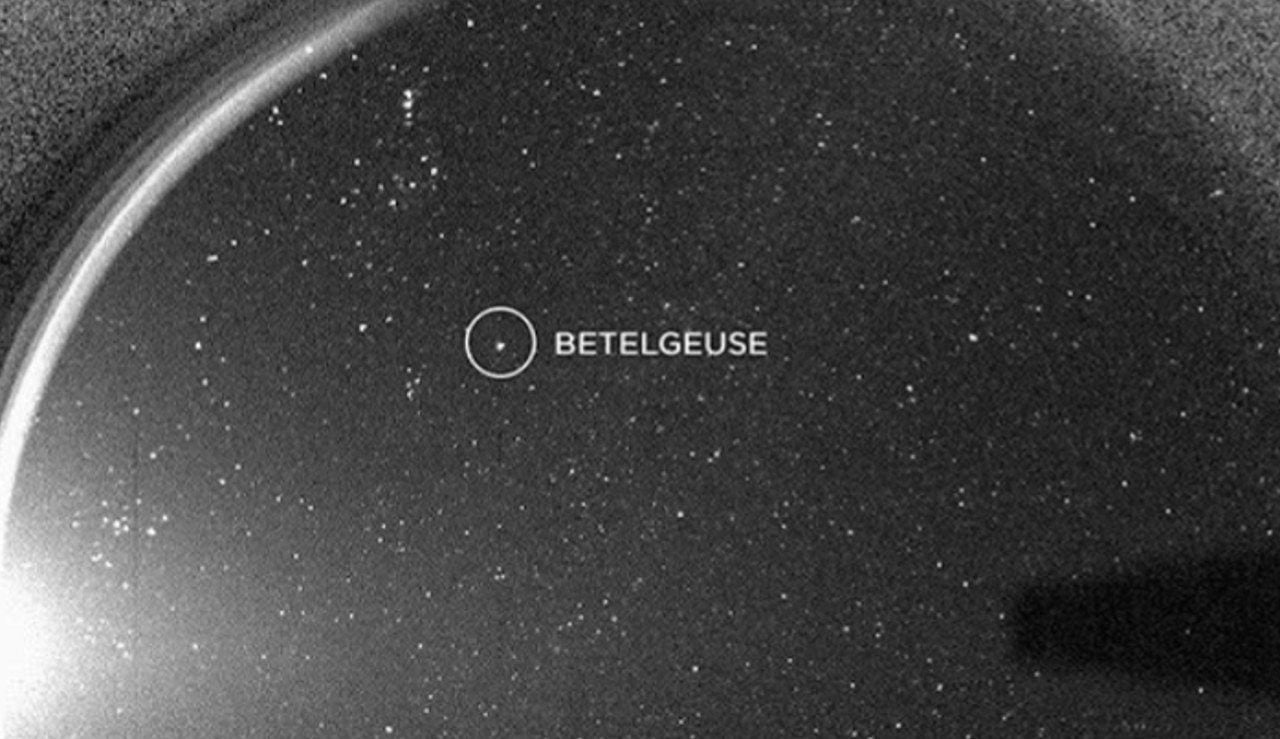
New telescope observations have provided the strongest evidence yet that the bright red star Betelgeuse is, in fact, a binary system. This discovery may finally solve a decades-old mystery about the famous “shoulder star” in the night sky, after astronomers captured the clearest image of a small star positioned next to the supergiant Betelgeuse.
Betelgeuse, the reddish star that marks the shoulder of the constellation Orion, has been a landmark for celestial observers for millennia. Now, it looks like she may have had her own company all this time.
Astronomers have confirmed they have obtained the highest-definition image of a faint star closely orbiting Betelgeuse. They consider this the strongest proof yet that the renowned red supergiant is not alone. The revelation was made by the European Southern Observatory (ESO) on July 28 and detailed in an article recently published in the journal Astronomy & Astrophysics.
Considered one of the ten most luminous stars visible from Earth, Betelgeuse goes through natural cycles of expansion and contraction every 400 days, resulting in variations in brightness, according to information from NASA. However, for years, scientists have wondered about an additional cycle: a slower darkening and lightening that occurs every six years and deviates from the standard 400 days.
Two research teams, acting independently — one under the leadership of astrophysicist Morgan MacLeod of Harvard University, and the other with Jared Goldberg, a postdoctoral fellow at the City University of New York — have developed models for this long-term oscillation. Using brightness and velocity data collected over decades, both groups came to the same conclusion: the enigmatic pattern was caused by a hidden companion star, rotating so close to Betelgeuse’s bloated surface that it was virtually impossible to detect.
However, the projections they calculated indicated a period, in December 2024, when this companion star would be far enough away from Betelgeuse so that it could be photographed.
Thus, in December of that year, a team led by astronomer Miguel Montargès, from the Paris Observatory, directed the Very Large Telescope from the European Southern Observatory to Betelgeuse. After months dedicated to analyzing the data collected, the effort was rewarded: they found what is believed to be the companion star, now named Betelgeuse B.
“It is remarkable that we can still discover a close companion, more massive and luminous than the Sun, orbiting such an intensely studied star,” Montargès said in an ESO statement. He added that “these are some of the most rewarding moments in science: spotting something new and unexpected.”
The discovery brought a surprise: the companion star turned out to be more robust than expected. Although scientists estimated that it had a mass equivalent to our Sun, the new images indicate that it is actually two to three times heavier, which also makes it brighter and easier to detect than predicted.
Despite the evidence, researchers say they need one more image of the star. “To be absolutely sure that the companion really exists, we need to observe it again in a year, on the other side of the star, but there is already very little room for doubt,” said Montargès.
If confirmed, the discovery has the potential to redefine astronomers’ understanding of Betelgeuse’s ultimate fate. As a red supergiant, it is in its terminal phase and will eventually explode in a supernova — although determining the exact date of this event is a considerable challenge, according to Montargès. “The question is whether this companion will have any impact on the evolution of the red supergiant,” explained Montargès.





