
European telescope records Betelgeuse’s companion star and solves mystery
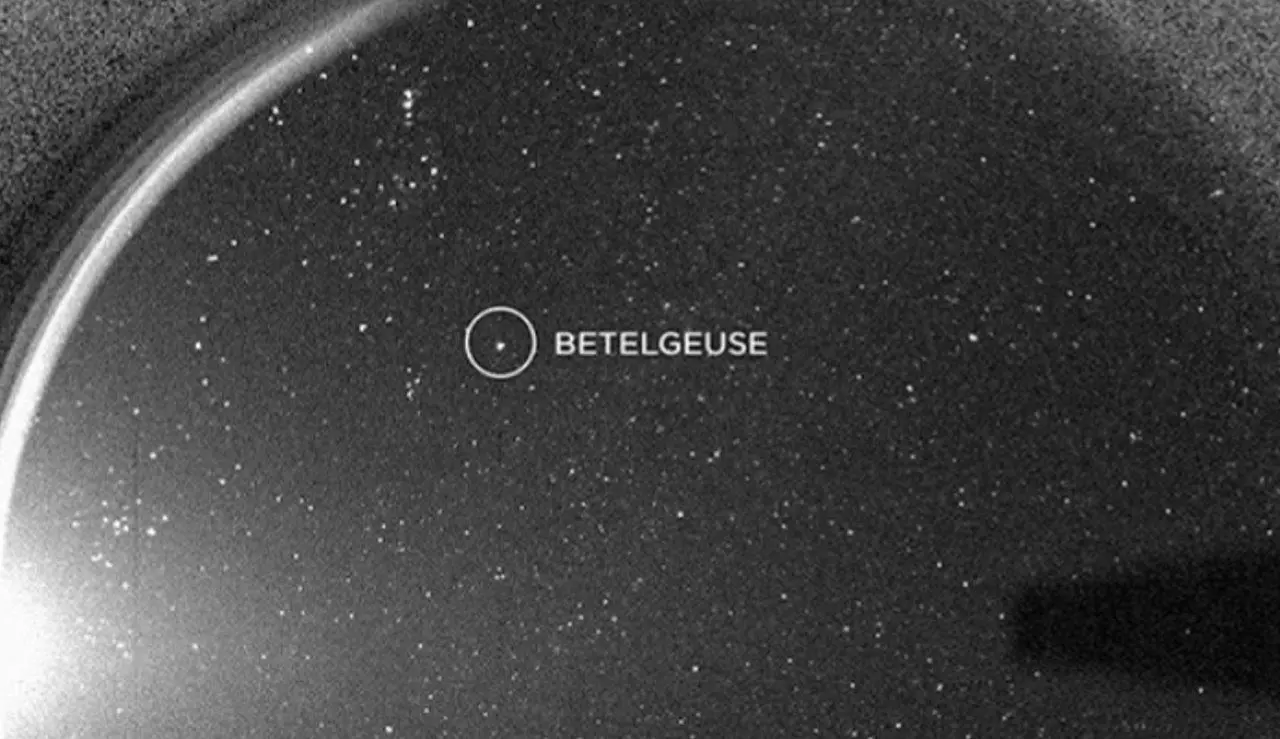
Researchers have managed to record the most compelling proof yet that the famous red supergiant located in the constellation Orion does not orbit alone in space. Recent images captured by high-precision equipment revealed the presence of a smaller celestial body positioned exactly next to the main star. The finding ends decades of academic debate about the irregular brightness behavior of this star, which is approximately 650 light-years from Earth. Visual confirmation transforms the classical understanding of one of the brightest points in our night sky.
Popularly known for forming the shoulder of the hunter’s figure in the constellation Orion, the supergiant has always served as a guide for navigators and space observation enthusiasts throughout history. The new data shows that, throughout these millennia of human observation, the massive star kept a gravitational partner hidden by its own intense brightness.
Scientific publication details the unprecedented visual capture of the binary system
The very high resolution photographic record showing the secondary celestial body was validated by international experts after rigorous analysis. The European Southern Observatory (ESO) made the discovery official at the end of July, accompanied by a complete peer-reviewed study. The technical details of the astronomical find made the pages of the prestigious scientific magazine Astronomy & Astrophysics, consolidating the theory that the system is effectively composed of two stars.
More on this story: Betelgeuse revelation: Giant star is actually a binary system
Classified in the group of the ten brightest stars that can be seen with the naked eye from our planet, the supergiant has its own dynamics of physical expansion and retraction. The American space agency, NASA, documents that this natural movement lasts approximately 400 days, causing normal fluctuations in the luminosity that reaches Earth. The problem that intrigued the scientific community was a second, much longer, darkening cycle, which occurred strictly every six years and did not fit into known thermodynamic models.
Researchers from American institutions predicted the exact location of the star
The theoretical solution to the enigma emerged from the simultaneous work of two distinct groups of astrophysicists in the United States. Morgan MacLeod, a researcher at Harvard University, and Jared Goldberg, working at the City University of New York, created complex computer simulations to understand the long-term anomaly. By crossing historical information on radial velocity and light variation accumulated over decades, scientists concluded that only the gravitational force of a second celestial body, rotating very close to the outer layer of the main star, could explain the visual phenomenon.
Read also: Unpublished telescope images show Betelgeuse as a double star, solving ancient mystery
The mathematical calculations generated by the American teams went beyond just suggesting the existence of the hidden object in deep space. The models indicated a specific window of opportunity, pointing out that in December 2024 the orbit would move the companion far enough away from the red supergiant’s blinding glare. This temporary separation would create the perfect setting for an attempt at direct photographic recording from ground-based telescopes.
Observatory in Chile makes historical record of the new companion star
Relying on mathematical projections prepared in the United States, astronomer Miguel Montargès, linked to the Paris Observatory, organized an observation campaign at the end of last year. The team used the power of the Very Large Telescope, the European Southern Observatory’s infrastructure installed in the Chilean desert, pointing the mirrors directly at the target. Processing the raw data took months of painstaking work to reveal the clear presence of the celestial body, which was technically named Betelgeuse B.
The leader of the observation team expressed enthusiasm with the result of the project in an official statement released by the European institution. Montargès highlighted the magnitude of the feat by managing to identify a massive object orbiting one of the most monitored stars in the history of modern astronomy. The scientist classified the experience of viewing something totally unexpected in the telescope’s data as the pinnacle of space research work.
Understand the case: Astronomers reveal unprecedented image of the hidden star orbiting Betelgeuse
Physical characteristics of the new celestial body surprise the scientific community
The preliminary analysis of the image captured in Chile yielded data that contradicted the initial expectations of theoretical physicists. The original simulations pointed to an object with a mass similar to that of our Sun, but the recorded light signature revealed much greater proportions than initially calculated.
Data extracted from direct observation established new parameters for the newly discovered system, changing the understanding of local dynamics:
- The mass of the secondary body is equivalent to two or even three times the total weight of our Sun.
- The smaller star’s own light emission is significantly higher than mathematical models predicted.
- The large size and brightness made it easier for the terrestrial telescope’s infrared sensors to capture the image.
Next steps involve continuous monitoring and study of the end of the system
Even with the photographic record in hand, the rigor of the scientific method requires additional verification steps to rule out any optical anomaly. The Paris-based team plans a new round of observations a year from now, when the orbit puts the object on the opposite side of the main star. This second image will serve as definitive and unquestionable proof of the existence of the binary system, eliminating the small margin of doubt that still remains about the capture.
The definitive confirmation of this scenario profoundly changes studies on stellar evolution in the Orion constellation. As it is a red supergiant in an advanced stage of life, the main star is inevitably heading towards a massive explosion, known in astrophysics as a supernova. The researchers’ big challenge now is to calculate how the strong gravitational interaction of this newly discovered neighbor will accelerate, delay or modify the final collapse of the entire cosmic structure.
More news in Latest News (EN)
See more → Sony clarifies launch timing and hardware price plans for PS6
 Sony PlayStation 6 cost nears $950 as memory prices climbAfD state election triumph prompts urgent review of Germany’s democratic foundationsAaron Judge returns to Yankees lineup, igniting playoff push after three-month rib injury absenceHigh-altitude tragedy: Climber perishes after fall on Aspen-area 14er summitEgyptian TV personality and 11 co-defendants condemned to death for large-scale synthetic drug trafficking
More news on Mix Vale
- 1Somali piracy resurgence threatens shipping lanes amid regional conflicts and Red Sea disruptions
- 2Kyiv faces renewed ballistic missile assault after U.S. envoys’ peace mission concludes
- 3Families turn to online networks for flood victim data amidst official silence near Tibet border
- 4Indian civil servant gains widespread social media fame leading aggressive food safety crackdown
- 5PlayStation 6 component bills surge to $960 amid memory crunch
- 6Rockstar North adds canine waste throwing to GTA 6 world
- 7Rockstar North details dog mechanics and street combat in GTA 6
- 8Corporate ChatGPT users gain custom text style replication
- 9Workplace ChatGPT starts copying individual writing styles
- 10Top Ukrainian prosecutor resigns following probe into vast illegal call center network scheme