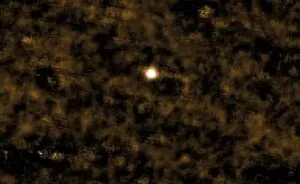
Extreme heat from the Sun threatens to destroy the third interstellar comet ever discovered

A cosmic visitor of singular proportions has his days numbered as he advances through the inner borders of our planetary system. Identified by astronomers as 3I/ATLAS, this celestial body traveled for millennia in the darkness of deep space before being captured by Earth’s lenses in the year 2023. Now, the object’s path puts it on a virtual collision path with the extreme temperatures emitted by the Sun. The closest approach, known in astrophysics as perihelion, is calculated to occur in 2026, when stellar radiation will test the physical integrity of its ancient structure.
The motion signature of this space intruder reveals a hyperbolic orbit, which acts as a birth certificate from outside our cosmic neighborhood. Unlike traditional comets that orbit our star in elliptical cycles, 3I/ATLAS has an escape velocity that proves its interstellar origin. It will only pass by once before being ejected back into the galactic void, if it manages to survive its scorching encounter with our host star.
The role of monitoring technology in detecting spatial anomalies
The historic find bears the name of the system responsible for its initial location, the Asteroid Terrestrial-impact Last Alert System. This network of telescopes, originally designed to scan the night sky for space rocks that could threaten Earth, ended up recording the arrival of this exotic artifact. The equipment’s rapid scanning capability allowed the global scientific community to turn its eyes to the target long before its critical approach.
On the same topic: Extreme heat from the Sun threatens to disintegrate rare interstellar comet 3I/ATLAS by 2026
This is a milestone for contemporary astronomy, consolidating 3I/ATLAS as the third interstellar traveler confirmed by modern science. The pioneer of this list was the enigmatic ‘Oumuamua, which crossed our skies in 2017 leaving more questions than answers due to its elongated shape and atypical acceleration. Two years later, comet 2I/Borisov provided the first chemical data from an alien system. Now, the new discovery offers a third invaluable opportunity to study the raw material that makes up other regions of the Milky Way.
Experts estimate that the passage of celestial bodies with this origin occurs a few times every century, but the technology to detect them has only become mature in the last decade. The current object began its journey in an uncharted zone far beyond the Oort Cloud, the bubble of frozen debris that hugs the extreme limits of solar gravity. This long journey in the absolute cold preserved primordial chemical compounds that are now beginning to react to the unprecedented heat.
Learn more: Unprecedented detection of methane on interstellar comet 3I/ATLAS surprises scientists
Destructive dynamics caused by approaching solar radiation
The comet’s physical architecture, fundamentally composed of a fragile mixture of cosmic dust and volatile ices, presents severe vulnerabilities in the face of sudden warming. As the distance from the Sun decreases, the temperature at the surface of the core skyrockets, triggering a violent process of sublimation. At this stage, the ice jumps directly into the gaseous state without going through the liquid phase, creating internal pressure that the porous structure may not be able to withstand.
Recent images captured by cutting-edge observatories already reveal that the celestial body is losing its cohesion. The uncontrolled release of gas jets acts as random thrusters, subtly altering the rotation of the core and generating extreme mechanical stress. The Sun’s gravitational tidal forces work in conjunction with this thermal stress, relentlessly pulling and distorting the comet’s mass.
The research centers that monitor the object’s daily trajectory have compiled a series of evidence that points to an imminent catastrophic end. Signs that the nucleus will not survive perihelion include specific behaviors recorded by spectrographs:
See Also

Electrical discharge knocks man off roof in Jaguaruana after contact with power lines

Global auction raises US$11.9 million and Brazil’s historic currency reaches record value

Former fighter Prichard Colón dies at age 33 after decade in a vegetative state
More on this story: Interstellar comet 3I/ATLAS travels at 58 km/s and will have its route altered by Jupiter
- Abnormal acceleration in the emission of gaseous compounds, indicating that heat has penetrated the deeper layers of the ice.
- Appearance of multiple fissures in the main crust, suggesting that the core has already begun to fragment into smaller pieces.
- Full rupture is projected to create a vast cloud of glowing debris, altering the object’s visual signature in space.
If the structural collapse is confirmed, the event will not represent a direct danger to the Earth’s surface, given the immense distance from the projected orbit. However, the disintegration will scatter tons of alien material across the vacuum, which could eventually result in low-intensity meteor showers visible from our planet. This secondary phenomenon would provide a visual spectacle and an extra chance to collect interstellar dust in the upper atmosphere.
International effort to decode the chemistry of other star systems
The urgency of the situation mobilized an unprecedented astronomical task force, uniting the resources of the North American space agency and its European partners. The Hubble Space Telescope was redirected to maintain a constant focus on the target, operating in synchronization with terrestrial giants installed in the mountains of Chile and the volcanic peaks of Hawaii. This global network ensures that the comet is monitored around the clock, regardless of Earth’s rotation.
The real hidden treasure in 3I/ATLAS lies in its chemical composition, which differs drastically from comets born in our own cosmic backyard. Analysis of the light passing through the comet’s hair revealed the presence of complex organic molecules, considered the fundamental building blocks for the emergence of life. Finding these elements in an object forged around another star reinforces the theory that the biological ingredients are abundant throughout the galaxy.
Scientific opportunity generated by the possible destruction of the nucleus
Paradoxically, the comet’s death may be the most productive scenario for investigative science. When a celestial body remains intact, instruments can only read the composition of its surface and the gases ejected externally. A total fragmentation would expose the heart of the nucleus, revealing materials that have been protected from cosmic radiation since the object’s formation, billions of years ago.
The next few months will be decisive for observational astrophysics, with research teams adjusting their mathematical models daily. The expectation is to capture the exact moment when the structure will give way to solar forces, generating a database that will feed academic theses for decades. Understanding how this alien ice reacts to our Sun will help map the thermodynamic conditions of the planetary system where the comet was born.
Learn more: Scientists reveal the age and place of origin of the interstellar comet 3I/ATLAS
As the year 2026 approaches, the observation window becomes simultaneously richer and shorter. The scientific community races against the astronomical clock to extract every drop of information before the intense solar glare blinds the telescopes or completely vaporizes the visitor. The destination of 3I/ATLAS will serve as an extreme natural laboratory, testing the limits of human knowledge about the mechanics and chemistry of the deep universe.