New evidence on Neptune indicates violent past and unusual moon formation
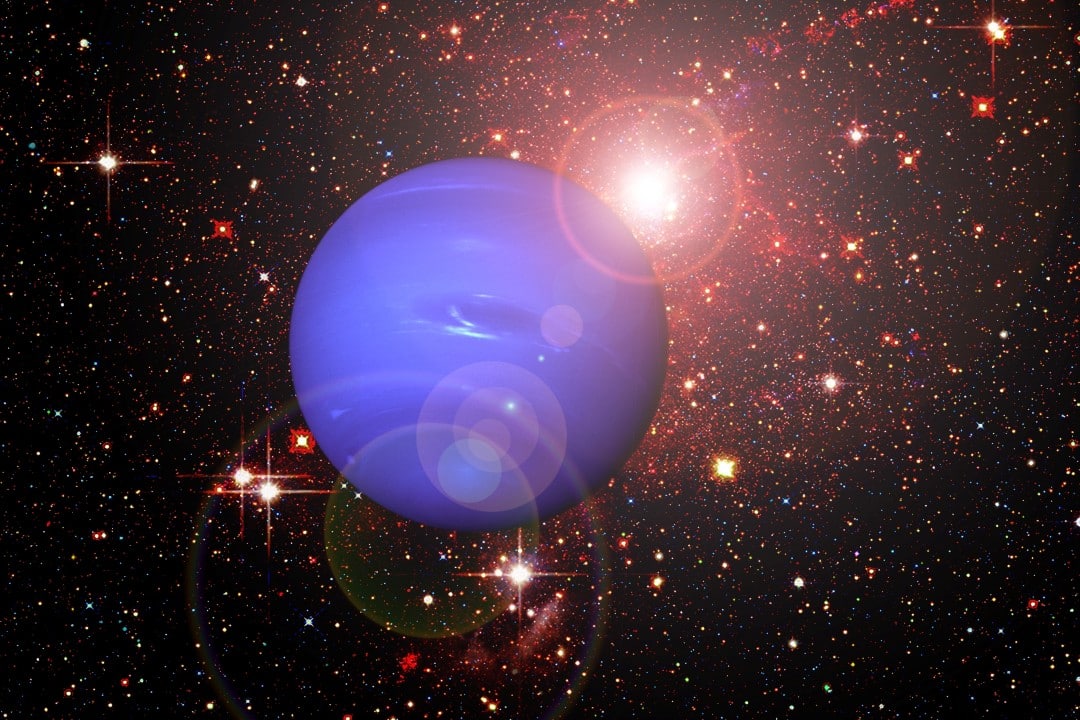
A new study suggests that Neptune’s moon system underwent a cataclysmic event in the past, involving the destruction of larger satellites and the formation of today’s smaller bodies from the debris. Researchers have investigated the planet’s rings and three of its inner moons, revealing minerals that point to a history of violent collisions. The research, published in the journal *Science Advances*, offers a new perspective on the dynamics of distant planetary systems.
Discovery of unexpected minerals on Neptune’s moons
The team of scientists used the spectroscopy technique to analyze the light waves reflected by Neptune’s rings and three of its inner moons, identifying the chemical composition of these bodies. Data from the James Webb Space Telescope revealed the presence of magnesium-rich phyllosilicates in the rings and on two of the moons examined, Larissa and Galatea. The discovery of these minerals generated great questions for researchers.
Phyllosilicates are a group of minerals that require prolonged contact between liquid water and rock to form. However, the study found no signs of water ice on the moons or rings, which makes the presence of the minerals even more enigmatic. The moons themselves are too small and cold for this chemistry to have occurred locally.
Ryleigh Davis, a planetary scientist at the University of California, San Diego, and lead author of the study, explained that the minerals had to come from somewhere else. According to her, the origin would be the deep interior of a significantly larger ancient world, which no longer exists in its original form.
Triton: the celestial body that may have caused the devastation
Scientists’ leading hypothesis points to Triton, Neptune’s largest moon, as the likely catalyst for this ancient destruction. Triton is a peculiar object in the planetary system, known for its retrograde orbit, that is, it revolves around Neptune in a direction opposite to the planet’s rotation. Triton is believed to have originated in the Kuiper Belt, a region beyond the orbit of Neptune.
The theory suggests that Neptune’s gravity captured Triton, which then invaded the existing system of moons, causing a series of destructive collisions. This event would have fragmented the original satellites and dispersed their materials. Some of this debris was later recycled, forming the smaller inner moons we observe today.
The process of capturing Triton would have been one of the most violent events in Neptune’s history. The interiors of large icy moons often remain inaccessible to scientists, hidden beneath dense layers of ice. However, Neptune’s inner moons may represent a rare opportunity to directly observe this material. Dr Davis said a catastrophic event “turned these ancient worlds inside out”, exposing internal components.
Research implications for understanding icy worlds
The absence of phyllosilicates on Proteus, the third and largest of the moons studied, indicates that its formation may have occurred from a different region of the debris disk compared to Larissa and Galatea. Another possibility is that the minerals in Proteus may have been later destroyed by heating. This variation suggests complexity in the material recycling process after the collision.
The current study aligns with previous research by some of the same authors, which already indicated a “lunar massacre” scenario. This previous research suggested that Triton’s capture propelled the moon Nereid, the only complete survivor of the chaos, into a wide and especially elliptical orbit. Despite the strength of the Triton hypothesis, the researchers admit the possibility of another, less likely scenario: the capture of a Kuiper Belt object similar in size to Pluto, which could also have been fragmented by Neptune’s gravity.
Regardless of the specific object that caused the devastation, Ryleigh Davis emphasized that the material found on the moons had to come from the deep interior of something much larger. Helen Maynard-Casely, a planetary scientist who was not involved in the study, commented that the discovery of these mysterious materials “just highlights, again, how much we still don’t know” about the universe.
Future challenges for Neptune exploration
The complexity of the Neptune system and the nature of the most recent discoveries reinforce the need for future space missions to deepen understanding of this gas giant and its moons. Currently, the Voyager 2 probe is the only spacecraft that has visited Neptune, the planet furthest from the Sun, in a passage that occurred in 1989. Since then, no other probe has been sent to investigate the planet.
The lack of current, detailed data about Neptune and its surroundings limits scientists’ ability to solve many mysteries. The scientific community longs for a new probe that can explore the planet and its moons with modern technology. Dr Maynard-Casely highlighted that a mission to Uranus and Neptune is highly desired by every planetary scientist. An initiative like this could unravel the origins and evolution of icy planetary systems, providing crucial information about the Solar System and beyond.