
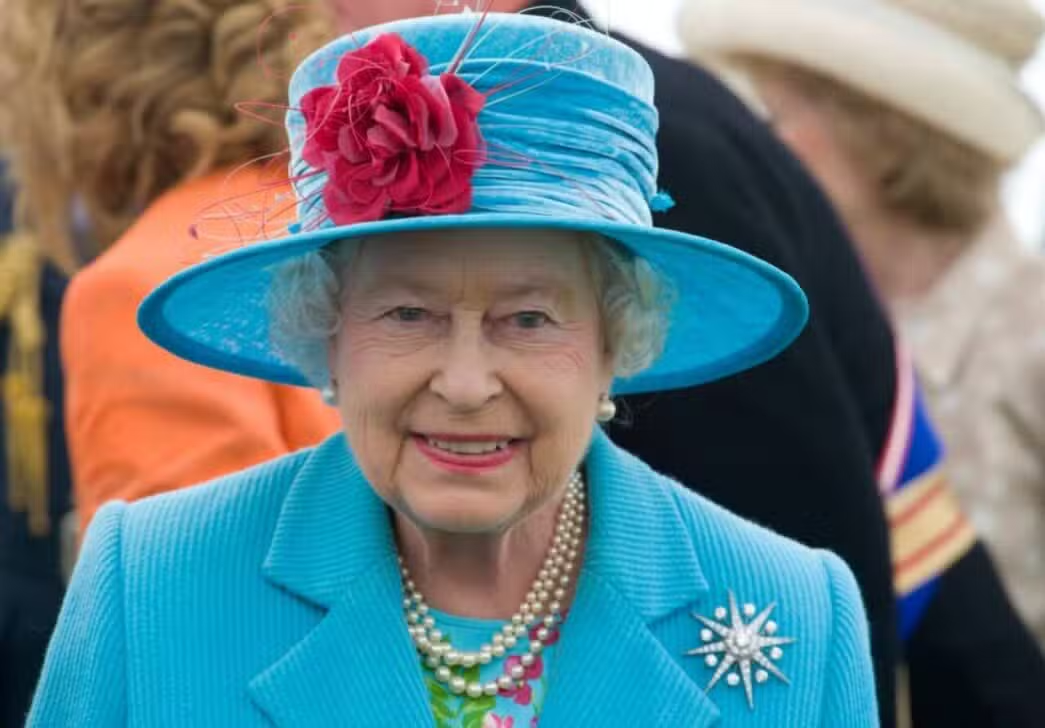
A notable episode from Queen Elizabeth II’s reign, which highlights her well-known dry humor, has come to light with revelations from biographer Robert Hardman. The British monarch reacted wittily to the refusal of a royal invitation, a fact that remains remarkable for understanding the sovereign’s personality. The details of this interaction were disclosed by Hardman in his book “Elizabeth II: In Private. In Public. Her Story”.
The anecdote, which transcends the queen’s formal image, offers a glimpse of how she dealt with unusual situations with a dose of irony. This characteristic contributed to humanizing the royal figure, showing a more relaxed side behind decades of official commitments and an impeccable posture.
Official refused royal invitation to Balmoral: the details of the decision
The episode narrated by biographer Robert Hardman describes an invitation made by Queen Elizabeth II to a senior court official to spend a weekend at Balmoral, one of the royal family’s favorite residences. To the surprise of the monarch herself, the invitation was refused.
The justification given by the employee was that he had already committed to receiving guests in his own home that same weekend. Although unusual for someone who declined an invitation from the sovereign, the explanation was given. Elizabeth II’s response, however, demonstrated that she would not miss the opportunity to use her humor.
Succinctly, the queen said, “Well, then, I won’t invite you again.” This phrase became a classic example of his ability to handle situations with subtle irony, maintaining his composure even when contradicted in an unexpected way.
Understand the origin of Queen Elizabeth II’s dry and regal humor
Queen Elizabeth II’s style of humor, often described as dry and sharp, was not an isolated trait. According to Robert Hardman, this particularity was inherited from his parents, who also had a similar sense of humor.
The biographer explains that this characteristic was an integral part of his personality, allowing him not to take himself as seriously as many might imagine, given the rigidity of his role. This lightness was manifested both in private moments and in more public situations, revealing a lesser-known facet of British royalty.
Unexpected interactions that revealed the queen’s humorous side
In addition to the anecdote with the employee, other moments illustrate the relaxed side of Queen Elizabeth II. Hardman recalls an occasion, in her later years, when the monarch burst into laughter while trying, unsuccessfully, to help a butterfly out of the window of her office in Balmoral, demonstrating her ability to laugh at everyday situations.
In public appearances, she also surprised by showing off her humor. Examples include:
- His appearance in a sketch with agent James Bond during the opening ceremony of the 2012 London Olympic Games.
- The fun performance opposite the character Paddington Bear in a video that marked the celebrations of its Platinum Jubilee in 2022.
These moments show that Elizabeth II did not hesitate to participate in comedy scenes, something unusual for world leaders, and did so with remarkable naturalness, expanding the perception of her personality.
The Lasting Impact of Royal Irony on the British Monarch’s Legacy
Queen Elizabeth II’s ironic response to the official has stood the test of time and continues to draw attention as it offers a more intimate perspective of the figure behind the crown. Far from the image of unshakable rigidity, the monarch demonstrated an intelligence and a sense of humor that could transform ordinary situations into remarkable memories.
These stories, compiled by Robert Hardman, reinforce a legacy that goes beyond protocol duties. They paint a portrait of a woman with wit and communication skills who, even in a context of extreme formality, managed to express her personality in a memorable and deeply human way.