

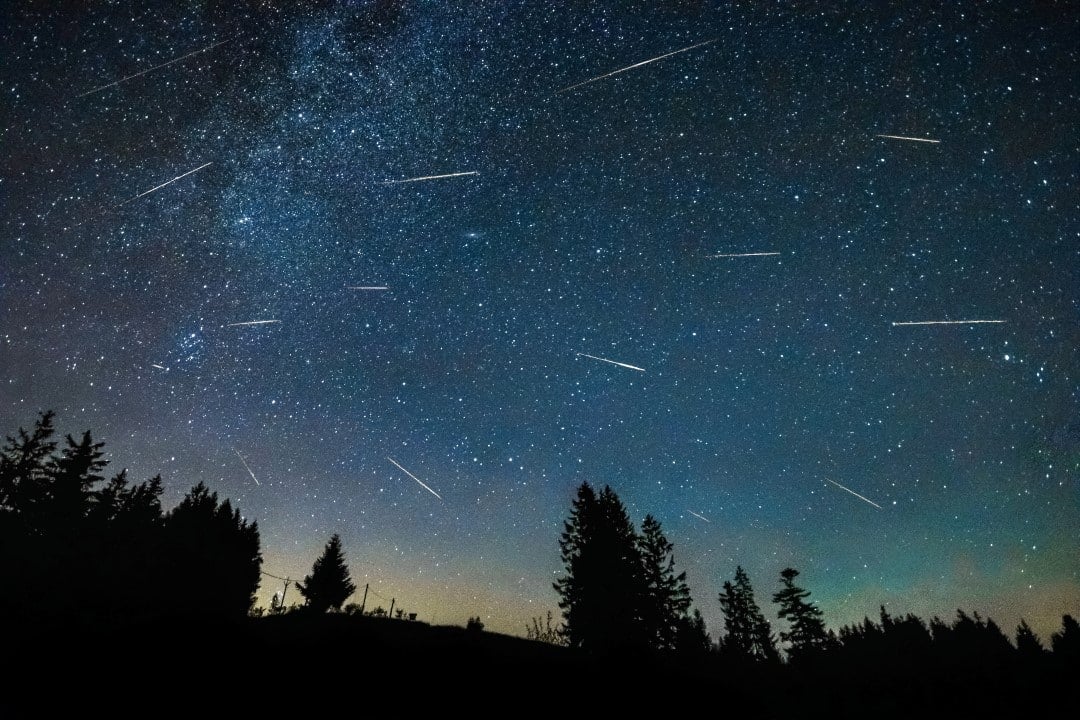
The Perseid meteor shower in 2026 is gearing up to deliver an unforgettable spectacle to skywatchers. Viewing conditions will be the most favorable in years, with the peak of the phenomenon coinciding with the new moon phase in mid-August 2026. This rare conjunction promises darker skies, ideal for capturing the beauty of meteors.
In addition to the intense activity of the Perseids, the period will be even more special with the occurrence of a solar eclipse. This overlapping of astronomical events provides a unique setting for enthusiasts and the curious. The phenomenon is one of the most anticipated annually, but the synchronization with the new moon raises expectations for 2026.
Why the 2026 Perseids will be so special to watch
The main reason for the high expectation in 2026 is the coincidence of the peak of the meteor shower with the new moon. The absence of lunar glare significantly reduces natural light pollution, allowing even the dimmer meteors to be visible. This creates an ideal dark “canvas” for the celestial spectacle.
Learn more: Perseid meteor shower of 2026: see how and when to observe the peak in August
The peak night, predicted for mid-August 2026, is the moment when Earth passes through the densest part of the debris trail left by comet Swift-Tuttle. With darker skies, the number of meteors per hour visible to the naked eye tends to be greater and clearer, providing an unparalleled visual experience.
Understand the true origin of the “shooting stars” of the Perseids
Although popularly known as “shooting stars”, the luminous points that cross the sky during a meteor shower are not stars. They are actually tiny particles of dust and rock, known as meteoroids, that break off from comets.
In the case of the Perseids, this debris originates from comet Swift-Tuttle. As Earth orbits the Sun, it periodically crosses the wake left by this comet. When these particles come into contact with the Earth’s atmosphere at high speeds, they burn up due to friction, creating the bright flashes of light we see. Comet Swift-Tuttle takes about 133 years to complete its orbit around the Sun, leaving a path of dust behind.
On the same topic: Perseid meteor shower arrives this month: find out how to observe
Best locations and tips for following the meteor shower
The visibility of the Perseid meteor shower is best for those located in the northern hemisphere. In these locations, the shower’s radiant – the point in the sky where the meteors appear to originate – is higher in the sky, increasing the chances of observation.
- Look for a dark sky, away from city lights.
- Lie down or sit in a reclining chair for a wide view of the sky.
- Let your eyes adapt to the darkness for at least 20 to 30 minutes.
- Observe with the naked eye, as binoculars or telescopes restrict the field of view.
- Be patient, as meteors can appear at irregular intervals.
The rare coincidence of a solar eclipse during the cosmic spectacle
In addition to the Perseid meteor shower with its optimized visibility, 2026 will hold another significant astronomical phenomenon: a solar eclipse. Although the specific details of its visibility and exact date are not the priority of the meteor shower, the occurrence of both events in the same period is a notable overlap.
This combination offers a fantastic opportunity for astronomy enthusiasts to witness multiple celestial phenomena in a short space of time. The solar eclipse alone is an event that attracts great attention, and its proximity to the new moon Perseids promises a memorable astronomical period.