
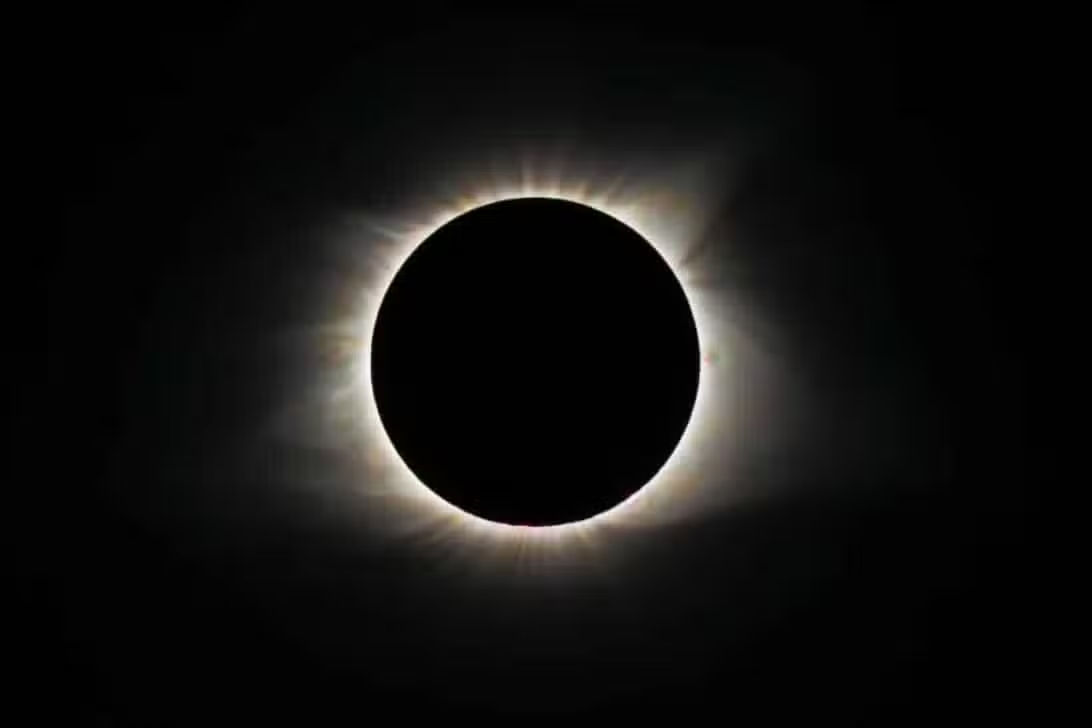
A rare astronomical occasion awaits the United Kingdom on the evening of August 12, when a partial solar eclipse, considered the most notable in almost thirty years, will be visible across the entire territory.
This same celestial event can be enjoyed across Europe, with the possibility of a total solar eclipse, the ultimate spectacle for some observers.
Millions of enthusiasts are preparing to travel to northern Spain and the west coast of Iceland, seeking favorable weather conditions to witness this awe-inspiring phenomenon, in which the Sun, Moon and Earth align perfectly.
During the height of the event, natural lighting will decrease drastically, immersing those present in an unusual twilight environment of profound silence.
As the Sun is covered by the Moon, a sudden drop in temperature and a decrease in wind intensity will be noticed, and there may even be a change in its direction.
In a fleeting moment, an intense solar rim glow, visible around the Moon, will create the illusion of a large diamond ring floating in the sky.
Then, this flash will dissipate, giving the impression that a huge dark opening has completely consumed the Sun.
During the period of darkness generated by the lunar shadow, nature adopts unusual behavior: birds tend to remain silent, as if it were night, while nocturnal insects can begin their characteristic song.
If sunset has not yet occurred, the daytime light reappears as quickly as it disappeared, and the environment returns to its usual routine.
This unique experience takes many people to travel to different parts of the world, looking for the chance to witness the phenomenon.
Eclipse visibility locations on August 12
In the band of totality, most observers will see the Sun be hidden for less than two minutes, a duration significantly shorter than the four minutes recorded in the United States in 2024.
The eclipse journey will begin in Siberia, Russia, and will continue through regions close to Iceland and Greenland, covering extensive uninhabited areas of the Arctic Circle and the North Atlantic Ocean.
The last points on land to observe the phenomenon will be the islands of Mallorca and Menorca, in Spain, before the shadow dissipates in the Mediterranean Sea, coinciding with sunset.
It is important to note that in vast areas of Europe, especially in the Central and Eastern portions, the Sun will still be partially eclipsed at the time of its setting.
Although the total eclipse range is limited, the partial phenomenon will have a wide scope, reaching practically the entire European continent.
Capitals like Dublin will have 94% of the sun covered, Paris 92%, London 90%, and Berlin 85%, in a highly visible partial spectacle.
Eclipse viewing details in the UK
For those in the United Kingdom, if the sky is clear, the best opportunities to observe this partial eclipse will be in the western regions of the country.
However, the total phenomenon cannot be seen in the United Kingdom, as the band of totality will only cross the maritime area, close to the southwest coast.
Despite this, the Moon’s partial shadow will cover the entire United Kingdom, with regions such as Cornwall and Pembrokeshire seeing up to 95% solar occultation, while the majority of the territory will have around 90% coverage.
An eclipse with 90% coverage will feature the Moon crossing the Sun at a low position in the sky, providing a distinctive view.
In the United Kingdom, the peak moment of the eclipse will vary depending on the location, happening between 7:02 pm and 7:16 pm, British Summer Time.
To make it easier to find the best viewing locations in the UK, several areas offer ideal conditions, including England, Scotland, Wales and Northern Ireland.
In Spain, observers will have the chance to witness the total eclipse in cities such as Bilbao, Valencia and Palma de Mallorca, while Barcelona and Madrid will experience occultation greater than 99%.
The peak of the total eclipse in these Spanish locations will occur between 8:26 pm and 8:33 pm local time, which corresponds to 7:26 pm and 7:33 pm British Summer Time (BST).
Essential precautions to observe the eclipse safely
Direct observation of the Sun, even during an eclipse, poses a serious risk of causing permanent damage to your vision.
It is essential to use glasses designed specifically for eclipses, and never resort to ordinary sunglasses, which do not offer sufficient protection and can result in irreversible visual damage.
The only exception to observing without protection is during the phase of totality, when the Sun is completely covered by the Moon; As this will not occur in the UK, eye protection must be maintained for the entire duration of the event.
Additionally, the use of binoculars, telescopes or camera viewfinders is prohibited, even with eclipse glasses, as magnification may compromise the effectiveness of protection and cause visual damage.
If you do not have specific glasses, an alternative is to observe the eclipse indirectly, by building an orifice projector.
A basic model can be made with a simple sheet of cardboard, or a more sophisticated one with a cardboard box; even a sieve can be used to create multiple simultaneous projections of the phenomenon.
Visual phenomena during a total eclipse
The moment the Sun is completely eclipsed, the Moon’s dark disk stands out, enveloped by delicate filaments of light that appear to ripple, as if caught in an imperceptible cosmic breeze.
A closer look at these filaments suggests that they are, in fact, bands of pulsating flames that encircle the lunar silhouette.
This intense luminosity, which radiates from the darkness, is known as the solar corona — made up of jets of superheated gas that extend thousands of kilometers into space.
It is a spectacle that only a total solar eclipse allows one to contemplate, as, under normal conditions, this structure is overshadowed by the intense light of the Sun.
Scientists will be monitoring with special attention to record luminous gas loops, in reddish or pinkish tones, called prominences, that move and curve from the solar surface.
These formations accompany the dynamic solar magnetic fields, and these gigantic plasma structures can occasionally be ejected into space, generating so-called coronal mass ejections.
The scientific explanation behind eclipses
An eclipse is the result of sunlight being blocked by the Moon, which is positioned between the Sun and Earth, preventing light from reaching our planet.
The shadow cast by the Moon generates a region of almost complete darkness on Earth, approximately 250 kilometers wide, called the umbra.
Around the umbra, the penumbra is formed, a zone of partial shadow of the eclipse, where the intensity of the phenomenon decreases as the observer moves away from the center.
If the lunar orbit coincided with the same orbital plane as the Earth in relation to the Sun, a monthly solar eclipse would occur.
However, the Moon has a slightly inclined orbit, which makes these alignments less frequent, resulting in a solar eclipse every eighteen months, on average.
Opportunely, the ability to observe a total eclipse is the result of an extraordinary cosmological coincidence.
The Sun is located at a distance of 150 million kilometers from Earth, which is 400 times further than the Moon.
However, the diameter of the Moon is 400 times smaller than that of the Sun, making both appear to be the exact same size when viewed from our planet.
If the Moon had a slightly smaller diameter or its orbit was slightly further from Earth, a total eclipse would be impossible.
In fact, this change of scenario will materialize in the future, as the Moon is gradually moving away from the Earth.
The good news is that this separation occurs at a rate of just a few centimeters annually, ensuring that total eclipses will continue to occur for another 600 million years or so.
This provides plenty of time for anyone who wants to witness one of these grand celestial spectacles.