Interstellar comet 3I/ATLAS travels at 58 km/s and will have its route altered by Jupiter

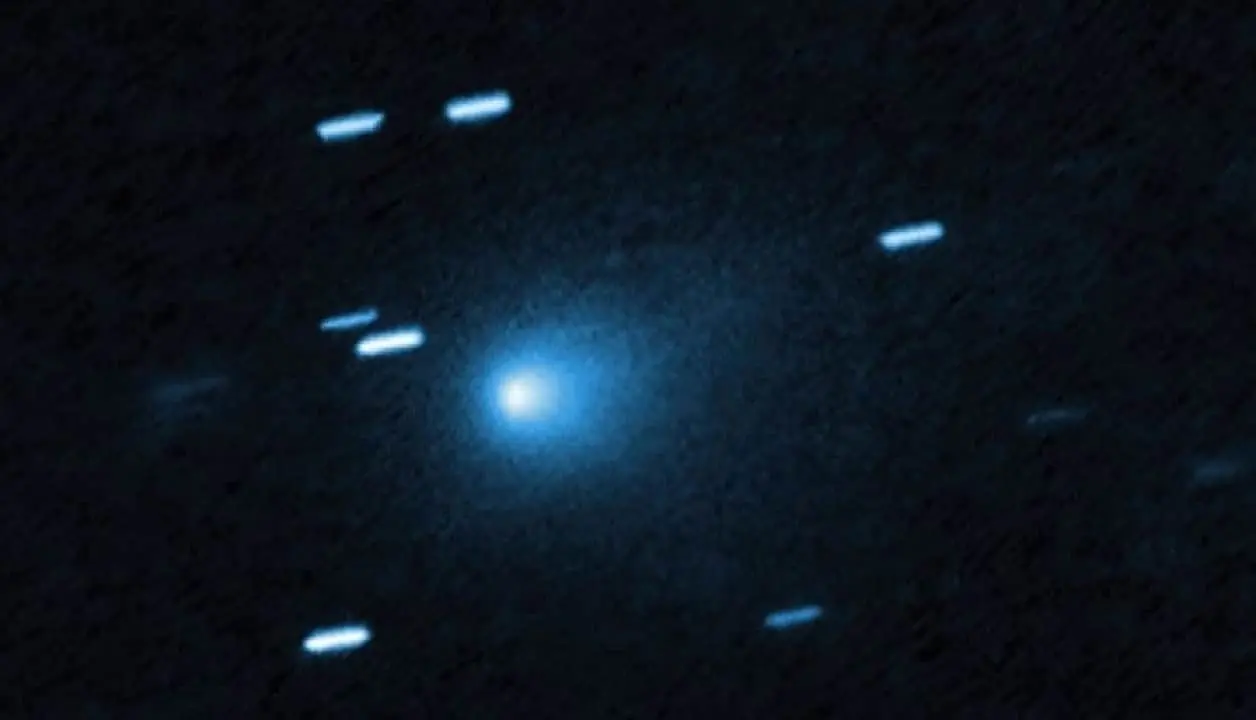
The astronomical community is closely following the trajectory of a rare visitor crossing our planetary system. Comet 3I/ATLAS, identified as an object of interstellar origin, is on an approach to the planet Jupiter, an event that promises to reconfigure its journey through space. Initially detected in July 2025 by the ATLAS tracking system, located in Chile, the celestial body travels at an impressive speed of 58 kilometers per second. This extreme speed is the main signature that it is not tied to our Sun’s gravity, confirming its alien nature. It consolidates itself as the third interstellar body confirmed by science, following in the footsteps of the famous 1I/’Oumuamua and 2I/Borisov, and offering a new window for studies on the formation of other stellar systems.
The culmination of this visit to our gaseous neighbor is scheduled to occur on March 16, 2026. During this moment of maximum approach, the comet will pass at a distance of 0.358 Astronomical Units from the center of Jupiter, which is equivalent to approximately 5.36 million kilometers. Although it seems a colossal distance by terrestrial standards, in astronomical terms, it is an extremely close encounter, capable of generating significant physical and orbital consequences for the traveler of ice and dust.
On the same topic: Extreme heat from the Sun threatens to destroy the third interstellar comet ever discovered
Jupiter’s gravitational pull and the Juno probe mission
As it is the most massive planet in our neighborhood, Jupiter acts as a true gravitational slingshot in space. The researchers point out that this close passage will inevitably modify the route of 3I/ATLAS. The gas giant’s immense gravitational field will cause a deviation in the comet’s trajectory, a phenomenon widely known in astrophysics but rarely witnessed in real time with an object coming from outside the Solar System. In addition to the change in route, the interaction can cause changes in the physical structure of the cometary nucleus, possibly intensifying the release of gases due to strong tidal forces.
To record every detail of this historic meeting, NASA mobilized the Juno probe, which is already in Jovian orbit. Between March 9 and 22, 2026, the spacecraft’s high-precision instruments will be aimed at the comet. The main objective is to collect unprecedented data on the composition of the material and the level of activity of the object as it traverses Jupiter’s complex magnetic environment. If a severe gravitational interaction occurs, Juno’s telemetry will be able to measure the most subtle orbital variations, allowing scientists to accurately trace the new path that the comet will follow towards deep space.
Ancient origins and the long journey through the Milky Way
The past of 3I/ATLAS is as intriguing as its future. Spectroscopic analyzes and reverse tracking of its orbit indicate that this celestial body probably formed in the thick disk of the Milky Way, a galactic region characterized by harboring generations of very old stars. This suggests that the comet itself is a primordial relic of our galaxy. Astronomical calculations estimate that it has been traveling through the interstellar void for at least 100,000 years. An even more surprising finding reveals that the object has not passed close to any other star in the last 10 million years, maintaining its original chemistry preserved in a deep freeze.
This pristine chemical composition began to be revealed as soon as the comet felt the heat of our Sun. Earth-based observatories were able to detect the emission of specific gases, including cyanogen and carbon radicals. The release of these volatile elements formed an asymmetric coma, which is the cloud of gas and dust that surrounds the comet’s nucleus. The peculiar shape and chemical signature of this coma provide crucial clues about the environmental conditions of the distant planetary system where 3I/ATLAS was born.
More on this story: Extreme heat from the Sun threatens to disintegrate rare interstellar comet 3I/ATLAS by 2026
See Also

Electrical discharge knocks man off roof in Jaguaruana after contact with power lines

Global auction raises US$11.9 million and Brazil’s historic currency reaches record value

Former fighter Prichard Colón dies at age 33 after decade in a vegetative state
The path through the Solar System and monitoring by space agencies
Long before meeting Jupiter, the comet was already the target of intense international monitoring. In November 2025, the JUICE probe, operated by the European Space Agency, managed to photograph the object against the starry background as it traveled towards the Jovian system. The complete package of scientific data captured by this mission is expected to arrive on Earth in February 2026. Scientists are awaiting this information to obtain detailed descriptions of the morphology of the gas cloud that accompanies the nucleus.
The interstellar traveler also made a notable appearance in the vicinity of Mars in October 2025. On that occasion, the Gemini North telescope, installed in Hawaii, was directed to record the event, capturing high-resolution images that highlighted changes in the coma’s activity. To understand the scale of 3I/ATLAS’ passage through our system, it is possible to observe the schedule of its most important approaches:
- October 29, 2025: The comet reached perihelion, its closest point to the Sun, at a distance of 1.36 Astronomical Units.
- October 3, 2025: Passage close to Mars, reaching 0.194 Astronomical Units from the red planet.
- November 3, 2025: Crossing the orbit of Venus, at a distance of 0.65 Astronomical Units.
- December 19, 2025: Point of closest approach to Earth, reaching a safe 1,798 Astronomical Units, without any risk of impact.
Atypical physical behavior and the final goodbye to our system
After reaching its hottest point close to the Sun, 3I/ATLAS demonstrated intense physical reactions. The comet experienced episodes of brightness explosions, a behavior expected when solar radiation abruptly sublimates the internal ice. This process resulted in the formation of distinct tails of dust and ions, creating a visual spectacle for telescopes. Furthermore, photometric observations revealed a cyclical variation in its luminosity, which allowed astronomers to determine that the comet’s nucleus completes a rotation around its own axis every four hours.
In January 2026, NASA’s TESS space telescope carried out an observation campaign dedicated to studying this rotation and the celestial body’s general activity level. One of the most striking discoveries of this analysis was the very high concentration of carbon dioxide. This abundance of CO2 drastically differentiates 3I/ATLAS from typical comets that form within our Solar System, reinforcing its alien identity and indicating that it was forged in a chemical environment substantially different from ours.
Learn more: Radio emissions from comet 3I/ATLAS make NASA activate planetary defense system
After completing its gravitational dance with Jupiter, the comet will continue its one-way journey out of the Solar System. Mathematical projections indicate that, around the year 2189, the object will reach the inner edge of the Oort Cloud, the vast bubble of frozen debris that surrounds our cosmic neighborhood. It will take another 8,000 years for it to cross the outer limit of this cloud, definitively disappearing into the interstellar medium. Until that happens, it remains one of the most valuable targets for contemporary planetary science.