
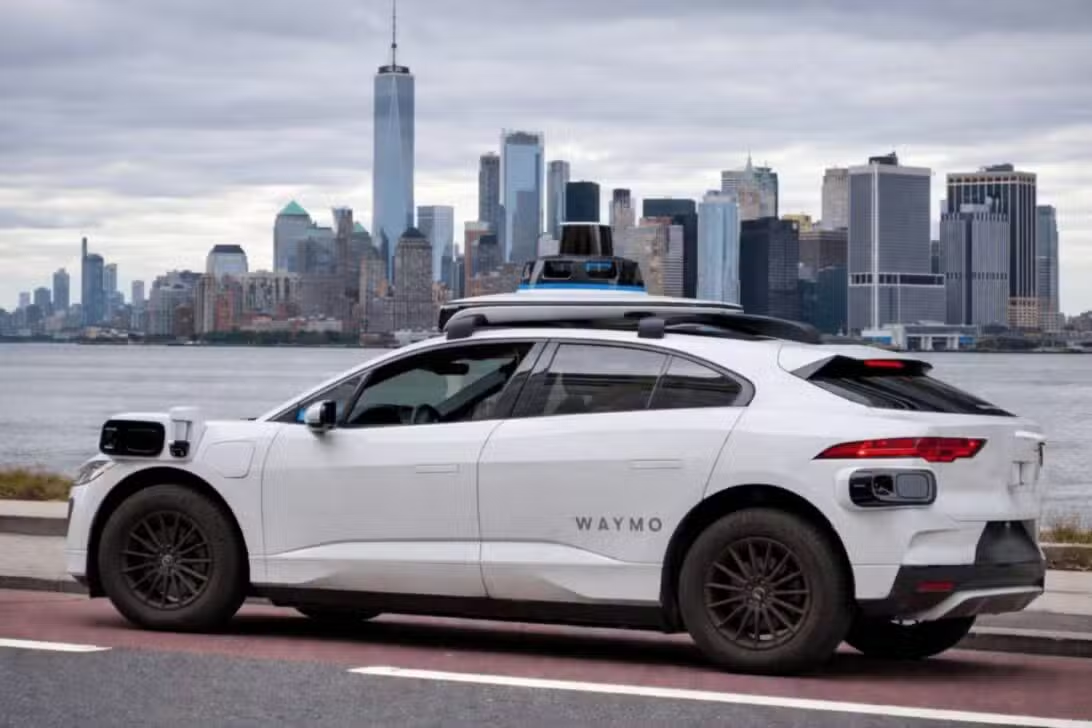
Waymo maintains a significant volume of almost a thousand robotaxis at its manufacturing facility in Arizona, ready to begin operations. The company continues to expand its autonomous fleet capacity.
According to the most recent aerial inspection of the site, Waymo has already completed the conversion of 684 of its new Ojai robotaxis at its factory located in Mesa, Arizona.
This number corresponds to 72% of the total 953 autonomous vehicles present in the Ojai parking lot, indicating that most are already equipped. This data highlights the robust production capacity of autonomous vehicles that Waymo has developed.
Monthly observation reveals fleet growth
Monthly aerial image analysis of the Waymo Magna factory in Mesa provides a consistent picture of progress. The update for August 2026 recorded 953 units of the Ojai model: 684 of them already complete, equipped with all sensors and ready for delivery, and another 269 still in the initial phase, awaiting conversion. This regular, although unofficial, monitoring offers a unique perspective on the pace of the company’s expansion.
A new element emerged this month: the identification of 12 completed Hyundai Ioniq 5 robotaxis in the yard. This is the first time that this second model, developed specifically for Waymo, has been seen ready at the factory.
Although they are not official information from Waymo, the monthly sequence of these observations has proven to be a reliable indicator of the growth of operations, with a marked upward trend. The same monitoring had recorded approximately 500 Ojai units in early June 2026.
Details about the Ojai model and partner Magna
The Ojai represents Waymo’s first purpose-built robotaxi. Its base platform is produced in China by Zeekr, and then sent to Mesa, where supplier Magna carries out the adaptation, integrating Waymo’s sixth generation Driver system.
The sixth generation hardware constitutes an important differentiator, as it includes 13 cameras and four lidars, with a 42% reduction in the number of sensors compared to the previous generation. Waymo claims the total cost of this suite is less than $20,000 per vehicle, which, combined with a more affordable base vehicle, allows the company to build a fleet with real expansion potential and more efficiency.
This expansion is crucial.
The Ojai model is replacing the old Jaguar I-Pace fleet, which was not designed for robotaxi purposes and has a higher operating cost. Waymo began operating paid rides with Ojai in San Francisco, Los Angeles and Phoenix earlier this year.
Seven hundred ready robotaxis represent a significant advance
Currently, Waymo completes around 500,000 paid trips per week in approximately twelve cities, with the goal of reaching one million weekly trips by the end of 2026. At the beginning of 2026, the company’s fleet operated with just a few thousand vehicles.
In this context, a reserve of 684 robotaxis ready for use is significant. If Waymo is able to deploy some of these vehicles on the streets quickly, it will be one of the largest expansions of its fleet to date.
These are not unfinished cars waiting. With 72% conversion already carried out, the adapted vehicle production line is in line with Zeekr’s deliveries. Neither production nor conversion are bottlenecks; the central question is how quickly Waymo will integrate this finished inventory into the paid travel service.
The 12 Ioniq 5s signal the future of Waymo, which is incorporating a second model into the same factory. This strategy allows us to diversify suppliers and strengthen the fleet’s expansion capacity.

Assessment of the autonomous vehicle scenario
Waymo’s current situation is encouraging, especially when compared to other initiatives in the sector. The reason is clear.
Waymo has already overcome the most complex phase, operating a fully autonomous service on a large scale, without the presence of human operators in the vehicles, with half a million paid trips per week and a projection of one million. The company demonstrated the solution to a Level 4 autonomy problem, and now focuses on scalability. Therefore, with almost 700 robotaxis ready at the factory, the direct path is expansion to more trips, more cities and greater revenue. The technology is proven; the focus is on adding more units.
Other companies are still seeking this level. An autonomous service still in development, for example, has a few dozen Model Y vehicles in Austin, after more than a year, and is still in the testing phase to operate without safety monitoring. A single factory yard with 684 ready-made Waymos already exceeds the number of autonomous vehicles that other companies have placed on public roads.
In this way, the main indicator is now the speed of implementation, and no longer the production capacity. Waymo demonstrates expertise in building and adapting its vehicles quickly. If the company manages to integrate finished cars into the service at the same pace, the goal of one million weekly trips may even prove to be conservative. With a second vehicle already in production in addition to the Ojai, the question is how quickly to transition to an even more diverse fleet.